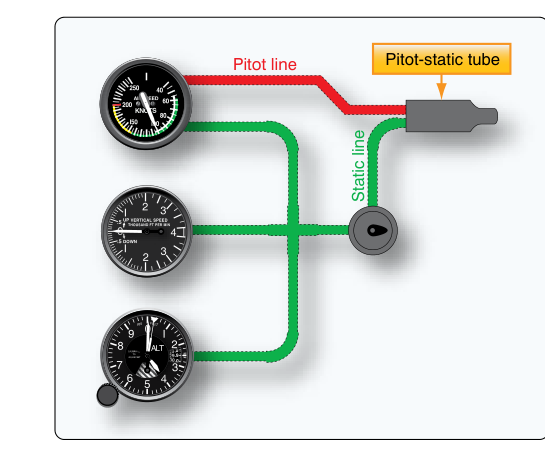
Flying in instrument meteorological conditions (IMC) places extraordinary trust in the cockpit instruments. Among the most fundamental of these is the pitot-static system, a network of ports, lines, and chambers that converts air pressure differences into the readings displayed on three critical flight instruments: the airspeed indicator (ASI), the altimeter, and the vertical speed indicator (VSI). Because these instruments share a common pressure source, a single blockage can cascade into multiple false readings — sometimes in ways that seem counterintuitive and almost always at the worst possible moment. Mastering how the system works, and precisely how it fails, is both a safety imperative and a heavily tested area on the FAA Instrument Rating knowledge exam.
This article covers the physics of the pitot-static system, the role of each port, how instrument readings change under each blockage scenario, and the practical steps a pilot must take in the cockpit when something goes wrong.
How the Pitot-Static System Works
The pitot-static system uses two types of air pressure: ram air pressure (also called pitot pressure or impact pressure) and static pressure (also called ambient or atmospheric pressure). Ram pressure is the dynamic pressure generated by the aircraft's forward motion through the air; static pressure is the surrounding atmospheric pressure independent of movement.
The pitot tube is mounted on the airframe — typically on the wing or nose — facing directly into the relative wind. Its open forward-facing port captures ram air pressure, which is routed exclusively to the airspeed indicator. Most pitot tubes also contain an electric heating element that the pilot can activate to prevent ice accumulation; pitot heat is typically installed per the aircraft's certification standards and equipment list, and 14 CFR 91.205(d) sets out the instruments required for IFR flight, including a sensitive altimeter and a slip-skid indicator, among others.
The static port (or ports — most aircraft have two, one on each side of the fuselage to average out pressure errors in slips or sideslips) is a small flush-mounted hole that senses only the ambient atmospheric pressure. Static pressure is supplied to all three instruments: the ASI, the altimeter, and the VSI.
An alternate static source is fitted in most IFR-certified aircraft. It draws static pressure from inside the cockpit cabin, bypassing the external static port if it becomes blocked. Because cabin pressure is typically slightly lower than outside ambient pressure (air accelerates as it flows around the fuselage), switching to the alternate static source generally causes a small but noticeable shift in instrument readings — the altimeter reads slightly higher, the airspeed indicator reads slightly higher, and the VSI briefly shows a climb before stabilizing. Pilots should be aware of these shifts and consult the Pilot's Operating Handbook (POH) for specific correction values.
How Each Instrument Uses the Pressures
Understanding which instruments use which pressures is the key to diagnosing blockage effects.
- Airspeed Indicator (ASI): Uses both pitot pressure and static pressure. A calibrated diaphragm inside the instrument expands or contracts based on the difference between pitot (ram) pressure applied inside the diaphragm and static pressure applied to the surrounding sealed case. If these pressures are equal — as they are when the aircraft is stationary on the ground — the difference is zero and the ASI reads zero.
- Altimeter: Uses static pressure only. An aneroid wafer stack inside the instrument expands as static pressure decreases (climb) and contracts as it increases (descent). The instrument is calibrated to translate these pressure changes into altitude readings based on the International Standard Atmosphere (ISA).
- Vertical Speed Indicator (VSI): Uses static pressure only. The VSI measures the rate of change of static pressure by comparing static pressure inside a diaphragm (which changes immediately) to pressure in the surrounding case, which bleeds in or out through a calibrated restrictor at a controlled rate. When static pressure is constant (level flight), the pressure equalizes and the VSI reads zero.
Blockage Scenarios and Their Effects
Pitot Tube Blockage — Forward Port Only (Static Drain Open)
If the forward-facing pitot port becomes blocked (commonly by ice, insects, or debris) but the pitot drain hole remains open, ram pressure trapped inside the pitot line slowly bleeds off to ambient. The ASI then effectively measures the difference between ambient static (in the case) and ambient static (now also in the diaphragm), and reads zero. This is the most recognizable failure — the ASI drops to zero or near-zero regardless of actual airspeed.
Pitot Tube Blockage — Both Ports Blocked (Pitot Ice with Drain Blocked)
This is the most dangerous and counterintuitive scenario. If both the ram air port and the drain hole are blocked by ice, the ram pressure is sealed inside the pitot line. The static port continues to function normally. As the aircraft climbs, ambient static pressure decreases, but the pressure inside the pitot diaphragm remains constant (it is sealed). The diaphragm therefore expands — because the outside case pressure is now lower — and the ASI reads an increasing airspeed even though actual airspeed may be constant or even decreasing. Conversely, during a descent, increasing static pressure compresses the diaphragm and the ASI reads a decreasing airspeed. The instrument behaves almost like a second (inverted) altimeter. This scenario has contributed to fatal accidents, including the loss of a large transport aircraft when pilots reacted to the false airspeed increase by reducing thrust and allowing the aircraft to slow to a stall.
Static Port Blockage
A blocked static port traps static pressure inside all three static-system instruments at the value that existed at the moment of blockage. The effects are distinct for each instrument:
- Altimeter: Freezes at the altitude where the blockage occurred and will not change regardless of actual altitude changes.
- VSI: Immediately reads zero and remains there because no pressure differential can develop across the restrictor.
- ASI: Continues to work, but inaccurately. Because static pressure is frozen, any increase in ram pressure (accelerating) shows as a higher-than-actual airspeed, and any decrease in ram pressure (decelerating) shows as lower-than-actual airspeed. Additionally, if the aircraft climbs above the blockage altitude, true ambient static falls below the trapped value — the ASI reads higher than actual. If the aircraft descends below blockage altitude, the ASI reads lower than actual.
The memory anchor here: with a blocked static port, the altimeter freezes, the VSI freezes at zero, and the ASI becomes unreliable in a specific, predictable pattern — high above blockage altitude, low below it.
Why It Matters in IFR Operations
In VMC, a pilot experiencing instrument anomalies can simply look outside and fly visually. In IMC, there is no such option. A false airspeed reading can lead to structural overspeed if the pilot trusts a high reading and dives to chase a stall warning, or to an actual stall if the pilot slows to what appears to be a safe approach speed but is actually dangerously fast. A frozen altimeter can cause controlled flight into terrain (CFIT) on an approach or departure. These are not theoretical risks — blocked pitot-static systems appear repeatedly in accident reports investigated by the NTSB.
Pitot heat is essential equipment for IFR flight in icing-prone conditions, but it must be used, not merely present. Many accidents have occurred when pitot heat was inoperative, forgotten, or not activated prior to entering icing conditions. The FAA recommends activating pitot heat before encountering visible moisture at temperatures near freezing.
Key Numbers and Rules
- IFR instrument requirements: 14 CFR 91.205(d) lists the instruments and equipment required for IFR flight, including a sensitive altimeter and a slip-skid indicator; pitot heat requirements typically stem from aircraft certification and equipment list requirements rather than this section.
- Two static ports: Most IFR aircraft have redundant static ports to minimize pressure errors in uncoordinated flight.
- Alternate static source effect: Generally increases altimeter and ASI readings slightly; consult the POH for exact corrections.
- VSI lag: Under normal operation, the VSI has a 6–9 second lag before stabilizing on a new rate of climb or descent — this is normal, not a blockage symptom.
- Blocked pitot + open drain = ASI reads zero.
- Blocked pitot + blocked drain = ASI acts like an altimeter (climbs = higher airspeed shown).
- Blocked static = altimeter and VSI freeze; ASI reads high above blockage altitude, low below.
Common Test Traps
- Pitot blockage vs. static blockage confusion: The FAA often presents a scenario where the altimeter and VSI both freeze — this is a static port blockage, not a pitot blockage. Remember: pitot pressure only feeds the ASI diaphragm; static pressure feeds all three instruments.
- The climbing ASI trap: Many students assume a blocked pitot always causes the ASI to drop. In fact, when both ports are blocked with ice, the ASI reads higher during a climb. The exam may describe an ASI that increases during a climb with no change in power — recognize this as the dual pitot blockage scenario.
- Alternate static source direction: Students often guess the altimeter reads lower on the alternate source. It actually reads slightly higher because cabin pressure is lower than external ambient at the static port location.
- VSI zero vs. VSI lag: A VSI that reads zero after a blockage stays at zero permanently. Normal VSI lag lasts only seconds before showing the correct trend. If the VSI refuses to budge from zero at all, suspect a blocked static port.
- Pitot heat timing: The test may imply that activating pitot heat after ice has already formed is as effective as preemptive use. In practice, ice already bridging the port may not immediately clear; the FAA recommends proactive use before encountering icing conditions.