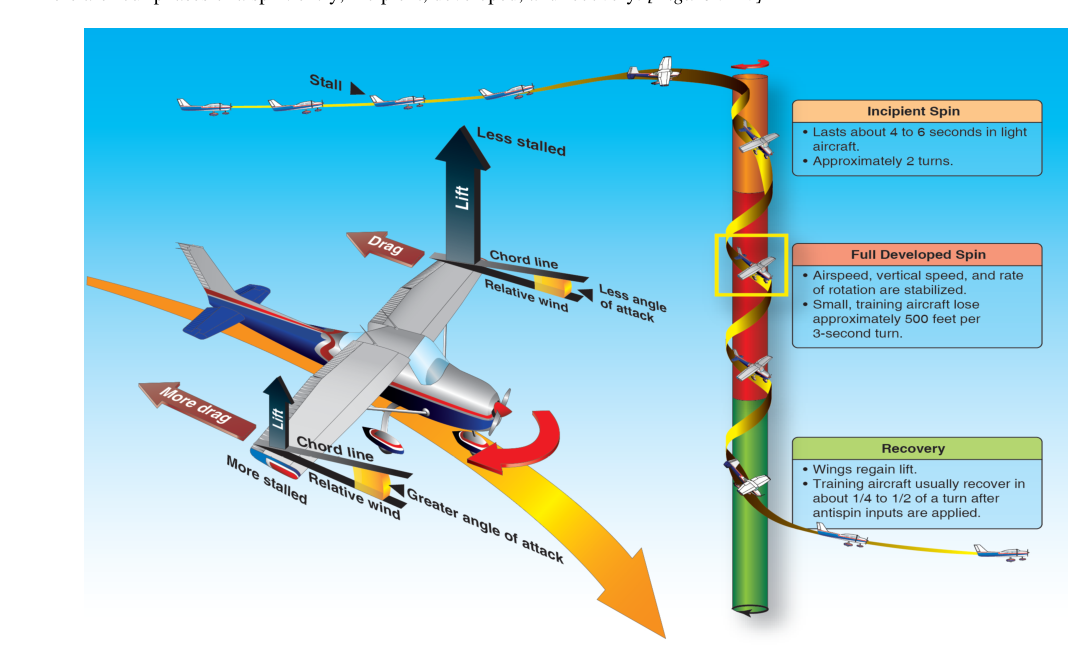
A spin is one of the most dramatic and dangerous situations a pilot can encounter, yet it is also one of the most misunderstood. Unlike a simple stall, a spin involves simultaneous stalling and autorotation — the aircraft descends in a corkscrew path, losing altitude rapidly while rotating around a vertical axis. What makes spins particularly lethal in general aviation is that they frequently occur close to the ground during takeoff and landing phases, leaving little altitude for recovery. The FAA requires that private pilot applicants demonstrate an understanding of spin awareness and, in most cases, receive at least a logbook endorsement confirming spin awareness training before a practical test. Understanding the mechanics of how spins develop, how to recover promptly, and how to prevent them from happening in the first place is not just a test requirement — it is a core survival skill.
The goal of this article is to give you a thorough, FAA-grounded understanding of spin aerodynamics, the correct recovery technique, the common scenarios where spins ambush unsuspecting pilots, and the habit patterns that make spin entry an extremely rare event in a well-trained pilot's flying career.
How a Spin Develops
Before you can recover from a spin, you must understand how one starts. A spin requires two things happening simultaneously: a stall and a yaw. If the aircraft is stalled and one wing drops while yaw is present — from uncoordinated rudder input, for instance — the dropping wing moves rearward relative to the flight path, increasing its angle of attack further above the critical angle. The rising wing, traveling faster and at a slightly lower angle of attack, continues to generate more lift. This asymmetric lift difference causes the aircraft to roll and yaw in the direction of the more-deeply-stalled wing. That self-reinforcing rotation is called autorotation, and once it is established, it sustains itself even without pilot input. The aircraft is now in a spin.
Aeronautical texts and the FAA's Airplane Flying Handbook (FAA-H-8083-3) describe three phases of a spin: the incipient phase, the developed phase, and the recovery phase. During the incipient phase — typically the first one to two turns — the rotation rate and descent rate are still building. This is the easiest phase from which to recover. In the developed phase, the spin has stabilized into a steady, repeatable rotation with a high descent rate (often 5,000 to 6,000 feet per minute or more) and a relatively slow airspeed. Recovery from a developed spin takes more deliberate action. The recovery phase begins the moment the pilot applies the correct recovery technique and ends when the aircraft returns to normal flight.
The Standard Spin Recovery Procedure
The FAA recognizes a standard recovery technique known by the mnemonic PARE, which stands for Power, Ailerons, Rudder, Elevator. This sequence, described in the Airplane Flying Handbook, gives pilots a reliable cognitive checklist under high stress.
Memory Aid: PARE
- P — Power to idle. Reducing throttle to idle decreases the spiraling slipstream effect and reduces the tendency to tighten the spin on some aircraft types. It also reduces torque.
- A — Ailerons neutral. Aileron inputs during a spin can worsen autorotation or complicate recovery depending on the aircraft's design. The safe default is to center the ailerons and leave them there throughout recovery.
- R — Rudder opposite to rotation, full deflection. This is the most critical step. Apply full rudder pedal opposite to the direction of rotation. This counteracts the yaw that is sustaining autorotation. Hold the opposite rudder until rotation stops.
- E — Elevator forward (stick/yoke forward of neutral). Once opposite rudder is applied, briskly move the elevator control forward to reduce the wing's angle of attack below the critical angle, breaking the stall on the inside wing. Do not pull back — pulling back keeps the wing stalled and will sustain or worsen the spin.
After rotation stops, neutralize the rudder and smoothly apply back pressure to recover from the resulting dive. Avoid an abrupt pull-out, which could lead to a secondary stall or excessive g-loading. Throughout recovery, keep your eyes on the horizon or the heading indicator to confirm rotation has stopped.
One critically important caveat: while PARE is the FAA's standard teaching reference, always follow the specific recovery procedure in the Pilot's Operating Handbook (POH) for your aircraft. Some aircraft have certified spin recovery procedures that differ from the generic technique — for example, some require a specific number of turns before applying the rudder step. The generic method is a solid default, but the POH is the final authority.
Why Spins Matter: The Real-World Picture
The FAA's accident data consistently shows that loss-of-control accidents — many of which involve unintentional stalls and spins — are the leading cause of fatal general aviation accidents. The most common scenario is the so-called base-to-final turn spin trap. A pilot overshoots the final approach course, instinctively adds inside rudder (skidding the turn) while pulling back on the yoke to tighten the turn, and finds the aircraft already slow in the landing configuration. The result is a crossed-control stall that transitions instantly into an incipient spin. At traffic pattern altitude — typically 800 to 1,000 feet above the ground — there is almost no room for recovery.
A similar hazard exists just after takeoff. A pilot who cuts the throttle due to an engine issue and then pulls back aggressively to stretch the glide is simultaneously slowing the aircraft and raising the nose — a recipe for a stall. If any yaw is present from asymmetric thrust or crossed controls, a spin can begin at the worst possible altitude. Altitude is always the spin pilot's most precious commodity; a spin entered below 1,500 feet AGL in most trainer aircraft leaves very little margin for successful recovery.
Spin Avoidance: The Better Strategy
The most important spin skill is never needing to use your recovery technique in unplanned flight. Spin avoidance is a habit-based discipline centered on maintaining coordinated flight and respecting stall margins at all times, especially at low airspeeds near the ground.
- Keep the ball centered. The slip/skid indicator (ball) in the turn coordinator tells you whether the aircraft is in coordinated flight. An uncoordinated slip or skid at low airspeed is the primary setup for a spin. Make it a habit to check coordination during every turn, and especially during base-to-final.
- Use coordinated aileron and rudder. In training aircraft, aileron and rudder inputs should generally be applied together in the same direction. Crossing the controls — applying right aileron and left rudder, for instance — creates exactly the uncoordinated condition that permits autorotation to begin at the stall.
- Know your aircraft's stall speed in every configuration. Stall speed increases with bank angle and load factor. At a 60-degree bank, the stall speed increases by approximately 41 percent over wings-level. A pilot who routinely flies base-to-final at 20 knots above stall on final may actually be much closer to stall than they realize if they enter a steeper-than-expected bank.
- Maintain adequate airspeed in the pattern. Follow the manufacturer's recommended pattern speeds. Rushing or distraction can cause pilots to let airspeed bleed away unconsciously. Regular GUMPS (Gas, Undercarriage, Mixture, Propeller, Switches/Seatbelts) checks and speed cross-checks keep you anchored to the aircraft state.
- Never fixate on a runway correction at the expense of aircraft control. If you are high, wide, or otherwise poorly set up for a landing, go around. A botched go-around is rarely fatal. A spin at 500 feet AGL almost always is.
Key Numbers and Regulatory Facts
- 14 CFR Part 61 requires that a student pilot receive spin awareness training and a logbook endorsement from an authorized instructor before the private pilot practical test (61.87(d)(1) for solo, and Part 61 Appendix requirements for the PPL checkride).
- For the Flight Instructor certificate, actual spin training (not merely awareness) is required per 14 CFR 61.183(i).
- Spins are approved only in aircraft that are either certificated in the Normal category for spins or the Utility or Acrobatic categories. Most Normal-category aircraft are only tested for spin recovery from an incipient (one-turn) spin — meaning extended developed spins are outside the tested envelope.
- A developed spin commonly involves a descent rate of 5,000 feet per minute or more, making altitude loss extremely rapid.
- Spin recovery from the incipient phase typically requires at least 500 feet of altitude loss in most two-seat trainers; developed spin recovery requires significantly more.
Common Test Traps
- Assuming ailerons cure a spin. Many students instinctively apply aileron toward the high wing to stop the roll. During a spin, this can worsen autorotation. The correct answer is ailerons neutral, not aileron input.
- Confusing spin direction with bank direction. In the base-to-final overshoot scenario, the aircraft spins toward the inside of the skidding turn — which is toward the runway. Students sometimes assume the aircraft would spin outward. Remember: the inside (more-stalled) wing drops.
- Forgetting that power goes to idle first. Under stress, pilots instinctively want to add power. In a spin, adding power before stopping rotation can worsen the spin on many propeller-driven aircraft.
- Thinking that pulling back stops the spin. Back pressure keeps both wings at or above the critical angle of attack and sustains the stall — exactly the opposite of what recovery requires. The elevator must go forward to break the stall.
- Believing all Normal-category aircraft are spin-approved. Most Normal-category aircraft have only been shown to recover from a one-turn incipient spin. Intentional spins in a Normal-category-only aircraft are outside the approved envelope and potentially catastrophic.
Spin recovery and avoidance represent one of the most important skill sets a private pilot develops, not because you will use spin recovery often, but because the discipline of staying coordinated and stall-aware at low altitude is what keeps you alive across a lifetime of flying. Train seriously, respect the physics, and use PARE if you ever need it — but build the habits that mean you never will.