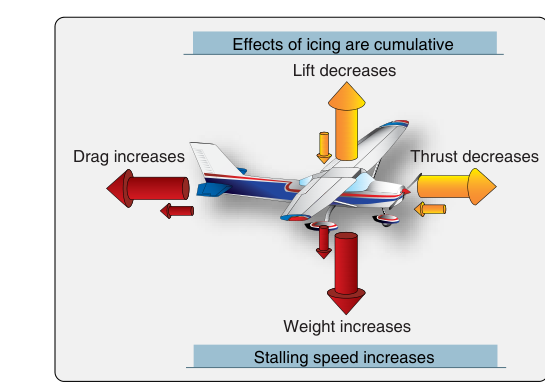
Of all the hazards that instrument-rated pilots face, structural icing ranks among the most deceptive. Unlike turbulence or thunderstorms, ice can begin accumulating silently, invisibly altering the wing's shape and the aircraft's performance before the pilot notices anything unusual. A coating of ice as thin and rough as sandpaper can reduce lift by as much as 30 percent and increase drag by 40 percent or more — numbers that can push a lightly loaded aircraft past the edge of controllability. For IFR pilots, understanding exactly how ice forms, which types are most dangerous, and what your aircraft is — and is not — certified to handle is both an exam requirement and a survival skill.
Structural icing refers to any accumulation of ice on the airframe itself: wings, tail surfaces, propeller, windshield, antennas, and pitot-static probes. Each location affects safety differently, but all share the same root cause — supercooled liquid water droplets (SLDs) or other precipitation that freezes on contact with the aircraft surface.
How Structural Ice Forms
Water normally freezes at 0°C (32°F), but in the atmosphere, cloud droplets can remain liquid well below that temperature — down to approximately −40°C — in a state called supercooling. These supercooled liquid water droplets are in an unstable equilibrium. The moment they strike an aircraft surface, the disturbance causes them to freeze on contact. The rate and character of that freezing determines which type of ice forms.
The Aviation Weather Handbook (FAA-H-8083-28) identifies three primary types of structural ice: clear ice, rime ice, and mixed ice. Each has distinct physical properties, formation conditions, and levels of danger to the airframe.
Clear Ice (Glaze Ice)
Clear ice — sometimes called glaze ice — is the most hazardous type. It forms when large supercooled water droplets strike the leading edge and flow back across the surface before freezing. Because the water spreads out before solidifying, clear ice is dense, heavy, and adheres tightly to the airframe. It tends to be transparent or translucent, which makes it difficult to see, especially at night.
Clear ice forms most readily at temperatures between 0°C and −10°C, where droplets are large and liquid water content (LWC) in the cloud is high. Conditions associated with freezing rain or drizzle — particularly supercooled large droplets (SLDs) — are especially prone to producing clear ice that extends far aft of the leading edge, beyond the protected area of most de-icing boots. This characteristic makes clear ice uniquely threatening even to aircraft equipped with standard anti-icing or de-icing systems.
Rime Ice
Rime ice forms when small supercooled droplets freeze almost instantly on contact with the leading edge. Because the droplets freeze before they can flow, rime ice builds up as a rough, opaque, milky-white deposit directly on the stagnation point of the leading edge. It is less dense than clear ice and somewhat more brittle, so pneumatic de-icing boots tend to be more effective against it.
Rime ice typically forms at colder temperatures — generally colder than about −15°C — where droplets tend to be smaller and liquid water content is lower, conditions often associated with stratiform clouds. These boundary temperatures are approximate rather than fixed cutoffs, and clear ice remains most associated with the warmer 0°C to −10°C range. Although rime ice is generally less severe per unit of time than clear ice, its rough texture disrupts airflow effectively. Even a small deposit of rime ice on the leading edge significantly disturbs the boundary layer and can cause early flow separation.
Mixed Ice
Mixed ice — a combination of clear and rime ice — forms when flight conditions alternate between or simultaneously present both large and small droplet environments. It is irregular, rough, and difficult to remove because the clear ice component bonds tenaciously to the airframe while rime fills the gaps. Mixed ice is particularly common when flying through layers of varying cloud types or precipitation. Its irregular shape is highly effective at disrupting airflow and increasing drag.
Other Forms of Structural Icing
Frost is not the same as in-flight structural icing, but it presents a critical pre-takeoff hazard. Frost forms when the aircraft surface temperature is at or below the dew point and below freezing. Unlike in-flight ice, frost does not add significant weight, but its rough crystalline texture disrupts boundary layer airflow enough to significantly degrade lift — sometimes preventing liftoff or causing loss of control immediately after rotation. FAA regulations and operating handbooks are clear: frost must be removed from lifting surfaces before flight.
Freezing rain and freezing drizzle involve precipitation that has already formed as liquid rain above (in a warm layer aloft) and then falls through a shallow freezing layer near the surface. This scenario produces some of the most rapid and dangerous ice accumulations. Freezing rain droplets are very large, creating clear ice that can overwhelm even certificated anti-icing systems quickly.
Aircraft Certification: Known Ice vs. Flight Into Icing
One of the most important and frequently misunderstood concepts for IFR pilots concerns what an aircraft is actually certified to do in icing conditions. The FAA distinguishes between several certification categories, and understanding them is critical for both legal compliance and personal safety.
An aircraft certificated for flight into known icing (FIKI) has been shown, through formal FAA certification testing, to operate safely in icing conditions meeting the Appendix C icing envelope, as defined in 14 CFR Part 25 Appendix C for transport category aircraft and in 14 CFR Part 23 Appendix C (pre-Amendment 23-64) for normal, utility, acrobatic, and commuter category aircraft. FIKI certification requires the aircraft to be equipped with approved anti-icing or de-icing equipment — such as heated leading edges, pneumatic boots, or a TKS weeping wing system — that has been demonstrated to be effective within defined icing envelopes. These aircraft may legally enter known icing conditions as defined in the certification basis.
An aircraft that is not FIKI certificated — the vast majority of general aviation training aircraft and light singles — may not be flown into known icing conditions. Known icing is generally interpreted as conditions where a pilot knows or reasonably should know that ice will accumulate on the airframe. This includes PIREPs reporting ice, visible moisture below 0°C, and forecasts of icing along the route. Simply having a pitot heat switch does not make an aircraft approved for flight into icing; pitot heat addresses the pitot probe only and is not structural ice protection.
It is critical to note that even FIKI-certificated aircraft have certification limits. Certification to Appendix C does not cover SLD conditions (freezing rain, freezing drizzle), which can cause ice accretion beyond the protected leading-edge areas. The FAA addressed this with updated SLD rules, and newer aircraft may have Appendix O certification for SLD environments. Pilots must know their specific aircraft's limitations — spelled out in the Pilot's Operating Handbook (POH) Limitations section — not just a general FIKI label.
Why Structural Icing Matters: Performance and Control
The aerodynamic penalties of structural ice are severe and cumulative. Ice on the wing's leading edge disrupts the smooth airflow the wing was designed for, reducing the camber and altering the pressure distribution that generates lift. The stall angle of attack is reduced, meaning the aircraft can stall at a lower nose-high attitude than normal — sometimes catching pilots completely off guard. Stall speed increases significantly with ice contamination. Ice accumulation on the horizontal stabilizer is especially insidious: a tail stall caused by ice on the elevator or stabilizer can produce an uncommanded, often abrupt pitch-down tendency, which is worsened by flap extension (a maneuver commonly performed on approach) and requires specific recovery procedures. This is why some procedures specify keeping flaps retracted or limiting flap deployment when icing is suspected.
Ice also adds weight, which further degrades climb performance and increases stall speed. Propeller ice reduces thrust and can cause dangerous vibration if it sheds asymmetrically. Antenna ice can affect communications and navigation. And iced-over static ports produce erroneous altimeter, airspeed, and vertical speed readings.
Key Numbers and Rules
- 0°C to −10°C: Prime temperature range for clear ice formation; large SLDs, high LWC.
- Colder than about −15°C: More common for rime ice; smaller droplets, stratiform cloud environments.
- Below −40°C: Supercooled water droplets become rare, as an approximation; ice crystals dominate, and structural icing risk greatly diminishes.
- Lift loss: Even a thin layer of rough ice can reduce lift by up to 30% and increase drag by 40% or more.
- Known icing prohibition: Non-FIKI aircraft may not be operated in known icing conditions per the aircraft's POH limitations and applicable FARs.
- Frost: Must be removed from all lifting surfaces before flight — even a thin coating is dangerous at liftoff.
- Appendix C vs. Appendix O: Standard FIKI certification covers Appendix C icing envelopes (Part 25 Appendix C for transport category, Part 23 Appendix C for smaller categories); Appendix O covers SLD (freezing rain/drizzle) conditions, which are more severe.
Common Test Traps
- Confusing anti-icing with de-icing: Anti-icing prevents ice formation (e.g., heated leading edges, TKS fluid applied before ice forms); de-icing removes ice after it has accumulated (e.g., pneumatic boots that inflate to crack and shed ice). The FAA exam tests both terms and their correct application.
- Assuming pitot heat equals icing approval: Pitot heat is required equipment for IFR flight but does not constitute structural ice protection; it only keeps the pitot probe clear. A non-FIKI aircraft with pitot heat is still prohibited from known icing.
- Thinking colder means more ice: The most dangerous icing typically occurs between 0°C and −10°C, not at the coldest temperatures. Very cold air (below −40°C) rarely produces structural icing because supercooled droplets become rare at those temperatures.
- Underestimating tail plane icing: Candidates often focus on wing ice alone. Tail plane icing causes an uncommanded pitch-down tendency and is worsened by flap extension on approach — a scenario the FAA specifically tests.
- Misidentifying frost as a minor issue: Frost does not add weight like in-flight ice, so students sometimes dismiss it. The FAA emphasizes that frost's rough texture alone is sufficient to degrade lift enough to prevent safe flight, and it must be removed before takeoff.