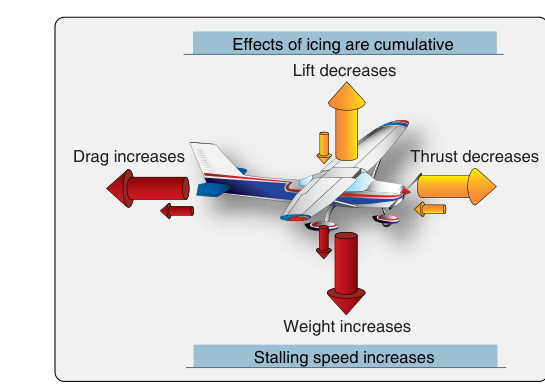
Structural icing is one of aviation's most insidious hazards. Unlike turbulence, which announces itself immediately, ice can accumulate quietly on your wings, tail, and control surfaces while you focus on other tasks — and by the time you notice a problem, performance may already be seriously degraded. Every year, icing-related accidents claim aircraft and lives, making this one of the most heavily tested weather topics on the FAA Private Pilot Knowledge Test and one of the most important concepts to carry into your flying career.
At its core, structural icing occurs when an aircraft flies through visible moisture — clouds, rain, drizzle, or freezing precipitation — and the airframe temperature is at or below freezing. The result is ice that accumulates on leading edges, propellers, antennas, pitot tubes, and other exposed surfaces. Understanding the types of ice, the atmospheric conditions that produce them, and the correct pilot responses will help you both pass your knowledge exam and make smart go/no-go decisions in the real world.
How Structural Icing Forms
The critical ingredient in structural icing is supercooled water. Supercooled water droplets are liquid water that exists at temperatures below 0°C (32°F). This happens because water droplets in clouds can remain liquid at temperatures as low as approximately -40°C if they lack solid particles called ice nuclei to trigger freezing. When a supercooled droplet strikes an aircraft surface, the impact provides the energy needed to initiate freezing, and the droplet instantly or progressively turns to ice.
The rate and type of ice formation depend on three primary factors: temperature, liquid water content (how many droplets per unit volume of air), and droplet size. Warm icing temperatures — just below freezing — tend to produce one type of ice, while colder temperatures produce another. Large droplets spread across a surface before freezing; small droplets freeze almost immediately on contact. These differences give us the three distinct types of structural ice.
The Three Types of Structural Ice
Clear Ice (Glaze Ice)
Clear ice is the most dangerous type. It forms when temperatures are between approximately 0°C and -10°C and when large water droplets — typical of freezing rain or large cloud droplets — strike the airframe. The droplets do not freeze instantly; instead, they flow back over the surface before solidifying into a smooth, dense, transparent layer that can be nearly invisible in low light. Clear ice is heavy, adheres strongly to the aircraft, and is very difficult to remove by deice systems. Because it flows before freezing, it conforms to the shape of the wing only on the very leading edge — it extends back along the chord and can radically change the wing's airfoil profile. Of all ice types, clear ice has the greatest impact on aircraft performance.
Rime Ice
Rime ice forms in colder temperatures, roughly -10°C to -20°C (though rime can occur in a wider range), and in air with small, low-liquid-water-content droplets typical of stratiform clouds. When these tiny droplets hit the leading edge, they freeze almost instantly, trapping air bubbles and producing a rough, opaque, milky-white deposit. Rime tends to build up in a pointed or jagged shape right at the leading edge. Because it freezes so quickly, it does not spread rearward as dramatically as clear ice, but its rough texture significantly disrupts airflow over the wing. Rime ice is easier to remove than clear ice because it is more brittle, but it should still be treated with urgency.
Mixed Ice
Mixed ice is a combination of clear and rime ice and occurs when the aircraft passes through air containing a mixture of droplet sizes and temperatures near the transition zone between rime and clear ice conditions. Mixed ice combines the worst characteristics of both types: it can be rough in texture like rime and dense and hard to remove like clear ice. It often forms an irregular, jagged shape that is especially effective at disrupting the smooth airflow over the wing.
Conditions That Favor Icing
Structural icing is most likely when all three factors align: visible moisture, temperatures at or below 0°C at the flight altitude, and an airframe that is at or below 0°C. Pilots should be alert to icing potential in the following situations:
- Stratiform clouds: Layered clouds (stratus, altostratus, nimbostratus) often contain large areas of supercooled water, particularly between 0°C and -20°C. While the icing rate may be moderate, the prolonged exposure across a wide layer can lead to significant accumulation.
- Cumuliform clouds: Cumulus and cumulonimbus clouds have high liquid water content and can produce rapid icing, including clear ice, at temperatures just below freezing. Flying into convective clouds should be avoided entirely.
- Freezing rain: Freezing rain is especially dangerous because the large droplets have already fallen through warm air aloft and are supercooled when they reach your altitude. They freeze on contact and produce heavy clear ice accumulation extremely rapidly.
- The freezing level: Icing is possible anywhere from just above the freezing level (where temperatures first dip below 0°C) to approximately -40°C. The most intense icing is typically found between 0°C and -20°C.
- Visible moisture is required: Structural icing does not occur in clear air, even if temperatures are well below freezing. Ice crystals alone (cirrus clouds) generally do not cause significant structural icing because they do not adhere to surfaces in the same way liquid water does.
Effects on Aircraft Performance
Ice accumulation destroys performance in multiple ways. Even a thin layer of ice — sometimes described in FAA publications as rough as sandpaper — can significantly reduce lift and increase drag, with FAA materials citing that even small amounts of ice roughness can reduce lift and increase drag substantially. Ice adds weight, raises stall speed, reduces the margin of safety before the critical angle of attack, and can render flaps or control surfaces impossible to extend or deflect. Tailplane icing is particularly dangerous and can cause a sudden pitch-down that is not recoverable if the pilot mistakes it for a main wing stall and applies the wrong correction. Ice on the propeller reduces efficiency, creates vibration, and can shed in chunks that damage the fuselage.
The pitot tube is especially vulnerable. Ice over the pitot opening causes the airspeed indicator to give false readings — sometimes reading too high, sometimes frozen at whatever speed was showing when icing began. Ice over static ports produces errors in the altimeter, vertical speed indicator, and airspeed indicator simultaneously.
Key Numbers and Rules
- Supercooled water can exist from 0°C down to approximately -40°C; below -40°C, all water is in ice crystal form.
- The most hazardous icing zone is generally 0°C to -20°C.
- Clear ice: large droplets, temperatures near 0°C to -10°C, most dangerous and hardest to remove.
- Rime ice: small droplets, colder temperatures (~-10°C to -20°C), brittle, opaque, rough texture.
- Mixed ice: combination of conditions, combination of characteristics.
- Freezing rain produces the most rapid ice accumulation and should be exited immediately.
- Only aircraft certificated for flight in known icing conditions (FIKI) may be flown intentionally into icing. Most light training aircraft are not so certified.
- PIREPs (Pilot Reports) are the most accurate real-time source of icing information for a specific route and altitude.
Pilot Actions When Icing is Encountered
The single most important rule is simple: exit icing conditions immediately. For most light aircraft without anti-icing or deicing equipment, there is no safe way to continue flight in known icing. Here is what the FAA recommends:
- Turn on pitot heat immediately upon entering visible moisture near or below freezing to protect the pitot tube.
- Activate any available deice or anti-ice equipment without delay — pneumatic boots, heated leading edges, or propeller deice systems if installed.
- Request a different altitude from ATC. Climbing above the cloud tops (if above the freezing level) or descending to warmer air below the freezing level can quickly eliminate the icing environment. Descending is often faster and more effective.
- Divert if necessary. If ice is accumulating faster than your equipment can handle, or you have no equipment, declaring an emergency and landing at the nearest suitable airport is appropriate and strongly encouraged.
- Do not delay action. Ice accumulation is not linear — once a rough surface forms, airflow becomes turbulent over that surface, promoting even faster accumulation.
Common Test Traps
- Trap 1 — Ice crystals don't cause structural icing: Many students confuse ice crystals (cirrus clouds) with supercooled water. Ice crystals generally do not adhere and cause structural icing; it is liquid supercooled water that freezes on contact.
- Trap 2 — Clear ice vs. rime ice danger: Students often assume rime ice is more dangerous because it looks rougher. In fact, clear ice is the most dangerous because it is denser, heavier, harder to remove, and changes the airfoil shape more severely.
- Trap 3 — Temperature alone is not enough: Below-freezing air alone does not cause structural icing. Visible moisture must also be present.
- Trap 4 — Freezing level and icing level are different: Ice can form above or below the surface freezing level depending on the temperature profile of the atmosphere. Always check freezing levels at your planned altitude, not just at the surface.
- Trap 5 — Tailplane icing correction: If tailplane icing causes a pitch-down, the correct response is to retract flaps (or avoid further flap extension) and apply back pressure/pull the yoke aft while reducing power — the opposite of the recovery technique used for a normal wing stall. The FAA knowledge test may test whether you know this distinction.