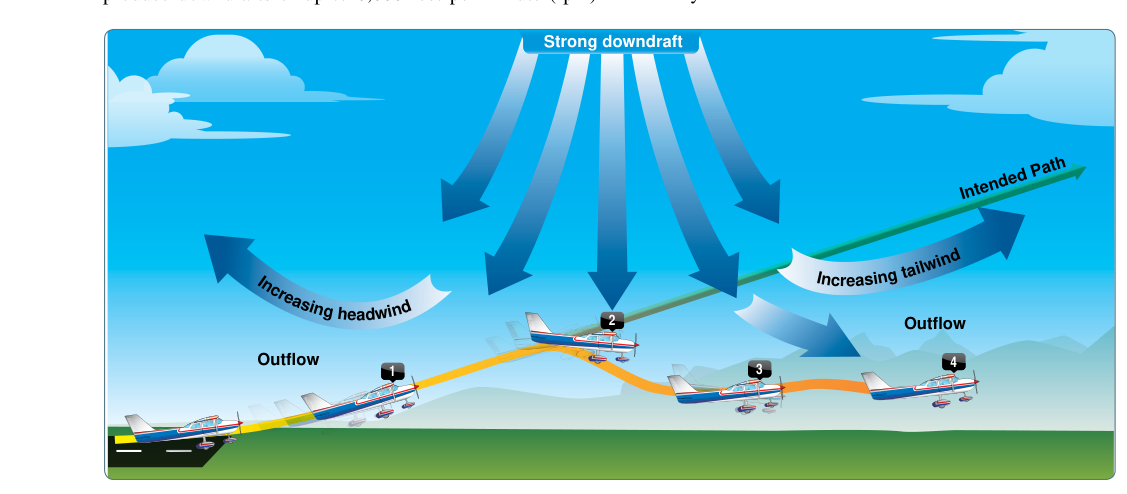
Wind shear is a sudden change in wind speed and/or direction over a short distance, either horizontally or vertically. For a pilot flying in IMC, this invisible hazard can impose massive, nearly instantaneous changes in airspeed, lift, and aircraft attitude — with little or no visual warning. The most violent form of wind shear is the microburst, a compact, intense downdraft that strikes the surface and spreads outward in all directions. Microbursts have been directly implicated in catastrophic approach and departure accidents, and they remain the primary meteorological reason instrument pilots must understand low-level wind shear thoroughly. This article covers the physical mechanics, recognition cues, avoidance procedures, and the key regulatory and performance facts you need for the instrument rating knowledge test and practical exam.
The Physics of Wind Shear
Wind shear occurs whenever adjacent air masses have significantly different velocities. The FAA's Aviation Weather Handbook (FAA-H-8083-28) distinguishes two fundamental types. Horizontal wind shear occurs when adjacent columns of air side-by-side differ in speed or direction — a pilot crossing a front or entering the boundary layer of a sea breeze will experience this. Vertical wind shear occurs when wind speed or direction changes with altitude; this is the form most dangerous during approach and departure because the aircraft passes through several shear layers in a short time.
From an aerodynamic standpoint, wind shear affects the aircraft through changes in indicated airspeed (IAS) and angle of attack. When an aircraft suddenly encounters a strong headwind component, IAS spikes upward and the aircraft pitches nose-up momentarily — the aircraft temporarily performs better than commanded. The peril comes a few seconds later when that headwind transitions to a tailwind: IAS drops sharply, lift decreases, and the aircraft sinks well below the intended flightpath. On a short final at low altitude with reduced thrust and high drag (gear and flaps extended), there may be no altitude remaining in which to recover.
Microbursts: Nature's Worst-Case Scenario
A microburst is a concentrated downdraft — a column of cold, dense air descending rapidly from a convective cell — that impacts the ground and diverges outward in a radial burst pattern. The FAA defines microbursts as having a horizontal extent of less than 4 nautical miles and lasting typically 2 to 5 minutes at peak intensity, though some persist up to 15 minutes. Vertical velocities inside the downdraft core are commonly cited on the order of several thousand feet per minute. Outflow winds at the surface can be strong enough to produce hazardous differential wind shifts, with surface gusts in severe cases exceeding 45 knots in some documented events.
An aircraft flying through the classic microburst encounter on approach experiences a three-phase performance trap. In the first phase, the aircraft enters the outflow and encounters an increasing headwind — performance improves, IAS increases, and the aircraft tends to rise above the glidepath. An unwary pilot may reduce thrust to compensate. In the second phase, the aircraft passes through the downdraft core; vertical velocities drive the aircraft down regardless of pitch attitude. In the third phase, the aircraft exits into the tailwind portion of the outflow — IAS drops suddenly (sometimes 30 to 90 knots), lift collapses, and the aircraft sinks rapidly at very low altitude with insufficient thrust and energy to recover. This total airspeed excursion across all three phases is called the total wind shear magnitude; total airspeed losses of roughly 15 knots or more are generally considered operationally significant and hazardous.
Microbursts can occur with or without precipitation reaching the surface. A dry microburst (common in the high plains and desert southwest) produces a virga shaft — precipitation that evaporates before touching the ground — making it essentially invisible on weather radar. Wet microbursts are more detectable because precipitation returns appear on radar, but the downdraft core may still not be identifiable until it is too late to deviate.
Recognition Cues for Pilots
Because microbursts are small and short-lived, advance recognition relies on a combination of ground-based systems, ATC advisories, and in-cockpit alerting.
- LLWAS (Low-Level Wind Shear Alert System): A network of anemometers surrounding an airport that detects diverging surface winds consistent with a microburst outflow. Controllers are required by ATC orders to issue wind shear alerts derived from LLWAS or when a pilot report (PIREP) is received.
- TDWR (Terminal Doppler Weather Radar): Installed at major airports, TDWR provides rapid-update Doppler wind data and can detect microbursts and wind shear within the approach and departure corridors. Data from TDWR is processed through systems such as WARP and ITWS and displayed to controllers, who then relay wind shear and microburst alerts to pilots.
- Airborne weather radar and predictive wind shear systems: Many transport-category aircraft are equipped with predictive wind shear systems that use forward-looking Doppler radar to alert pilots on the order of tens of seconds before encounter, providing time to execute a go-around. General aviation aircraft with weather data links (e.g., ADS-B weather) do not receive this real-time resolution.
- PIREPs: A pilot report of wind shear or airspeed fluctuations is one of the most immediate sources of actionable information. The FAA urges every pilot who encounters wind shear to file a PIREP promptly.
- Visual cues: Rotor clouds, blowing dust rings on the surface beneath a convective cell, or virga streaks beneath cumulonimbus anvils are visual indicators that a microburst may be occurring or imminent.
- Cockpit performance anomalies: Unexpected, sustained deviations from a stabilized approach — airspeed fluctuating more than ±10 knots, vertical speed deviating significantly from normal, or the glideslope/glidepath deviating more than one dot without a clear reason — are in-flight red flags.
Avoidance: The Only Reliable Strategy
The FAA is unequivocal: the only truly safe response to a known or suspected microburst is avoidance. Once inside the downdraft core, even maximum thrust may be insufficient to prevent ground contact in a heavily loaded aircraft at low altitude. The AIM and the Aviation Weather Handbook both state that pilots should not attempt to fly through a reported or suspected microburst.
Specific avoidance guidelines include the following. If a wind shear or microburst alert is issued for the airport or runway in use, pilots should avoid the affected area and continue to monitor LLWAS, TDWR, and PIREP data rather than assume the hazard has passed after any fixed amount of time — microburst-producing cells can persist or redevelop in the same area with little warning. If already established on the approach and a wind shear alert is issued, execute an immediate go-around unless the aircraft is in a position where a go-around itself is no longer safe. During departure, if wind shear is reported on the departure corridor, delay takeoff or select an alternate runway.
Escape Maneuver When Encounter Is Unavoidable
If a microburst encounter begins on approach and the pilot determines a go-around is necessary, the FAA recommends the following actions based on guidance in the Aviation Weather Handbook and standard transport-category procedures: advance thrust to maximum immediately, rotate to a wings-level, nose-high attitude (typically a fixed pitch attitude per the aircraft's AFM — commonly around 15° nose-up, or to initial stick-shaker/buffet margin, in transport aircraft), do not attempt to retract flaps or gear until safely clear of the terrain, and do not chase airspeed — accept the speed deviation and prioritize climb performance and obstacle clearance. The goal is to trade energy into altitude, escape the downdraft core, and fly out of the hazard zone.
Key Numbers and Rules
- Microburst horizontal extent: less than 4 nautical miles
- Microburst duration at peak intensity: 2–5 minutes (can persist to 15 minutes)
- Downdraft vertical velocities: commonly on the order of several thousand ft/min
- Surface outflow winds: can exceed 45 knots in severe cases
- Total airspeed loss across a microburst: 30–90 knots — losses of roughly 15 knots or more are considered operationally significant and hazardous
- After a wind shear or microburst alert: avoid the area and continue monitoring LLWAS/TDWR/PIREPs rather than relying on a fixed timed delay
- Wind shear alert phraseology from ATC includes type (microburst/wind shear), location, and reported/expected airspeed change in knots
- Wet microbursts: detectable by radar via precipitation echoes; dry microbursts may show only virga or no radar return
Common Test Traps
- Confusing the performance sequence: Many students remember that a microburst causes airspeed loss and miss the earlier headwind phase where performance temporarily improves. The FAA tests this sequence — the initial headwind gain is the trap that lures pilots into reducing thrust before the dangerous tailwind loss hits.
- Assuming radar will detect all microbursts: Dry microbursts produce little or no radar return. Absence of a radar echo does not mean the area is safe; virga and convective activity visible in the area are sufficient reason for caution.
- Thinking a stabilized approach can continue through shear: A wind shear alert for the approach corridor is a go-around trigger regardless of how well-stabilized the approach appeared moments earlier.
- Underestimating microburst duration: Students often assume microbursts pass in under a minute. While peak intensity may be brief, an active microburst can persist up to 15 minutes, and new cells can develop in the same area.
- Retraction of flaps and gear during escape: During a microburst escape maneuver, the priority is maximum thrust and a fixed pitch attitude. Retracting flaps prematurely can reduce lift precisely when it is needed most; the AFM escape procedure takes precedence over normal go-around flows.