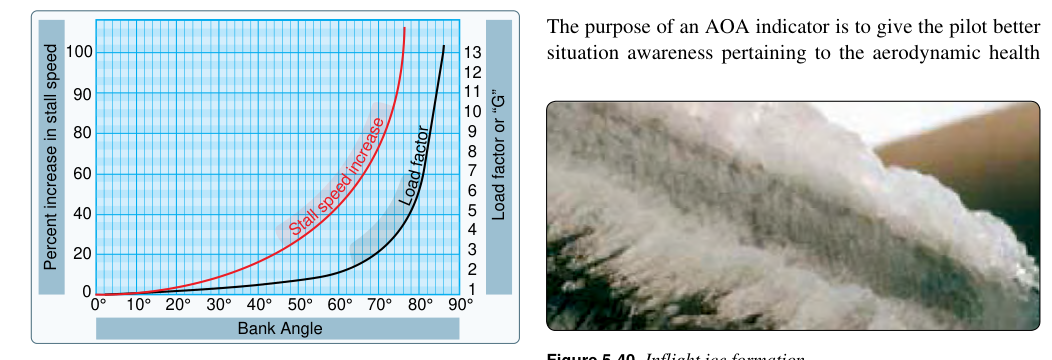
Every student pilot learns that an airplane stalls when the wing exceeds its critical angle of attack. What often surprises new pilots is that the airspeed at which a stall occurs is not fixed — it rises significantly as bank angle increases. The culprit is load factor: the ratio of the aerodynamic lift supporting the aircraft to the airplane's actual weight. Understanding how bank angle drives load factor, and how load factor drives stall speed, is one of the most important aerodynamic concepts for both the FAA knowledge test and real-world safety.
This relationship catches pilots off guard most dangerously during the base-to-final turn, a low-altitude maneuver where steepening the bank to "get lined up" can produce a stall at an airspeed well above the number on the airspeed indicator's low end — with almost no altitude to recover.
Load Factor: The Foundation
Load factor (often expressed as g or the symbol n) measures how many times the total lift force equals the aircraft's weight. In straight-and-level, unaccelerated flight, lift equals weight and load factor is exactly 1.0 g — the wing supports one "unit" of weight. The moment you enter a bank, you introduce a complication: lift acts perpendicular to the wing's surface, not straight up relative to the earth. To maintain altitude in a bank, the pilot must increase back pressure, tilting the lift vector more steeply and requiring the total lift to be greater than it was in level flight.
The vertical component of lift must still equal weight to prevent the airplane from descending. As bank angle increases, an ever-larger fraction of the lift vector is directed horizontally (providing the centripetal force for the turn) and a smaller fraction remains vertical. To keep that vertical component equal to the airplane's weight, total lift must increase — and lift can only increase at a given airspeed by increasing the angle of attack. More lift means more load, so the wings are supporting more than just the airplane's weight: they feel a multiplied force, expressed in g.
The Load Factor Formula and Bank Angle Values
The relationship between bank angle and load factor is precise and worth memorizing for the test. Load factor equals 1 divided by the cosine of the bank angle:
n = 1 / cos(bank angle)
You do not need to compute cosines in flight, but you do need to know the resulting values at common bank angles. The FAA Pilot's Handbook of Aeronautical Knowledge provides this table of reference points:
- 0° bank: Load factor = 1.0 g
- 30° bank: Load factor = approximately 1.15 g
- 45° bank: Load factor = approximately 1.41 g
- 60° bank: Load factor = 2.0 g
- 75° bank: Load factor = approximately 3.86 g
- 80° bank: Load factor exceeds 5.75 g
Notice that the numbers are deceptively gentle at shallow angles — a 30° bank only adds about 15% extra load — but the relationship accelerates rapidly. By 60°, the wings bear exactly double the airplane's weight. Beyond 70°, the load factors skyrocket to levels that can exceed the structural limits of a normal category aircraft (which are certified to 3.8 g positive load).
How Load Factor Raises Stall Speed
The connection between load factor and stall speed comes directly from the lift equation. Stall occurs at the critical angle of attack, which produces a specific maximum lift coefficient (CL max). At that point, any attempt to squeeze out more lift by increasing angle of attack causes the flow to separate and lift to collapse.
Because the wing must generate more total lift in a banked turn (to offset the increased load factor), it must reach its critical angle of attack at a higher airspeed than it would in level flight. The math works out elegantly: stall speed in a turn equals the unaccelerated stall speed multiplied by the square root of the load factor.
VS turn = VS × √n
This formula has concrete, testable consequences. If an airplane stalls at 50 knots in level flight (1 g), here is what happens in banked turns:
- 30° bank (1.15 g): Stall speed ≈ 50 × √1.15 ≈ 53.6 knots
- 45° bank (1.41 g): Stall speed ≈ 50 × √1.41 ≈ 59.4 knots
- 60° bank (2.0 g): Stall speed ≈ 50 × √2.0 ≈ 70.7 knots
- 75° bank (3.86 g): Stall speed ≈ 50 × √3.86 ≈ 98.2 knots
The jump from level flight to a 60° bank raises stall speed by more than 40% — from 50 to nearly 71 knots. A pilot who pulls back hard in a steep bank without adequate airspeed will encounter an accelerated stall, sometimes with little aerodynamic warning buffet, because the stall is reached rapidly rather than gradually.
Why This Matters: Safety and Real-World Application
The practical danger is greatest at low altitude and low airspeed — exactly the conditions found in the traffic pattern. Consider a pilot flying a close-in base-to-final turn at pattern airspeed. Noticing the runway is off to one side, the pilot steepens the bank past 45° and simultaneously pulls back to arrest the descent. Airspeed may still be well above the level-flight stall speed shown on the indicator, yet the airplane can stall and enter an incipient spin with 300 feet of altitude — not enough for recovery.
This scenario, historically known as the "base-to-final turn stall/spin," is one of the leading causes of fatal general aviation accidents in the traffic pattern. The FAA emphasizes in both the Pilot's Handbook of Aeronautical Knowledge and the Airplane Flying Handbook that pilots should maintain shallow bank angles in the pattern, keep airspeed well above approach speed during turns, and never attempt to "stretch a glide" with back pressure in a turn.
Load factor also stresses the airframe. At 60° of bank, every component — spars, control surfaces, engine mounts — bears double the load it carries in level flight. Exceeding the airplane's maneuvering speed (VA) while applying full or abrupt control inputs can exceed the structural load limit and cause airframe damage or failure.
Key Numbers and Rules
- Load factor at 60° bank = 2.0 g (the most commonly tested value)
- Stall speed increases as the square root of load factor
- A 60° banked turn raises stall speed by approximately 41% over level-flight stall speed
- Normal category aircraft are certified to a maximum positive load factor of 3.8 g
- Utility category aircraft are certified to 4.4 g; aerobatic category to 6.0 g
- At 75° bank, load factor approaches 3.86 g — close to the normal category structural limit
- Stall can occur at any airspeed or attitude if the critical angle of attack is exceeded
Memory Aid
For the load factor at 60° bank, remember: "Sixty makes it twice as hard." A 60° bank doubles the load factor to 2 g, and doubling the load factor multiplies stall speed by √2 (about 1.41, or 41% faster). If you can recall that single anchor point — 60° = 2 g = 41% higher stall speed — you can reason through most related test questions.
Common Test Traps
- Confusing pitch with bank: The FAA may describe an airplane in a steep bank and ask what the pilot must do to maintain altitude. The answer involves increasing back pressure (raising angle of attack and increasing lift), not simply increasing power. The resulting load factor is caused by the bank, not the pitch attitude alone.
- Assuming stall speed is fixed: Some questions present a stall scenario at a speed "above VS" and ask whether a stall is possible. Yes — if load factor is elevated (by bank angle or other acceleration), stall speed rises above the published level-flight figure.
- Forgetting the square root: Doubling load factor does NOT double stall speed — it multiplies stall speed by √2 (≈1.41). A question asking how stall speed changes when load factor quadruples expects the answer that stall speed doubles (√4 = 2).
- Underestimating shallow banks: A 30° bank seems gentle, but it already adds 15% to load factor. At slow approach speeds, even a modest extra load can reduce the margin above stall meaningfully.
- Ignoring structural limits in steep banks: Questions about VA and load limits often appear alongside bank angle questions. Remember that exceeding the structural limit (3.8 g for normal category) can damage or destroy the airframe, independent of any stall consideration.