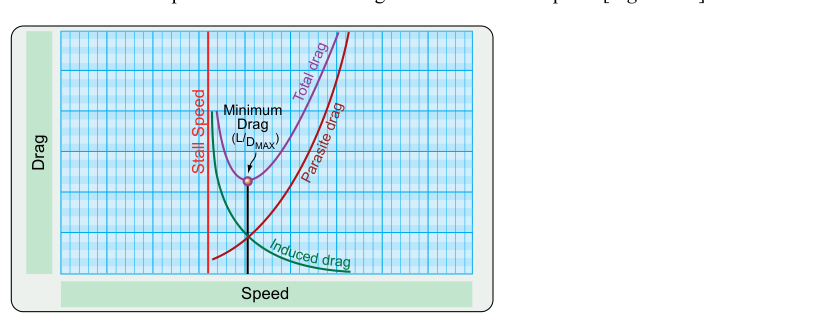
Every aircraft in flight wages a constant battle against two fundamentally different categories of drag. For light-sport aircraft (LSA), where engines typically produce 100 horsepower or less and cruise speeds sit well below those of general aviation singles, understanding these forces is far more than academic. Drag management directly influences fuel burn, climb performance, emergency glide range, and the safety margins built into every maneuver. The two primary drag categories are parasite drag and induced drag. Together, they sum to total drag, and their interaction produces one of the most important concepts in all of aerodynamics: the lift-to-drag (L/D) ratio.
Parasite Drag: The Speed Penalty
Parasite drag is the collective resistance offered by every part of the aircraft that displaces, deflects, or clings to air without contributing to lift. The PHAK (FAA-H-8083-25) identifies three distinct sub-components, each worth understanding on its own terms.
Form Drag
Form drag arises from the pressure differential between the leading and trailing portions of any body moving through air. A blunt, non-streamlined shape creates a large, turbulent wake behind it. The low pressure in that wake effectively pulls the aircraft backward. Streamlining—tapering the airframe so airflow reattaches smoothly—reduces the size of the wake and therefore reduces form drag. This is why LSA fuselages and struts are carefully faired and why wheel pants make a measurable difference in cruise performance on a small aircraft.
Skin Friction Drag
Skin friction drag results from air molecules adhering to the aircraft's surface. Even perfectly streamlined shapes suffer from it because the thin boundary layer of air in contact with the skin must be accelerated along with the aircraft. Polishing surfaces, using laminar-flow airfoil sections, and keeping the skin free of bugs, ice, and contamination all reduce skin friction drag. On a small LSA, a dirty leading edge can add a surprisingly significant drag penalty.
Interference Drag
Interference drag occurs wherever two different airflow streams collide and mix, creating turbulence greater than either stream would produce alone. Classic interference drag locations include the wing-fuselage junction, the junction between a strut and the wing, and anywhere a control surface hinge gap allows air from one side to leak to the other. Careful aerodynamic fairing at these junctions is standard practice on well-designed LSA.
The Parasite Drag–Speed Relationship
The defining characteristic of parasite drag is its relationship to airspeed: parasite drag varies with the square of the velocity. Double the airspeed and parasite drag quadruples. Triple it and parasite drag increases by a factor of nine. In practice, this means that an LSA already fighting meaningful parasite drag at 90 knots will face dramatically greater resistance at 110 knots. Pushing toward Vne (never-exceed speed) is not just a structural concern—it is also an enormous drag and fuel-burn penalty.
Induced Drag: The Lift Penalty
Induced drag is the unavoidable aerodynamic price of generating lift. To understand why it exists, you must follow what happens at a wing generating lift in real three-dimensional air. The pressure differential that produces lift—high pressure below the wing, lower pressure above—does not disappear neatly at the wingtip. Instead, high-pressure air beneath the wing spills outward and curls upward around the wingtip toward the lower-pressure region above, forming the familiar wingtip vortices. These rotating masses of air create a downward flow of air called downwash behind the wing. Downwash tilts the local relative wind downward, which in turn tilts the total lift vector slightly rearward. That rearward-tilted component of the lift vector is induced drag. As the PHAK explains, induced drag is literally drag induced by the act of producing lift—you cannot generate lift without generating some induced drag.
The Induced Drag–Speed Relationship
Induced drag behaves in the opposite way from parasite drag with respect to airspeed. At low airspeeds, the wing must fly at a high angle of attack to generate the lift needed to support the aircraft's weight. A high angle of attack produces stronger tip vortices and more pronounced downwash, which means more induced drag. As airspeed increases, the wing can generate the same lift at a lower angle of attack, vortex strength decreases, downwash is reduced, and induced drag falls. In mathematical terms, induced drag is inversely proportional to the square of the airspeed. This is why an LSA on a slow, power-off final approach—already at a high angle of attack—experiences its maximum induced drag, and why the pilot feels the need to add power even before a stall warning sounds.
Wing Design and Induced Drag
Wing geometry has a profound effect on induced drag. A wing with a high aspect ratio—long span relative to chord—confines the tip vortex to a smaller percentage of the total span, reducing downwash and induced drag. Many high-performance sailplanes exploit this with aspect ratios exceeding 30:1. Practical LSA designs balance induced drag reduction against structural weight and hangar-width limitations, typically landing in an aspect ratio range of roughly 6:1 to 9:1 depending on design philosophy. Winglets, which appear on some LSA, redirect and weaken tip vortices, offering a measurable reduction in induced drag without a proportional increase in wingspan.
Total Drag and the Drag Curve
When you plot parasite drag and induced drag against airspeed on the same graph and add them together, the result is the total drag curve—a characteristic U-shape. At very low airspeeds, induced drag is enormous and total drag is high. As speed increases from the left side of the graph, induced drag falls faster than parasite drag rises, so total drag decreases. Eventually, parasite drag begins rising faster than induced drag falls, and total drag climbs again. The bottom of the U—the single airspeed where total drag is at its absolute minimum—is the most aerodynamically efficient speed the aircraft can fly. This is the speed corresponding to the maximum lift-to-drag ratio, written as L/D max.
The Lift-to-Drag Ratio
The L/D ratio at any instant is simply the total lift being generated divided by the total drag acting on the aircraft at that moment. A higher L/D ratio means more lift is being produced per unit of drag—the aircraft is working more efficiently. At L/D max, the aircraft is at its aerodynamic peak. For a typical LSA, the L/D ratio at best-glide speed commonly falls in the range of roughly 8:1 to 12:1, though specific values vary by design and are published in the Pilot's Operating Handbook (POH). An L/D of 10:1, for example, means the aircraft travels 10 feet horizontally for every foot of altitude lost in a power-off glide under standard conditions.
L/D Max and Best-Glide Speed
The practical cockpit application of L/D max is best-glide speed, published in every LSA POH. In an engine-out emergency, pitching to best-glide speed maximizes glide distance, giving you the greatest number of landing options below. Flying faster than best-glide speed increases parasite drag and steepens the glide. Flying slower increases induced drag and also steepens the glide. Only the published best-glide speed places you at the bottom of the drag curve. Weight also matters: a heavier aircraft must fly at a slightly higher angle of attack to maintain lift, which slightly increases induced drag and shifts the drag curve. Some POHs account for this by publishing best-glide speeds for multiple weight configurations.
L/D Max, Vy, and Vx Are Not the Same Speed
A common misconception is that best-glide speed equals best-rate-of-climb speed (Vy) or best-angle-of-climb speed (Vx). They are related but distinct. Vy is the speed that produces the greatest excess power, which occurs slightly above L/D max on many designs. Vx is slower than Vy, optimizing the angle rather than the rate. None of these three speeds are interchangeable on the practical test or in the cockpit.
Why This Matters for LSA Pilots
An LSA pilot has limited power reserves to compensate for inefficiency. Flying even 10 knots below best-glide speed on a long cross-country wastes altitude and engine time. Flying 10 knots above it wastes fuel fighting rapidly increasing parasite drag. During slow-flight training, the dramatic increase in induced drag at low speed explains why full power may be needed to maintain level flight well above stall speed—the aircraft is deep on the back side of the power curve, where more thrust is required as speed decreases. Recognizing this region, respecting it, and knowing how to exit it by lowering the nose are fundamental LSA pilot skills grounded directly in the physics of these two drag types.
- Parasite drag increases with the square of airspeed — double the speed, quadruple the drag.
- Induced drag decreases as airspeed increases — it is highest at low speed and high angle of attack.
- Total drag is minimum at L/D max — this airspeed equals best-glide speed in power-off flight.
- Aspect ratio matters — higher aspect ratio wings generate less induced drag for a given amount of lift.
- Weight affects best-glide speed — heavier aircraft may require a slightly higher best-glide airspeed.
Common Test Traps
- Mixing up the speed relationships: Parasite drag rises sharply with speed; induced drag falls with speed. Students who reverse these will miss fundamental drag questions on the Sport Pilot knowledge test.
- Best glide versus Vy versus Vx: These are three different speeds for three different purposes. Do not substitute one for another on the test or in an emergency.
- Power required at slow speeds: If a question asks why more power is needed at very slow airspeeds in level flight, the answer is high induced drag — not high parasite drag.
- Source of induced drag: Induced drag is caused by the production of lift and the resulting wingtip vortices — not by the shape of the fuselage or skin friction.
- L/D ratio and glide ratio: In a power-off glide, L/D max numerically equals the glide ratio. An aircraft with L/D max of 10:1 glides 10 feet forward per foot of descent under still-air, standard conditions.
Memory aid
"Fast parasite, slow induces." Parasite drag is the dominant villain at high speeds; induced drag dominates at low speeds. Because induced drag is literally induced by lift, you can also remember: no lift, no induced drag — a descending, unloaded wing at zero angle of attack produces neither lift nor induced drag, only parasite drag.