When an engine quits, every pilot's first question becomes: how far can I glide? The answer is determined by a single aerodynamic number — the lift-to-drag ratio, commonly written as L/D. This ratio describes how much lift a wing generates for every unit of drag it produces. A high L/D means the aircraft is aerodynamically efficient: it stays aloft while traveling a long horizontal distance. A low L/D means the aircraft sinks quickly relative to its forward travel. Understanding L/D isn't just an exam topic — it's the principle that lets you choose a landing spot and reach it safely when the engine goes silent.
Beyond emergencies, the L/D concept explains why certain airspeeds are used for gliding, why aircraft are designed with particular wing shapes, and why flying too slow or too fast both cost you range. This article builds the concept from the ground up, connects it to the numbers you'll see in your Pilot's Operating Handbook (POH), and highlights the exam questions that trip up the most students.
How Lift and Drag Are Produced
Lift and drag are both aerodynamic forces generated whenever a wing moves through the air. Lift acts perpendicular to the relative wind, holding the aircraft up. Drag acts parallel to the relative wind, opposing forward motion. Both forces grow with the square of airspeed and with the density of the air, and both are strongly influenced by the angle of attack (AOA) — the angle between the wing chord line and the relative wind.
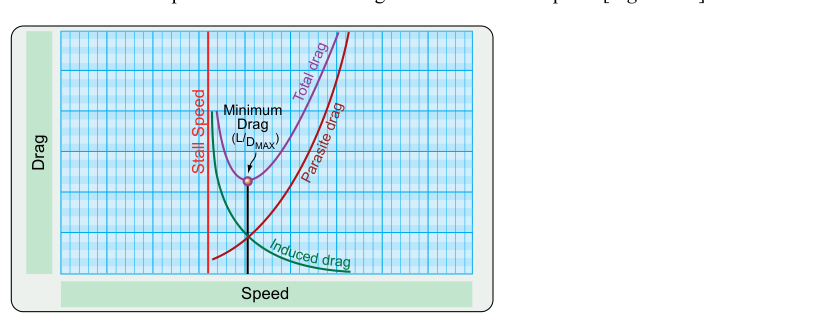
Total drag has two major components. Induced drag is the unavoidable byproduct of producing lift. It is highest at slow airspeeds and high angles of attack, decreasing as speed increases. Parasite drag — which includes form drag, skin friction, and interference drag — does the opposite: it rises sharply with increasing airspeed. The sum of these two components creates a U-shaped total drag curve when plotted against airspeed. At the very bottom of that U-shaped curve, total drag is at its minimum. That minimum-drag point corresponds to the maximum L/D ratio, and it is the most aerodynamically efficient operating point for the aircraft.
The L/D Ratio Explained
The lift-to-drag ratio is simply lift divided by drag: L/D = Lift ÷ Drag. At any given angle of attack, this ratio has a specific value. As AOA increases from a very low value, L/D initially rises because lift is growing faster than drag. Eventually, there is one particular AOA — the angle of attack for maximum L/D, often called L/Dmax — where the ratio peaks. Beyond that AOA, drag increases faster than lift, and the ratio falls. At the stall AOA, L/D collapses entirely because induced drag skyrockets.
A crucial insight from the FAA Pilot's Handbook of Aeronautical Knowledge is that the AOA for L/Dmax is fixed for a given airfoil design. It does not change with weight, altitude, or configuration (assuming clean configuration). What does change is the airspeed at which that angle of attack occurs. Heavier aircraft must fly faster to maintain the same AOA, so a heavier aircraft reaches its L/Dmax at a higher indicated airspeed. This is why best-glide speed is listed for a specific weight in the POH — and why you'll see notes to use a higher speed if the aircraft is heavier than the listed weight.
Glide Performance and the Glide Ratio
The practical payoff of L/D is the glide ratio — the horizontal distance traveled for every unit of altitude lost. If an aircraft has an L/Dmax of 10:1, it glides 10 feet forward for every 1 foot of altitude lost, regardless of altitude (assuming still air). A light trainer might have an L/D around 8:1 to 12:1. High-performance sailplanes can achieve 40:1 or better. A typical single-engine trainer at best-glide speed might cover roughly 1.5 miles for every 1,000 feet of altitude.
The glide ratio is numerically equal to the L/D ratio. This is not a coincidence — it is a direct mathematical consequence of the force equilibrium in a glide. In a steady glide, thrust is zero, lift approximately equals weight (for shallow glide angles), and the aircraft's flight path descends at an angle whose tangent equals drag divided by lift. Therefore, glide ratio = L/D. Maximizing L/D directly maximizes glide range.
The Effect of Airspeed on Glide
Flying faster than best-glide speed increases parasite drag without a proportional lift benefit, reducing L/D and steepening the glide. Flying slower than best-glide increases induced drag significantly and also reduces L/D. Only one airspeed — best glide (VBG) — achieves maximum L/D and therefore maximum glide distance. Deviating in either direction shortens your glide.
It is important to distinguish best-glide speed from minimum sink speed. Minimum sink speed (which is slower than best glide) keeps the aircraft airborne for the greatest amount of time, but it does not cover the most ground. You would use minimum sink speed only if you needed to stay aloft as long as possible — for example, to allow more time to troubleshoot an engine problem — not to maximize glide distance to a runway. For reaching a specific point on the ground, always use best-glide speed.
Factors That Affect Glide Distance
Several practical factors modify the theoretical glide performance you'd calculate from L/D alone:
- Wind: A headwind reduces glide distance over the ground; a tailwind increases it. In a headwind, the aircraft covers less ground per unit of altitude. In a tailwind, it covers more. For maximum distance in a headwind, some sources suggest flying slightly faster than published best-glide speed to compensate, though your POH guidance takes precedence.
- Configuration: Extending flaps or landing gear dramatically increases drag and sharply reduces L/D. A typical flap extension can cut glide distance by 30–40% or more. Always retract flaps (unless committed to landing) and leave gear up as long as safely possible during an engine-out glide.
- Propeller: A windmilling propeller creates significant drag compared to a feathered propeller on multi-engine aircraft. For single-engine aircraft, the propeller usually windmills and the pilot cannot feather it, so published glide data already accounts for this.
- Weight: As discussed, weight changes the speed at which L/Dmax is achieved, but — in still air — the ratio itself (and therefore glide distance in terms of altitude) remains essentially constant. A heavier aircraft and a lighter aircraft with the same L/D will cover the same distance per unit of altitude if each flies at its correct best-glide speed. The heavier aircraft simply descends at a higher rate and speed.
- Altitude: Altitude does not change glide ratio in terms of distance-per-foot-of-altitude lost, but it gives you more distance to glide from a higher starting point. Also, at higher density altitudes, true airspeed is higher than indicated airspeed, so you cover more actual ground distance at the same indicated best-glide speed.
Why It Matters
Engine failures, though rare, do happen. Pilots who understand L/D and have memorized their aircraft's best-glide speed can immediately fly the most effective profile the moment the engine quits, without having to think through the aerodynamics under stress. Every knot away from best-glide speed in either direction is lost runway length on the other end. In a real emergency, that margin can be the difference between landing in a field and landing in the trees at the edge of that field.
L/D also informs cruise efficiency. While pilots don't fly at best-glide speed during cruise (which is near maximum range, not maximum speed), understanding the drag curve helps explain why operating far outside the aircraft's efficient speed range wastes fuel and reduces endurance.
Key Numbers and Rules
- Best-glide speed (VBG) is published in the POH — always memorize it for your specific aircraft.
- The glide ratio is numerically equal to L/Dmax. An L/D of 9:1 means approximately 9 feet forward per foot of altitude lost, or about 1.5 nautical miles per 1,000 feet AGL in still air (this varies by aircraft).
- Induced drag dominates at low speeds; parasite drag dominates at high speeds. Minimum total drag — and maximum L/D — occurs at the speed where induced drag equals parasite drag.
- Adding flaps or lowering gear always reduces glide distance and should be avoided during an engine-out glide until committed to the landing.
- Best-glide speed increases with increased weight; use POH tables if your aircraft's weight differs significantly from the listed value.
- Wind affects glide distance over the ground but not glide ratio through the airmass — a headwind shortens your reach, a tailwind extends it.
Memory Aid
For the drag curve relationship, remember: "Slow = Induced, Fast = Parasite." At slow speeds, you pay with induced drag (the cost of high lift); at fast speeds, you pay with parasite drag (the cost of pushing through the air). The sweet spot in between — where the two are equal — is your most efficient flight condition, L/Dmax, and your best-glide airspeed.
Common Test Traps
- "Weight doesn't affect glide distance" — True, but tricky. Weight changes the speed for best glide but not the glide ratio itself (in still air). The FAA tests whether you know to fly a faster best-glide speed at higher weights.
- Confusing best-glide with minimum-sink speed. Minimum sink keeps you up the longest (in time); best glide gets you the farthest (in distance). These are different airspeeds, and the exam will test which to use in a given scenario.
- Assuming altitude improves glide ratio. Higher altitude gives you more room to glide (more feet of altitude to convert), but the ratio — feet forward per foot down — stays the same. Don't confuse starting altitude with glide efficiency.
- Forgetting the effect of configuration. A question may describe an engine failure and ask for the best action. Retracting flaps and maintaining best-glide speed should come before trying to restart — the FAA expects you to know that configuration changes dramatically affect glide performance.
- Wind and groundspeed traps. The glide ratio through the airmass is unchanged by wind. But over the ground, a 20-knot headwind can cost hundreds of feet of glide distance. The exam may give you a scenario where wind appears irrelevant but actually determines whether you make the runway.