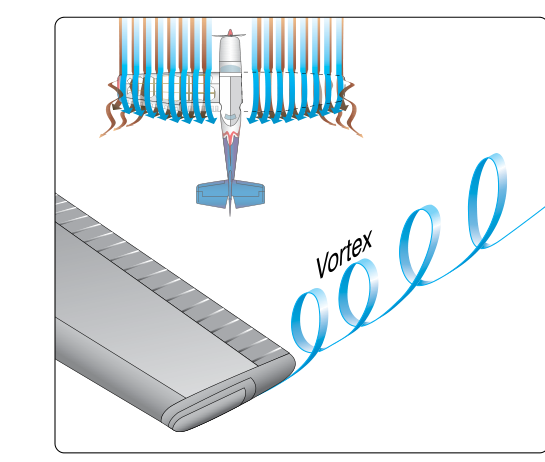
Every time a wing generates lift, it also generates a hidden byproduct: a pair of powerful, corkscrew-shaped air masses that spiral off each wingtip. These are wingtip vortices, and they are far more than an aerodynamic curiosity. They represent wasted energy — energy that could have gone into lifting the aircraft but instead spins uselessly into the atmosphere. The aerodynamic penalty that comes with producing those vortices is called induced drag, and it is one of the two primary categories of drag that every pilot must understand. Reducing induced drag is not just an academic exercise; it directly affects fuel burn, climb performance, and the safety hazard you create for aircraft flying behind you.
This article explains exactly how wingtip vortices form, why they produce drag, what factors make them stronger or weaker, and how aircraft designers and pilots can work together to minimize their effects. Along the way you will find the specific numbers and concepts that regularly appear on the FAA Private Pilot Knowledge Test.
How Wingtip Vortices Form
To understand vortices, start with the pressure difference that makes lift possible. The upper surface of a wing has lower pressure than the lower surface — that difference is what pushes (or more accurately, pulls) the aircraft upward. At the center of the wing this pressure difference does its job cleanly. But at the wingtip, nature cannot tolerate a pressure boundary floating in free air. The higher-pressure air beneath the wing curls outward and upward around the tip, trying to equalize with the low-pressure air above. This curling flow combines with the free-stream airflow moving rearward over the wing, and the result is a helical, spinning column of air that trails behind each wingtip like an invisible tornado.
The two vortices rotate in opposite directions: the one behind the left wingtip rotates clockwise when viewed from behind the aircraft, and the one behind the right wingtip rotates counter-clockwise. Between the two vortices, the net effect is a powerful downwash — air being pushed downward behind the wing. This downwash is the physical mechanism that connects vortex generation to induced drag.
Why Downwash Creates Induced Drag
A wing is designed to meet the oncoming air at a specific angle — the angle of attack. Downwash, however, tilts the local relative wind downward behind the wing. From the wing's perspective, the effective angle of attack is slightly reduced by the downwash, and the lift vector — which is always perpendicular to the local relative wind — is tilted slightly rearward. That rearward tilt of the lift vector produces a component that acts opposite to the direction of flight. That component is induced drag.
The word «induced» reflects the fact that this drag is a direct consequence, or side effect, of the lift generation process itself. You cannot produce lift without some induced drag. The goal is to minimize it, not eliminate it entirely.
What Makes Vortices Stronger or Weaker
Several factors control the intensity of wingtip vortices and thus the magnitude of induced drag:
- Angle of attack (airspeed): Induced drag is greatest at high angles of attack — that is, at low airspeeds. The greater the lift being generated and the slower the aircraft is flying, the stronger the pressure differential at the wingtip and the more powerful the vortex. This is why induced drag dominates during takeoff, climb, and the approach to landing.
- Weight: A heavier aircraft must generate more lift at any given speed. More lift means a bigger pressure difference, stronger vortices, and more induced drag. This is why a fully-loaded airliner produces far more dangerous wake turbulence than the same aircraft flying lightly.
- Wingspan and aspect ratio: Aspect ratio is the ratio of wingspan to average chord (width). A long, narrow wing (high aspect ratio) spaces the two wingtips far apart relative to the total wing area, which reduces the intensity of each vortex. Gliders, which need maximum efficiency, feature very high aspect ratios. Short, stubby wings (low aspect ratio) concentrate the vortex effect over a smaller span and produce more induced drag per unit of lift.
- Wing taper and elliptical lift distribution: An ideally elliptical distribution of lift along the span minimizes induced drag for a given wingspan. The classic elliptical planform wing — famous on the Spitfire fighter — achieves this naturally. Modern wings approximate it through careful taper and twist design.
- Speed: Since induced drag varies with the square of angle of attack and inversely with the square of airspeed, doubling your airspeed cuts induced drag to roughly one-quarter. Faster flight dramatically reduces induced drag, which is why the total drag curve has a characteristic «bucket» shape — as speed increases from stall, induced drag falls rapidly even as parasite drag climbs.
Winglets: The Designer's Answer
One of the most visible solutions to induced drag is the winglet — the small, upswept or angled fin attached to each wingtip on modern airliners and many general aviation aircraft. Winglets work by partially blocking the flow of high-pressure air around the wingtip, weakening the vortex and redistributing the pressure gradient more effectively along the span. The net effect is an increase in the effective aspect ratio without making the physical wingspan longer — a crucial advantage when hangar space, taxiway clearance, or structural weight is a concern. Winglets can reduce induced drag by roughly 3–5% in cruise flight on a typical transport aircraft, translating to meaningful fuel savings over millions of flight hours.
Wake Turbulence: The Safety Dimension
Wingtip vortices are not merely a performance issue — they are a significant flight safety hazard known as wake turbulence. The FAA and AIM devote considerable attention to this topic because a small aircraft inadvertently entering the wake of a large one can experience a rolling moment powerful enough to exceed full aileron authority, causing loss of control.
Key facts about wake turbulence behavior that every pilot must know:
- Vortices begin at the point of rotation on takeoff and end at the point of touchdown on landing — where the wings stop generating lift.
- Vortices sink at approximately 400–500 feet per minute and typically level off around 800–900 feet below the flight path of the generating aircraft.
- In calm conditions vortices drift with the wind, moving laterally away from the runway centerline at roughly 5 knots each. A light crosswind can hold one vortex stationary over the runway while pushing the other clear.
- When operating behind a larger aircraft, the FAA recommends staying at or above the larger aircraft's flight path and landing beyond its touchdown point. On departure, rotate before the preceding aircraft's rotation point and climb above its climb path.
- Vortices are strongest behind heavy, slow, and clean aircraft — heavy because of greater lift, slow because of higher angle of attack, and clean (flaps retracted) because full flap deployment reduces the tip pressure difference somewhat.
Key Numbers and Rules
- Induced drag varies inversely with the square of airspeed: halving airspeed quadruples induced drag.
- Induced drag is highest at low airspeeds (high angle of attack) and lowest at high airspeeds.
- Parasite drag is highest at high airspeeds; the point where induced drag equals parasite drag is the speed of minimum total drag — also the speed for best glide ratio and (in many aircraft) best range.
- High aspect ratio wings produce less induced drag than low aspect ratio wings at the same lift.
- The FAA categorizes aircraft for wake turbulence purposes by maximum certificated takeoff weight: Super (over 500,000 lb), Heavy (over 300,000 lb), Large (over 12,500 lb up to 300,000 lb), and Small (12,500 lb or less).
- Separation standards behind Heavy aircraft are typically 4–6 nautical miles for IFR operations; specific minimums are published in the AIM and 7110.65.
Memory Aid
To remember the conditions that make wingtip vortices — and therefore wake turbulence — most dangerous, use the phrase «Heavy, Slow, Clean»:
- Heavy — more lift required means a larger pressure differential and stronger vortex.
- Slow — higher angle of attack intensifies the tip pressure difference.
- Clean — flaps up preserves the strong pressure difference at the tip (flap deployment partially relieves it).
When you see a heavy transport aircraft on a long final with gear down but flaps still retracted, or on initial climb at a high gross weight, those are the moments its wake is most hazardous to you.
Common Test Traps
- Induced drag decreases as speed increases — not the other way around. Students often confuse induced and parasite drag. Parasite drag rises with speed; induced drag falls. The FAA frequently tests this distinction.
- Vortices start at rotation, not at the beginning of the takeoff roll. Before the wheels leave the ground the wing is not fully unloaded, but the critical point for ATC separation is rotation/liftoff.
- A crosswind can hold a vortex over the runway. Many students assume wind always clears vortices. A tailwind of 3–7 knots can actually keep both vortices near the touchdown zone — a particularly dangerous scenario.
- High aspect ratio reduces induced drag; it does not eliminate it. Any wing producing lift produces some induced drag. Aspect ratio only controls the magnitude.
- The speed for minimum drag (best glide speed) is where induced drag equals parasite drag — not the slowest or fastest speed on the drag curve. Confusing this with best endurance speed (which occurs at a different point) is a classic test error.