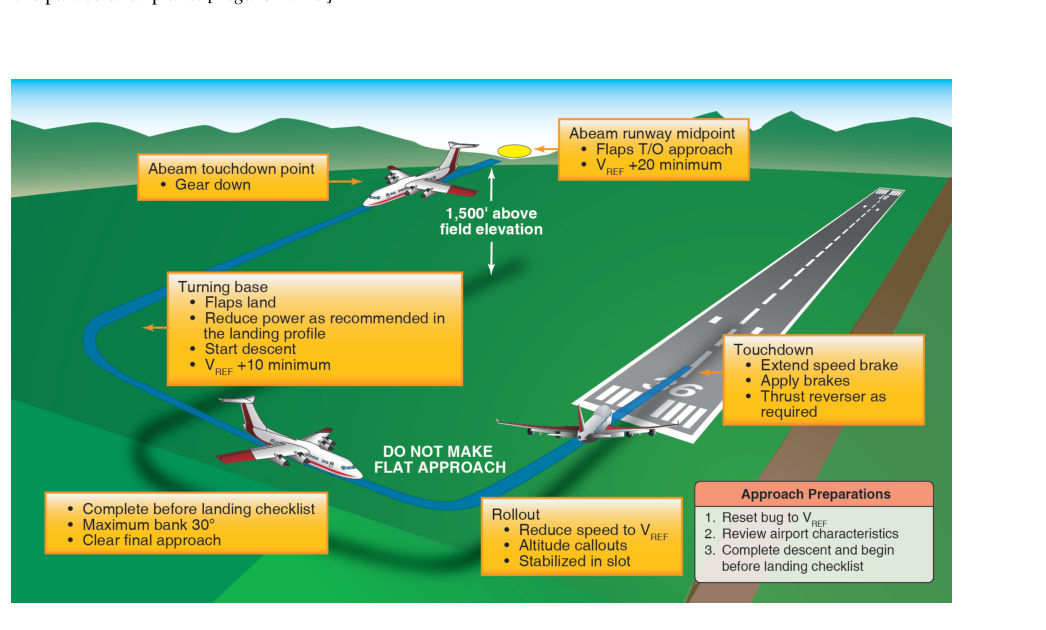
Among all the maneuvers an instructor must teach, the engine-out emergency approach and landing carries the highest real-world stakes. A student who botches a power-off 180 on a checkride simply performs a go-around; a pilot who botches the same maneuver following an actual engine failure may not get a second chance. The instructor's responsibility, therefore, goes well beyond demonstrating a tidy glide to a grass strip. It means building a repeatable, stress-resistant decision framework—one that survives task saturation, surprise, and altitude pressure—in every student, every flight. That requires a precise understanding of the specific errors students make most often, why those errors occur, and how to address them systematically both in the air and during the debrief.
The Physical Foundation: Best-Glide Speed and the Glide Profile
The Airplane Flying Handbook (FAA-H-8083-3) identifies best-glide speed—often labeled VG or VBG in the pilot's operating handbook—as the cornerstone of any emergency approach. At this speed the airplane achieves the flattest glide angle and therefore the greatest horizontal distance for every foot of altitude surrendered. Deviating in either direction from best-glide speed costs range and, at low altitude, costs options.
Flying faster than best glide increases drag disproportionately, steepens the descent angle, and shortens the glide. Flying slower than best glide also steepens the angle as the airplane moves up the back side of the drag curve, and it simultaneously reduces the stall margin—a dangerous combination in an already stressful situation. Instructors must teach students that the very first control input after recognizing power loss is a pitch change to place the airspeed indicator on best-glide speed. Engine restart attempts, radio calls, and field selection all come after that pitch change, not before it.
A practical note: best-glide speed and best-glide performance can vary with weight, and instructors should confirm the specific relationship for the airplane being flown using the POH rather than assuming a universal rule. This nuance seldom appears on knowledge tests but is worth mentioning in advanced instruction, because students who know the why behind numbers retain them under stress far better than students who memorize by rote.
Common Glide Profile Errors and How to Correct Them
Failing to Establish Best-Glide Speed Promptly
The most pervasive error is the momentary freeze that follows power loss. The student feels the sink, hears the silence, and pitches for whatever attitude feels comfortable—usually something close to cruise attitude—while precious altitude drains away. Instructors should require an immediate verbal callout of the target speed and a cross-check of the airspeed indicator within the first few seconds. Simulate power loss at varying phases of flight—climb, cruise, and slow flight—so the student stops associating it with one specific scenario.
Mismanaging the High Key / Low Key Pattern
The structured overhead pattern, which the Airplane Flying Handbook describes as a way to systematically manage altitude en route to the field, uses reference positions around the chosen landing area. The high key position is typically established directly over or abeam the intended touchdown point at a specific altitude cited in the airplane's POH or training standards. The low key position is approximately at the 180-degree point—abeam the landing threshold on the downwind side—where the pilot should have enough altitude remaining to complete the final approach segment with some adjustment available. Students who do not use this framework drift too wide, lose sight of the field, or arrive at the 180 position with wildly incorrect altitude. Brief these reference altitudes before flight; debrief every deviation from them afterward with specific numbers, not vague impressions.
Fixating on the Field and Neglecting Airspeed
Once a student commits visually to a field, attention tunnels onto it. Airspeed decays quietly. The instructor should instill a disciplined cross-check rhythm: field—instruments—field—instruments. Consider having the student call airspeed aloud every few seconds during practice approaches; the verbalization forces the scan even when anxiety is high.
Premature or Delayed Flap Extension
Early flap extension commits the pilot to a steeper, slower approach before it is certain the field is within glide range. If the pilot then determines the field is too far, retracting flaps may create a balloon and airspeed excursion at low altitude. Conversely, delaying flaps until the flare results in a flat, fast touchdown with a long rollout—potentially into obstructions at the far end. Teach students to hold flaps until the field is assured, then add them progressively in increments, reassessing the glide path after each addition. This gives the pilot active energy management tools in the final segment of the approach.
Skipping the Engine Restart Checklist
The Airplane Flying Handbook outlines a priority sequence for the emergency: establish best glide, select a suitable landing field, attempt a restart using the POH emergency checklist, and communicate the emergency (squawk 7700, transmit on the current frequency or 121.5 MHz) as time and altitude permit. Students under simulated pressure often jump straight to communication or skip the restart entirely. Remind them that a successful restart—however unlikely statistically—eliminates the emergency completely, but that field selection should not wait on the restart attempt. The checklist items vary by aircraft type but typically include verifying fuel selector position, mixture rich, magnetos to BOTH, primer in and locked, and carburetor heat ON as a standard troubleshooting step for power loss of undetermined cause.
Field Selection: A Priority Hierarchy
The Airplane Flying Handbook provides guidance on evaluating candidate landing areas. Instructors should teach students to apply these considerations in a structured priority order, not as an unranked checklist they work through randomly under stress.
- Proximity and glide range: The most perfect field just outside glide range is useless. The closest acceptable field almost always wins. Students tend to reach for an airport that is too far away rather than accepting a suitable off-airport surface.
- Size and surface: Is the area long enough to stop the airplane, accounting for no braking assistance from reverse thrust? Is the surface firm—paved road, mowed field, dry lakebed—or is it soft, sloped, or obstructed? A shorter but firm surface often beats a longer but soft one.
- Wind: Landing into the wind reduces groundspeed at touchdown and shortens the rollout. Students should learn to read visual wind indicators quickly: smoke direction, water surface texture, crop row patterns, dust movement, and the drift of the airplane itself during the approach.
- Obstructions on the approach path: Trees, power lines, and fences at the approach end are often more dangerous than a marginal surface, because the pilot cannot trade kinetic energy for climb to clear them. A field with a clear approach path and a short, firm surface frequently beats a long, smooth field with wires at the threshold.
- Traffic and pattern direction: Briefly consider which direction the final approach must be flown to satisfy wind and obstruction constraints, and ensure the high key / low key pattern can be set up on the correct side.
Key Numbers and Rules
- Best-glide speed (VG) is published in the POH and is the first speed to establish after power loss.
- Emergency transponder code: 7700 (emergency). 7600 = lost communications. 7500 = hijacking. These are commonly confused on knowledge tests.
- Emergency guard frequency: 121.5 MHz is monitored by ATC facilities and many airline aircraft.
- Flap extension: delay until the field is assured; then add incrementally.
- Pattern reference altitudes (high key, low key) are aircraft-specific—always brief from the POH or training standards before the flight.
Common Test Traps
- Best glide vs. minimum sink: Best-glide speed maximizes horizontal distance traveled per foot of altitude lost—correct for reaching a field. Minimum-sink speed maximizes time aloft at the cost of range. These are not the same speed, and test questions sometimes present them as interchangeable.
- Flap timing distractors: Knowledge and oral exam questions often ask when to extend flaps. The textbook answer is after the field is assured, not immediately after power loss.
- Weight effect on best-glide speed: Weight can affect glide performance, and instructors should verify the specific relationship in the applicable POH rather than relying on a blanket rule. Examiners may probe this relationship during an oral.
- Restart sequence: Questions may ask the correct order of emergency actions. Establish best glide first, then select a suitable landing field, then attempt a restart per the POH while communicating as time and altitude permit. Placing communication or restart ahead of field selection is a common student—and test—error.
- Nearest airport bias: Students and test distractors alike assume the best emergency landing area is always the nearest airport. The correct answer is the nearest suitable landing area, which could be a road, field, or beach if the airport is outside glide range or approach obstacles make it unsuitable.