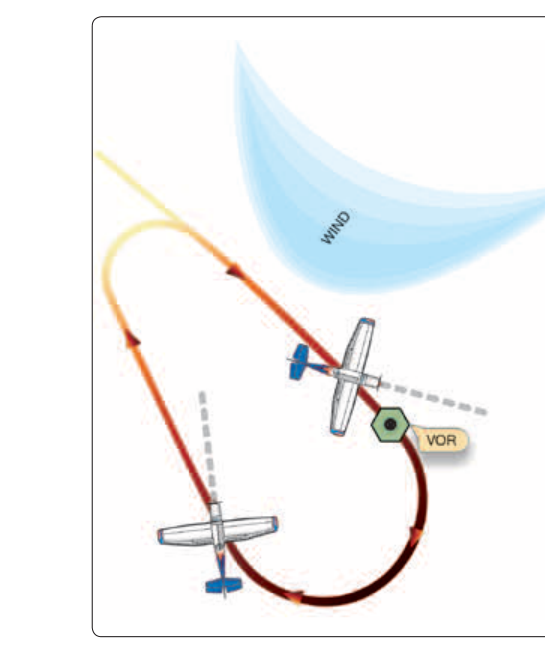
When ATC assigns a holding instruction, your job is not simply to fly racetrack-shaped circles in the sky — it is to keep the aircraft within a precisely defined block of protected airspace while you wait for a clearance, sequence, or weather improvement. In still air that task is straightforward. In the real atmosphere, wind is almost always present, and even a modest 20-knot crosswind can push a non-correcting aircraft miles outside the protected zone within a single circuit. Understanding how to recognize wind effects and apply systematic corrections is one of the most heavily tested instrument-rating topics and one of the most practically important skills you will use on actual IFR flights.
This article covers the full mechanics of holding-pattern wind correction — outbound timing adjustments, bank-angle corrections on the turns, wind correction angle (WCA) on the inbound and outbound legs, and how to refine the correction over successive laps. All guidance is grounded in the FAA Instrument Flying Handbook (FAA-H-8083-15) and the Aeronautical Information Manual (AIM).
How a Standard Holding Pattern Is Defined
A standard holding pattern is a racetrack flown with right-hand turns, two straight legs (inbound and outbound), and turns of approximately 180°. At or below 14,000 feet MSL, the standard inbound leg is 1 minute long. Above 14,000 feet MSL the standard inbound leg is 1.5 minutes. The fix, VOR, NDB, waypoint, or intersection defines the holding fix end of the inbound leg. The outbound leg ends at the point where you begin the turn back toward the fix.
The entire pattern — including the airspace on either side of the legs — is protected. If wind pushes you outside that protection, you may encounter terrain, obstacles, or conflicting traffic. The IFH makes clear that all wind corrections must be applied to keep the pattern within the charted holding airspace.
How Wind Distorts the Pattern
Imagine a headwind on the inbound leg. Without correction, the ground track on inbound is fine (the headwind slows you, so the 1-minute timing still works roughly), but on the outbound leg that same headwind becomes a tailwind, sweeping you much farther from the fix than intended. By the time you turn inbound again, you have a very long inbound leg and you blow through the fix or arrive late. Conversely, a tailwind on inbound (headwind on outbound) makes the inbound leg too short.
A crosswind, meanwhile, tends to push the entire racetrack laterally — displacing both legs in the direction of the wind. The turns are also unequally affected: a turn into the wind takes longer to change heading than a turn with the wind, so even the circular portions of the pattern drift.
The Three Elements of Wind Correction
1. Inbound Wind Correction Angle
When you are established on the inbound leg, fly a heading that compensates for the crosswind component so that your ground track aligns with the inbound course to the fix. Measure the drift you observe and apply a WCA into the wind. The inbound WCA is your reference — everything else is built from it.
2. Outbound Timing Adjustment
Because the outbound leg is flown in the opposite direction, a headwind on inbound becomes a tailwind on outbound and will extend your outbound leg beyond what is needed. A widely taught rule of thumb from the IFH and Instrument Procedures Handbook is to triple the inbound WCA on the outbound leg, applied in the same direction (into the wind), as a starting-point correction rather than a fixed formula guaranteed to be exact on the first attempt. Additionally, adjust outbound timing so that the inbound leg, once you turn back toward the fix, is actually 1 minute (or 1.5 minutes above FL140). The rule of thumb: if your inbound leg took longer than 1 minute, shorten the outbound leg, and vice versa. Specifically, adjust the outbound time by the same amount the inbound time differed from the target. For example, if the inbound leg took 1 minute 10 seconds (10 seconds too long), reduce the outbound time by 10 seconds.
3. Turn Corrections
When a crosswind blows across the holding pattern, the two 180° turns are affected asymmetrically. One turn is into the wind and the other is with the wind. The into-wind turn takes longer and produces less ground-track change per second, while the downwind turn is quicker and more aggressive. No direct bank-angle adjustment is normally specified in the IFH; rather, you maintain standard-rate turns and accept that the timing difference between the two turns is itself a wind correction — the pattern automatically compensates if you fly standard-rate turns consistently.
The Triple-WCA Rule — Step by Step
Here is the complete correction sequence, as described in FAA-H-8083-15:
- First lap inbound: Fly the published inbound course heading. Note any drift. Estimate your WCA.
- Outbound heading: Turn to the outbound heading (reciprocal of inbound course), then add three times the WCA into the wind. For example, if wind is from the right on inbound and you need a 10° right WCA, add 30° to the right on the outbound heading.
- Outbound timing: Start the outbound timer abeam the fix (or when wings level after the outbound turn if the fix cannot be identified abeam). Fly the adjusted outbound time.
- Inbound turn: Begin the turn inbound. Roll out on the inbound course heading corrected for the WCA you estimated.
- Evaluate and refine: If the inbound leg is again longer than 1 minute, the pattern is still not corrected enough. Increase the WCA slightly and readjust outbound timing. It typically takes two or three laps to nail the pattern precisely.
Practical Example
Suppose you are holding on the 090° radial (inbound course 270°) at a VOR, right-hand turns, 1-minute legs, and there is a wind from the south (180°). On the inbound heading of 270°, the southerly wind drifts you northward, so you need a left WCA on inbound — say 8°. Your inbound heading is therefore 262°.
On the outbound leg, your base heading is 090° (reciprocal of 270°). Apply 3 × 8° = 24° to the left (same side as the inbound WCA, into the southerly wind). Your outbound heading becomes 090° − 24° = 066°. Fly that heading for the outbound leg. The exaggerated outbound correction keeps the outbound ground track from being pushed too far north while also compensating for the asymmetric wind effect on the turns.
If your first inbound leg clocked 1 minute 12 seconds, next time reduce the outbound leg by 12 seconds to bring the inbound back to 1 minute.
Why It Matters
Holding pattern protected airspace is sized based on maximum airspeed limits for each altitude band (defined in the AIM and depicted on charts). Busting those boundaries is not just a test question — it can place you in unprotected airspace where terrain clearance is not guaranteed. Controlled airspace boundaries and missed approach obstacle clearance surfaces rely on the assumption that you are within the protected area. Proper wind correction is therefore a direct safety imperative, not merely a procedural nicety.
On the knowledge test, wind correction questions frequently appear in scenario form: given a holding clearance, a wind direction, and observed drift, select the correct outbound heading or timing adjustment. Knowing the triple-WCA rule and the inbound timing adjust rule will answer nearly all of these questions correctly.
Key Numbers and Rules
- Standard inbound leg: 1 minute at or below 14,000 feet MSL; 1.5 minutes above 14,000 feet MSL.
- Outbound WCA: Triple the inbound WCA, applied in the same direction (into the wind), as a rule-of-thumb starting correction.
- Outbound timing: Adjust by the same amount as the inbound leg differed from target (shorten if inbound was long, lengthen if inbound was short).
- Standard turns: 3° per second (standard rate) or 30° bank — whichever requires less bank. This applies at all holding altitudes; there is no separate 25° bank rule above 14,000 feet.
- Start outbound timer: Abeam the fix, or wings level if abeam cannot be determined.
- Correction direction: Always into the wind on both the inbound and outbound legs.
Memory Aid
"Triple it outbound, match it inbound." — Whatever wind correction angle you apply on the inbound leg, triple that angle on the outbound heading correction. Whatever time difference you see on the inbound leg compared to the target, match that difference as an adjustment (opposite direction) to your outbound time. This two-part phrase captures both the heading correction and the timing correction in a form you can recall under workload.
Common Test Traps
- Applying the triple WCA in the wrong direction. The outbound correction goes into the wind — the same side as the inbound WCA. Students sometimes mirror it incorrectly and apply it to the opposite side, which worsens the drift.
- Forgetting to adjust outbound timing. The triple-WCA heading correction alone is not enough. If the inbound leg is too long or short, outbound time must be adjusted on the very next lap.
- Starting the outbound timer too early or too late. The timer starts abeam the fix, not at the beginning of the outbound turn. If you cannot identify abeam, start timing when wings are level on the outbound heading.
- Applying the 1-minute rule at the wrong altitude. Above 14,000 feet MSL, the standard inbound leg is 1.5 minutes, not 1 minute. Exam questions occasionally place the scenario at FL180 to catch pilots who apply the low-altitude standard.
- Confusing right- and left-hand turns. "Standard" means right-hand turns. Non-standard (left-hand) holding is explicitly depicted on charts with an "L" or a left-turn symbol. If the question does not specify non-standard, assume right-hand turns. The WCA direction logic is the same regardless of turn direction — always into the wind.