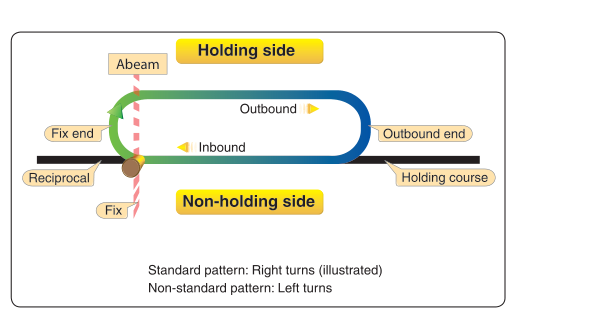
When an aircraft is instructed to hold, it enters a precisely defined racetrack-shaped circuit in the sky, maintaining position until ATC issues a clearance to proceed. One of the first questions that arises in any holding scenario is deceptively simple: which way do you turn? The answer determines every aspect of the pattern — which side of the fix the outbound leg falls on, how you cross the fix on the inbound, and which entry procedure applies. Mastering the distinction between standard and non-standard holding patterns is therefore foundational to instrument flying and a high-frequency topic on the FAA Instrument Rating knowledge test.
This article walks through exactly what makes a pattern "standard" or "non-standard," how turns are executed in each case, how to identify the direction from an ATC clearance, and how entry procedures change depending on direction. It is grounded in the Instrument Flying Handbook (FAA-H-8083-15) and the Aeronautical Information Manual (AIM).
Defining Standard and Non-Standard Patterns
A standard holding pattern uses right-hand turns. This is the default — the FAA assumes right-hand turns unless an ATC clearance explicitly states otherwise. On a standard pattern, the aircraft crosses the holding fix, turns right to the outbound heading, flies the outbound leg, turns right again to intercept the inbound course, and crosses the fix once more. The protected airspace is constructed to the right of the inbound course, which is why understanding the turn direction is critical for obstacle and traffic separation.
A non-standard holding pattern uses left-hand turns. ATC will specifically call out "left turns" in the clearance when a non-standard pattern is required, often because terrain, airspace boundaries, or traffic flow make a right-hand pattern impractical. On a non-standard pattern, both turns — the turn to the outbound and the turn back to the inbound — are made to the left, and the protected airspace falls to the left of the inbound course.
The inbound course itself is always the published or assigned holding course — typically the same track as the final approach course or a specific radial/bearing specified by ATC. Whether the pattern is standard or non-standard does not change the inbound course; it only changes which side of that course the rest of the pattern occupies.
Reading the ATC Holding Clearance
A full ATC holding clearance contains several elements, and the turn direction — if non-standard — appears explicitly. A typical clearance sounds like: "Cessna 452 Foxtrot, hold northeast of the ZONDA intersection on the 045 radial of the ABC VOR, right turns, expect further clearance at 1430, time now 1415." In this example, "right turns" confirms the standard pattern. If the controller says "left turns," the pilot must fly a non-standard pattern. If turn direction is not mentioned at all, assume right turns.
Published holding patterns on instrument approach plates and enroute charts depict the turn direction graphically — a teardrop symbol shows which side of the fix the pattern falls on. The chart legend and the notes block may also include "LT" for left-turn patterns. Always cross-check the chart depiction against any ATC instruction because a published non-standard pattern must still be flown with left turns even if the controller does not repeat that detail in the clearance.
Timing on the Outbound Leg
Regardless of turn direction, the outbound leg timing follows the same rule. At or below 14,000 feet MSL, the outbound leg is flown for one minute. Above 14,000 feet MSL, the outbound leg is one and a half minutes. Timing begins when the aircraft rolls wings-level on the outbound heading after completing the turn outbound from the fix. On subsequent laps, timing begins abeam the fix (when the station passage indicator, DME, or GPS indicates the abeam position).
If a DME or GPS distance is specified instead of time (common in RNAV holding), the outbound leg is defined by mileage rather than timing, and this applies equally to both standard and non-standard patterns.
Entry Procedures and How Direction Affects Them
The famous three holding entries — direct, teardrop, and parallel — are derived geometrically from the relationship between the aircraft's arrival heading and the holding pattern. Because a non-standard (left-turn) pattern is a mirror image of a standard (right-turn) pattern, the entry sectors are also mirrored.
For a standard (right-turn) pattern, the three sectors are:
- Direct entry: Arrival headings that fall within approximately 70° on the non-holding side (right of the inbound course, but left of the reciprocal). The aircraft crosses the fix and turns right to the outbound heading.
- Teardrop entry: Arrival headings within approximately 30° on the holding side of the inbound course, extending from the inbound course to about 30° beyond the outbound course. The aircraft crosses the fix, turns 30° toward the holding side on the outbound, then arcs back to intercept the inbound course with a right turn.
- Parallel entry: Arrival headings on the non-holding (left) side of the inbound course, covering the remaining sector. The aircraft crosses the fix, turns left to fly parallel to the inbound course outbound, then turns left and arcs back to cross the fix and enter the pattern.
For a non-standard (left-turn) pattern, the entire diagram is flipped. The holding side is now to the left, so:
- Direct entry: The aircraft crosses and turns left to the outbound heading.
- Teardrop entry: The aircraft crosses, turns 30° toward the holding side (which is now the left), then arcs back to the inbound course with a left turn.
- Parallel entry: The aircraft crosses, turns right to fly parallel outbound on the non-holding side (now the right), then turns right and arcs back to cross the fix and enter the left-turn pattern.
The key principle is that the holding side drives the entry geometry. Always identify the holding side first — right for standard, left for non-standard — and then apply the three-zone entry diagram to that mirrored picture. Many students who learn entries only in the context of right-hand patterns become confused when a left-hand holding clearance appears on the exam or in the cockpit; the fix is simply to flip the diagram.
Wind Correction in the Holding Pattern
Wind affects outbound timing and track in identical ways regardless of turn direction. The standard guidance is to apply a wind correction angle (WCA) on the outbound heading that is triple the correction required to track the inbound course. For example, if a 5° right crab is needed on the inbound leg, apply a 15° correction on the outbound heading. This triple-correction technique compensates for the fact that the outbound leg and inbound leg are flown in opposite directions, so drift compounds across the full circuit.
Outbound leg timing may also need adjustment. If inbound legs consistently come out long (more than one minute), shorten the outbound. If they come out short, extend the outbound. This self-correcting technique applies identically to both right-turn and left-turn patterns.
Why It Matters for Safety and Airspace
The FAA designs holding pattern protected airspace around the assumption that pilots will turn in the correct direction. Protected airspace accounting for bank angle, airspeed, and wind is only guaranteed on the correct side of the inbound course. A pilot who mistakenly flies right turns in a published left-turn pattern — or who forgets that ATC said "left turns" — exits the protected zone entirely. In mountainous terrain or congested airspace, this mistake can place the aircraft in uncontrolled proximity to terrain, obstacles, or other IFR traffic separated by adjacent airspace boundaries.
Non-standard patterns are assigned precisely when right-hand turns would infringe on terrain, restricted airspace, or conflicting traffic flows. Respecting the direction specification in the clearance is therefore not a procedural technicality — it is a direct safety requirement.
Key Numbers and Rules
- Standard pattern: right turns — the default when no direction is specified.
- Non-standard pattern: left turns — explicitly called out by ATC or published on the chart.
- Outbound leg timing: 1 minute at or below 14,000 ft MSL; 1.5 minutes above 14,000 ft MSL.
- Bank angle: Use the lesser of 3° per second standard rate or 30° of bank at holding speeds.
- Maximum holding airspeed (published): Varies by altitude and aircraft category; always comply with any ATC-assigned or charted speed restriction.
- Entry sectors: Mirrored left-to-right for non-standard patterns — always identify the holding side first.
- Wind correction on outbound: Triple the inbound correction angle.
Common Test Traps
- Assuming right turns when none are specified — correctly. Many questions try to trick students into selecting left turns when the scenario mentions no direction. If ATC or the chart does not specify, the answer is always right turns.
- Forgetting to mirror entry sectors for left-turn patterns. The FAA frequently presents a non-standard holding clearance and asks which entry applies. If you only memorized the right-turn diagram, you will pick the wrong sector. Practice drawing both versions.
- Confusing holding side with turn direction on parallel entry. In a non-standard (left-turn) pattern, the parallel entry requires an initial turn to the right (away from the holding side). Students who memorize "parallel = turn toward the fix side" without understanding the geometry get this backward.
- Applying 1-minute timing above 14,000 feet. The switch to 1.5-minute outbound legs above 14,000 ft MSL is testable and easy to overlook — it applies to both standard and non-standard patterns alike.
- Ignoring the chart when ATC clearance is incomplete. If a holding pattern is published on an approach plate with left turns, you must fly left turns even if the controller's clearance does not repeat that detail. The published procedure governs.