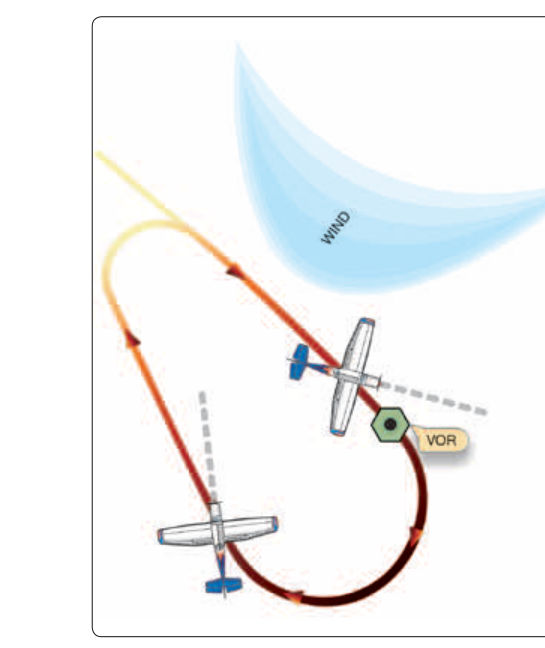
When an instrument-rated pilot hears "hold as published" or "hold at [fix], expect further clearance in twenty minutes," two very different sets of responsibilities come into play. In the first case, a charted holding pattern with pre-defined legs, courses, and turn directions already exists on an approach plate or en route chart. In the second case, the pilot must construct a safe, standard holding pattern from scratch, applying FAA rules to ensure the aircraft stays within protected airspace. Understanding the distinction—and knowing exactly how to execute each type—is a cornerstone of instrument flying and one of the most consistently tested areas on the FAA Instrument Rating knowledge exam.
This article walks through how charted and pilot-selected holding patterns are published, how each is entered and flown, the rules that govern both, and the practical cockpit skills needed to execute them correctly every time.
What Is a Charted Holding Pattern?
A charted holding pattern is a holding pattern that has been formally published on an instrument procedure chart—whether on a Standard Instrument Approach Procedure (SIAP), a Standard Terminal Arrival Route (STAR), a Standard Instrument Departure (SID), or on an en route chart. The FAA designs these patterns to provide known obstacle and terrain clearance within a specific block of airspace, and the depicted parameters are mandatory when ATC issues a "hold as published" clearance.
Charted holds display several explicit pieces of information: the holding fix (a VOR, NDB, waypoint, or intersection), the inbound course (the magnetic course the aircraft flies toward the fix on the inbound leg), the turn direction (right turns are standard; left turns are depicted with a specific notation and symbol), and often the leg length in nautical miles or minutes. When a charted hold is also used as a procedure turn alternative on an approach—sometimes called a "holding-in-lieu-of-procedure-turn"—the chart will show the pattern overlaid on the approach course, and the pilot must remain within the depicted racetrack.
Because the charted pattern is designed by the FAA with specific obstacle-clearance criteria, the pilot must fly it exactly as depicted. Changing the turn direction, flying the outbound leg in the opposite direction, or using a leg length different from what is charted without ATC authorization compromises the protected airspace and can place the aircraft in unprotected territory. If the controller issues "hold as published" and the pilot cannot locate the charted hold on the plate, the correct action is to query ATC immediately rather than guess.
What Is a Pilot-Selected (Unpublished) Holding Pattern?
A pilot-selected holding pattern—also called an unpublished or ATC-assigned holding pattern—occurs when ATC specifies a fix and perhaps a holding course or cardinal direction, but no charted pattern exists. The pilot must then apply the FAA's standard holding rules to construct a legal, protected hold. ATC may say something like: "Cessna 12345, hold east of the BOLEN intersection on the 090 radial, left turns, expect further clearance at 1430 Zulu." Everything not explicitly stated by ATC defaults to standard FAA holding rules.
When ATC does not specify turn direction, right turns are the default. When ATC does not specify leg length, the pilot uses one-minute legs at or below 14,000 feet MSL, and one-and-a-half-minute legs above 14,000 feet MSL. The inbound course is specified by ATC's instruction (e.g., "on the 090 radial" means the inbound course is 090°). The pilot is then responsible for timing the outbound leg correctly so that the inbound leg achieves the target duration, compensating for wind as necessary.
Holding Pattern Entries
Whether the pattern is charted or pilot-selected, the pilot must determine the correct entry procedure based on the aircraft's heading relative to the holding course when crossing the fix. The FAA defines three standard entry types, each protecting the aircraft within the holding pattern's airspace:
- Direct Entry: The aircraft is in the sector roughly on the holding side of the fix (within approximately 180° on the holding side). The pilot flies directly to the fix, makes a turn in the direction of the holding pattern, and proceeds outbound.
- Teardrop Entry: The aircraft is in the non-holding side, heading roughly parallel to the inbound course but pointing away from the fix. The pilot crosses the fix, turns to a heading roughly 30° toward the holding side, flies outbound for approximately one minute, then turns in the direction of the holding to intercept the inbound course.
- Parallel Entry: The aircraft is in the non-holding side, heading roughly the same direction as the inbound course. The pilot crosses the fix, turns to fly parallel to the inbound course in the outbound direction, flies for approximately one minute, then turns across the pattern to intercept the inbound course.
These entry sectors are determined by drawing imaginary lines through the holding fix: one aligned with the inbound course and one at 70° to the inbound course on the holding side, which distinguishes the parallel sector from the teardrop sector. The entry procedure is the same regardless of whether the hold is charted or pilot-selected—the entry type depends entirely on the aircraft's heading relative to the holding course when crossing the fix.
Airspeed Limits for Holding
The FAA establishes maximum airspeeds for holding to ensure the aircraft remains within the protected airspace. These are specified in the AIM and are commonly tested:
- At or below 6,000 feet MSL: 200 KIAS maximum
- Above 6,000 feet MSL up to and including 14,000 feet MSL: 230 KIAS maximum
- Above 14,000 feet MSL: 265 KIAS maximum
Civil aircraft that cannot comply with these speeds must advise ATC. These limits exist because holding pattern airspace is designed around known bank angles and turning radii; exceeding the limits causes the aircraft to bust the protected boundary. On charted holds, specific maximum airspeeds are sometimes depicted directly on the chart with a notation like "(MAX 200 KIAS)"—these depicted limits take precedence.
Wind Corrections in Holding
One practical skill that separates proficient instrument pilots from those who merely pass the test is the ability to compensate for wind in a hold. On the outbound leg, the pilot applies triple the inbound wind correction angle on the outbound heading to pre-correct for wind drift. For example, if the pilot needed a 5° left correction on the inbound leg to track the course, the outbound heading should be adjusted 15° into the wind. This technique, described in the Instrument Flying Handbook, helps set up a well-tracked inbound leg. Leg timing is also adjusted on the outbound side: if the inbound leg took more than one minute (due to a headwind), the pilot shortens the outbound leg; if less than one minute (tailwind), the pilot lengthens it.
Why the Distinction Matters
The charted vs. pilot-selected distinction has significant safety and legal implications. A charted hold carries the FAA's guarantee of obstacle clearance within the depicted pattern—but only when flown exactly as charted. A pilot-selected hold relies on the pilot applying standard rules correctly; any deviation from standard dimensions without compensating for wind or without ATC authorization can push the aircraft outside the protected area. During real-world IMC operations near mountainous terrain or complex airspace, this distinction can be the difference between a safe hold and a controlled flight into terrain.
From an ATC coordination standpoint, when ATC anticipates that a pilot may be delayed in a hold beyond a clearance limit, the controller issues an Expect Further Clearance (EFC) time before the aircraft reaches the fix. This is critical: if two-way radio communications are lost, the pilot uses the EFC time to determine when to leave the hold and continue the flight using the lost-communications procedures outlined in 14 CFR 91.185. Without an EFC, the pilot has no reliable way to plan a lost-comms departure from the hold.
Key Numbers and Rules
- Standard holding uses right turns; left turns must be explicitly authorized or charted.
- Standard leg length: 1 minute at or below 14,000 feet MSL; 1.5 minutes above 14,000 feet MSL.
- Maximum holding airspeeds: 200 KIAS (≤6,000 ft), 230 KIAS (6,001–14,000 ft), 265 KIAS (above 14,000 ft).
- Outbound wind correction is triple the inbound correction angle.
- "Hold as published" requires flying the charted parameters exactly—no modifications without ATC.
- ATC issues an EFC time whenever a pilot may be held beyond a clearance limit; lost comms procedure hinges on this time per 14 CFR 91.185.
- When ATC assigns holding and no charted pattern exists, all unspecified parameters default to standard FAA rules.
Memory Aid
For remembering the three entry types and their sectors, many instructors use the phrase "Direct, Parallel, Teardrop — remember your DPT" combined with visualizing the holding fix as the center of a clock: the inbound course points to 6 o'clock, and the 70° offset line divides the clock face. This mental image helps quickly identify which sector the aircraft is in when crossing the fix, making entry selection reliable even under workload.
Common Test Traps
- Assuming right turns when left turns are charted: If the approach plate depicts left-turn holding, you must fly left turns regardless of the standard. Always verify the published turn direction before flying a charted hold.
- Using one-minute legs above 14,000 feet: The exam often tests the 1.5-minute leg length rule above 14,000 feet MSL. Using one minute in that altitude range puts the aircraft outside protected airspace.
- Confusing the inbound course with the outbound heading: The inbound course is the track toward the fix; the outbound heading is the reciprocal plus any wind correction. These are not the same number, and the FAA test exploits this confusion.
- Ignoring the EFC time requirement: A question may ask what happens if ATC does not provide an EFC time when a delay beyond a clearance limit is expected, or what the pilot should do in lost comms. The answer flows directly from 14 CFR 91.185; not understanding EFC leads to wrong answers.
- Changing a charted hold parameter without authorization: Some students assume that if winds are strong, they can widen the pattern or extend the outbound leg beyond what is charted. In a "hold as published" clearance, this is not permitted without ATC coordination—the hold's obstacle clearance depends on flying within the depicted boundary.