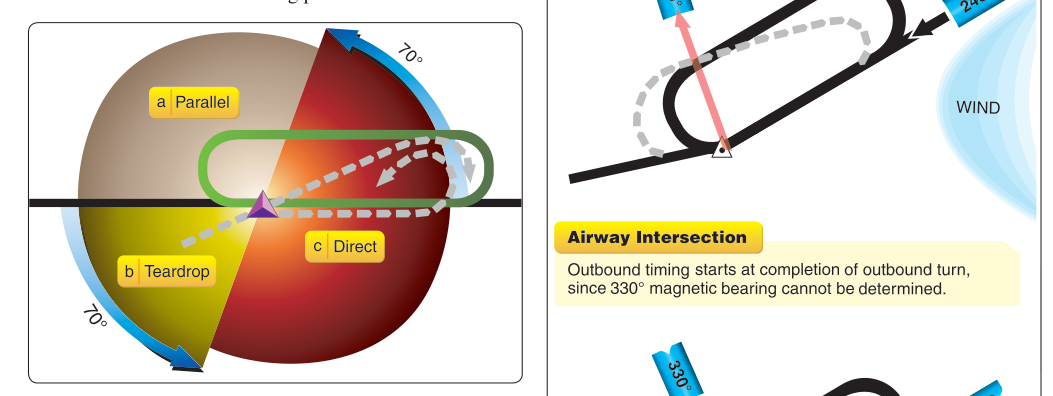
When ATC issues a holding clearance, your immediate job is to figure out how to enter the holding pattern in a way that keeps you within protected airspace and sets you up for a smooth, stabilized circuit. The FAA defines three standard entry procedures—direct, teardrop, and parallel—each designed for a specific range of arrival headings relative to the holding fix. Understanding the geometry behind each entry, not just memorizing which sector triggers which procedure, is what separates a pilot who can adapt in the cockpit from one who freezes when the fix is overhead.
This article walks through the mechanics of each entry, the sector boundaries that govern them, the timing and bank angle standards that apply, and the common traps the FAA knowledge test loves to exploit. All of the material is grounded in FAA Instrument Flying Handbook (FAA-H-8083-15) guidance and AIM Chapter 5.
Anatomy of a Holding Pattern
Before tackling entries, it helps to be precise about terminology. A standard holding pattern is a racetrack-shaped circuit flown to the right (all turns right) unless ATC specifies non-standard (left turns). The pattern has four segments: the inbound leg (the leg you want to time, ideally 1 minute below 14,000 feet MSL, 1.5 minutes at or above), the outbound leg (timed or DME-defined), and two 180-degree turns connecting them. The holding fix is the navigation point over which you cross at the beginning of each inbound leg. The holding side is the side of the inbound course on which the pattern lies. Visualizing these elements clearly is the foundation for understanding entries.
The Three Sectors and How to Determine Your Entry
The FAA divides the airspace around a holding fix into three sectors based on your arrival heading — the magnetic heading you are flying as you approach the fix. Draw a mental picture of the holding fix with the inbound course pointing toward you. The holding pattern extends to one side of that inbound course. Two lines drawn from the fix divide the surrounding 360 degrees into three zones:
- Sector 1 (Direct Entry): The largest sector, encompassing roughly 180 degrees on the holding side of the fix. If your arrival heading falls within this sector, you fly directly to the fix, turn to the outbound heading, and enter the pattern.
- Sector 2 (Teardrop Entry): A 70-degree sector on the non-holding side, measured from the inbound course. Arrival headings in this region call for a teardrop procedure.
- Sector 3 (Parallel Entry): The remaining roughly 110-degree sector on the non-holding side, between the teardrop sector and the holding side. Arrival headings here call for a parallel procedure.
In practice, the boundaries are drawn at 70 degrees from the inbound course on the non-holding side (separating teardrop from parallel) and at the inbound course extended (separating the holding-side direct sector from the non-holding side). The FAA does not require absolute precision at sector boundaries — a few degrees of difference does not create a safety issue — but you do need to correctly identify which sector you are in to choose the right entry.
The Direct Entry
The direct entry is the simplest. As you cross the holding fix, you immediately turn toward the holding side and fly the outbound leg. Because you are arriving from the holding side of the pattern, a simple turn puts you into the circuit with minimal overshoot. The turn direction is always toward the holding side: in a standard (right-turn) pattern, you turn right onto the outbound heading; in a non-standard (left-turn) pattern, you turn left.
One detail pilots sometimes miss: depending on exactly where your arrival heading falls within Sector 1, the outbound turn may be more than 180 degrees. For example, if you arrive nearly parallel to the inbound course but from the holding side, you might need to turn almost 270 degrees before rolling out on the outbound leg. That is still correct — the direct entry simply means turn toward the holding side and proceed, however large that turn must be.
The Teardrop Entry
The teardrop entry applies when you arrive in Sector 2 — the 70-degree wedge on the non-holding side, adjacent to the inbound course. Fly to the fix, then turn to a heading that is approximately 30 degrees toward the holding side of the outbound course, and fly outbound for the appropriate time (typically 1 minute or 1.5 minutes, depending on altitude). Then turn in the direction of the holding pattern (right for standard) through approximately 210 degrees to intercept the inbound course.
The teardrop is essentially a modified outbound leg that angles you back across the protected airspace so you intercept the inbound course from the correct side. The 30-degree offset is a practical guideline — the actual angle may be adjusted slightly based on wind — but 30 degrees is the number the FAA tests on. Think of drawing a teardrop shape: you angle inward on the outbound leg, then sweep around to line up inbound. This entry works because your arrival heading makes a simple direct entry impractical without departing protected airspace.
The Parallel Entry
The parallel entry is used when you arrive in Sector 3 — on the non-holding side but outside the teardrop sector. Cross the fix, then turn to fly parallel to the inbound course but in the outbound direction (away from the fix) on the non-holding side. Fly outbound for the appropriate time, then make a turn toward the holding side (more than 180 degrees for a standard pattern) to cross back over or near the fix and intercept the inbound course.
The parallel entry can feel counterintuitive because you are initially flying away from the holding pattern. The key insight is that your arrival heading is such that neither a direct turn nor a teardrop would put you cleanly into the inbound course — the parallel outbound leg gives you the time and geometry to arc back around to the correct side. After the outbound timed leg, turn right (for a standard right-turn pattern) more than 180 degrees — often described as turning to intercept the inbound course from the non-holding side, crossing near the fix, and then joining the pattern normally.
Wind Corrections in Holding
Once established in the pattern, you must correct for wind to keep the inbound leg at the target time. The AIM recommends tripling the inbound correction on the outbound leg as a starting point. For example, if wind requires a 10-degree wind correction angle on the inbound leg to track the course, apply a 30-degree correction on the outbound leg. Adjust each circuit based on observed timing — if your inbound leg was long (too much time), shorten the outbound leg; if short, lengthen it. Bank angle in holding is limited to 3 degrees per second standard rate turn, or up to 30 degrees of bank, whichever is less — the FAA specifies standard rate turns in holding.
Key Numbers and Rules
- Standard holding turn direction: Right (unless ATC specifies non-standard left turns).
- Inbound leg timing: 1 minute at or below 14,000 feet MSL; 1.5 minutes above 14,000 feet MSL.
- Teardrop offset: approximately 30 degrees toward the holding side of the outbound course.
- Sector 2 (teardrop) size: 70 degrees, measured from the inbound course on the non-holding side.
- Maximum holding airspeed: per AIM 5-3-8, varies by altitude — up to 200 KIAS at or below 6,000 feet MSL; up to 230 KIAS between 6,001 and 14,000 feet; up to 265 KIAS above 14,000 feet (published holding fixes may have their own charted speeds, and military turbojet aircraft may operate under different limits).
- Bank angle: Standard rate or 30 degrees maximum, whichever requires less bank.
- EFC time: ATC must issue an expect further clearance time when a delay is anticipated; this is your missed-approach/emergency planning reference.
Memory Aid
A widely-used mnemonic for remembering which entry goes in which sector is the «HIT» framework combined with a clock-face visualization, but the most reliable method most instrument instructors teach is the «pencil on the chart» technique: draw the holding pattern on your chart or scratch pad, draw your arrival heading into the fix, then ask yourself — does my arrival heading put me on the holding side (direct), in the 70-degree non-holding wedge near the inbound course (teardrop), or in the remaining non-holding area (parallel)? This physical drawing step slows you down enough to avoid the most common sector mis-identification errors and is far more dependable than any verbal mnemonic under cockpit workload.
Common Test Traps
- Forgetting non-standard (left-turn) patterns: All three entry sectors mirror when the pattern uses left turns. The geometry is identical but the holding side flips, changing which entry applies for a given arrival heading.
- Mis-identifying the holding side: The holding side is where the turns take place, not necessarily the right side of the inbound course. In a non-standard pattern, the holding side is left of the inbound course.
- Confusing the teardrop angle: The 30-degree offset is measured from the outbound course toward the holding side — not from the inbound course, and not 30 degrees off your arrival heading.
- Applying wrong timing: The 1 vs. 1.5-minute rule is based on altitude of the holding fix — at or below 14,000 feet MSL uses 1 minute; test questions sometimes reverse the threshold.
- Ignoring the EFC requirement: Test questions may ask what you should do if you lose communications while holding. Without an EFC time issued by ATC, you must depart the fix at your best estimate of when a clearance would have been issued — understanding EFC is part of the holding picture.