Most student pilots learn to calculate weight and balance before engine start and consider the job done. But weight and balance is not a static snapshot — it is a living condition that changes throughout every flight. As your engine consumes fuel, the total weight of the aircraft decreases, and — critically — the center of gravity (CG) shifts to a new location. Depending on where the fuel tanks are positioned relative to the aircraft's datum and CG envelope, that shift can move the CG forward, aft, or keep it relatively stable. Understanding this dynamic process is not just an exam topic; it directly determines whether your aircraft remains controllable from takeoff to landing.
This article walks through the mechanics of CG movement during fuel burn, explains why some scenarios create dangerous aft-CG conditions near the end of flight, and gives you the tools to evaluate any loading situation with confidence.
Center of Gravity: A Quick Foundation
The center of gravity is the single point at which the aircraft's total weight is considered to act. The FAA's Pilot's Handbook of Aeronautical Knowledge (PHAK) describes CG as the point around which all moments are balanced. For an aircraft to remain controllable, the CG must stay within the forward and aft limits published in the Pilot's Operating Handbook (POH) or Airplane Flight Manual (AFM) for all phases of flight — including landing, which occurs after a significant portion of fuel has been consumed.
A moment is simply weight multiplied by its arm (the distance from the datum). When fuel burns, both the weight contribution of the fuel and its moment are removed from the running total. Whether the CG moves forward or aft depends entirely on the arm of the fuel tanks compared to the current CG location.
How Fuel Burn Moves the CG
The fundamental rule is straightforward: if the fuel tank's arm is ahead of (forward of) the current CG, burning fuel moves the CG aft. If the tank's arm is behind (aft of) the current CG, burning fuel moves the CG forward. If the tank arm happens to coincide with the CG, burning fuel does not change the CG location — though this is rarely the case in practice.
Here is the logic in plain math terms. Suppose an aircraft has a current CG at station 42.0 inches, and the main fuel tanks are located at station 38.0 inches (forward of the CG). As fuel burns, you are removing weight and moment from a point that is ahead of the balance point. With the front-heavy influence of the fuel gone, the remaining weight distribution tilts relatively aft, and the CG moves rearward.
Conversely, if the tanks are located at station 48.0 inches — behind the CG — burning that fuel removes the aft-biased moment, and the CG drifts forward as fuel decreases.
A Worked Example
Imagine a simple aircraft loaded as follows at takeoff:
- Empty weight CG: station 41.5 in, weight 1,450 lb
- Pilot and passenger: station 37.0 in, 340 lb total
- Fuel (full, 40 gal × 6 lb/gal = 240 lb): station 48.0 in
- Baggage: station 60.0 in, 30 lb
Total takeoff weight: 2,060 lb. You would compute total moment and divide by total weight to find the takeoff CG — let's say it falls at station 42.8 inches, comfortably within limits.
Now suppose you land with only 5 gallons remaining (30 lb of fuel at station 48.0 in). You have burned 210 lb of fuel located aft of the takeoff CG. Recalculate total moment and weight for the landing condition: total weight drops to 1,850 lb, and the reduced aft moment from the nearly empty tanks pulls the CG forward. In this particular scenario the CG moves forward, which is benign. But flip the tank location: if those tanks were at station 36.0 inches, burning fuel would progressively move the CG aft — potentially toward or beyond the aft limit by the time you land.
This is why the POH weight and balance section often requires you to check both the takeoff condition and the landing (minimum fuel) condition on the CG envelope chart. An aircraft can be loaded legally at takeoff and become dangerously out of limits an hour later.
Why CG Position Matters So Much
CG position determines the relationship between the aircraft's lift and weight vectors and governs how much the horizontal stabilizer and elevator must work to maintain level flight.
- Forward CG: The nose-heavy tendency requires more back-pressure (up elevator) to maintain level flight. Stall speed increases slightly, but the aircraft is more stable longitudinally. Forward CG improves resistance to accidental stalls and spins. The risk is insufficient elevator authority to flare during landing, particularly at slow approach speeds.
- Aft CG: The aircraft becomes more pitch-sensitive and less stable. The pilot must apply more precise, smaller inputs. Stall speed decreases slightly, but critically, recovery from a stall or spin becomes progressively more difficult — and may be impossible if the CG exceeds the published aft limit. The PHAK notes that an excessively aft CG can render an aircraft unrecoverable from an inadvertent spin.
Because fuel burn commonly moves the CG aft in many high-wing Cessna-style designs (where tanks are in the wings near or slightly forward of the CG) and in aircraft with auxiliary tanks located further aft, the landing condition frequently represents the more critical CG scenario even though total weight is lower.
Aircraft-Specific Tank Configurations
Every aircraft has a unique tank layout, and you must consult the POH for your specific make and model. Common configurations include:
- Wing tanks in high-wing aircraft: Tank arms are often close to the datum, sometimes ahead of and sometimes near the CG. CG movement with fuel burn varies by model.
- Wing tanks in low-wing aircraft: Similar variability. Many low-wing aircraft have tanks whose arms fall close to the loaded CG, producing relatively small CG movement throughout flight.
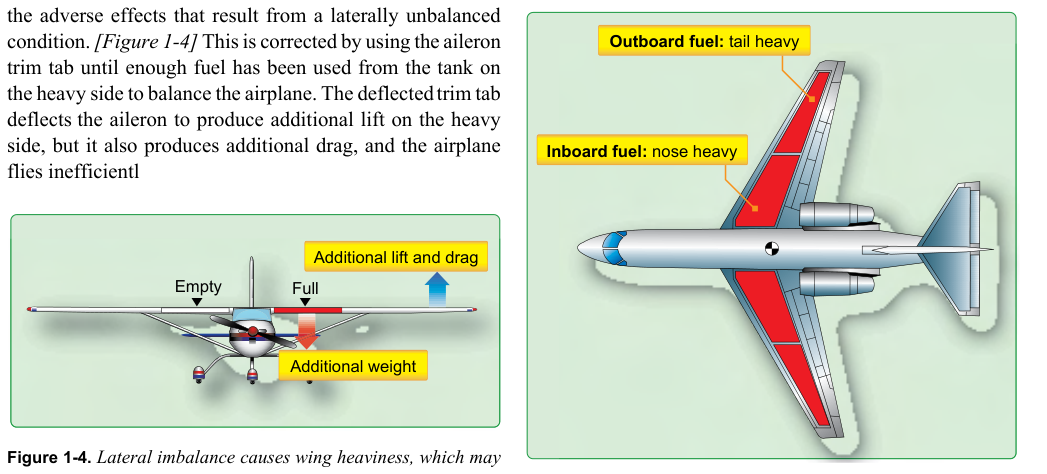
- Tip tanks: Located at the far outboard wing station. Their arm relative to the CG can be significantly forward or aft depending on the aircraft design. Burning tip tanks can cause noticeable CG shifts.
- Fuselage or belly tanks: These may be located well aft of the normal CG, so burning them moves CG forward — which may be desirable after heavy aft loading.
- Auxiliary tanks: Often added to extend range. If located aft, they may push the CG aft when full and release it forward as they burn, or the opposite if they are forward-located. Always confirm with the AFM/POH supplement.
Key Numbers and Rules
- Aviation gasoline (avgas) weighs 6 pounds per gallon — this is the standard value used in all weight and balance calculations unless the POH specifies otherwise.
- Jet-A fuel weighs approximately 6.7–6.8 pounds per gallon (used in turbine aircraft; not typically tested on the Private Pilot written but good context).
- You must verify CG is within limits for all critical phases of flight — at minimum, check the takeoff (maximum fuel) condition and the landing (minimum/reserve fuel) condition.
- CG limits are published in the POH/AFM and are expressed as a range of stations (in inches from the datum) at given weights. The envelope narrows as weight decreases in many aircraft.
- Under 14 CFR Part 91, the pilot in command is responsible for ensuring the aircraft is loaded within limits before each flight — this responsibility does not transfer to a dispatcher or FBO.
- If an aircraft has a symmetric fuel system (tank on each wing), fuel should be used symmetrically to prevent lateral CG imbalance, which creates a rolling tendency the ailerons must continuously correct.
Practical Planning Steps
When performing your preflight weight and balance calculation, make it a habit to run two scenarios: one with full fuel (or planned takeoff fuel) and one with only the FAA-required fuel reserve remaining. For VFR day flight, the reserve is fuel sufficient to fly at least 30 minutes beyond your destination at normal cruise power under 14 CFR 91.151. For VFR night flight, the reserve extends to 45 minutes. Use these minimum fuel quantities to represent your worst-case landing condition and plot both points on the CG envelope.
If either point falls outside the envelope — or uncomfortably close to the aft limit — adjust your loading before departure. Options include reducing baggage, repositioning passengers, or departing with less than full fuel (while still meeting reserve requirements) if doing so improves the CG picture for landing.
Common Test Traps
- Assuming takeoff CG equals landing CG. The FAA knowledge test frequently presents a scenario where the aircraft is within limits at takeoff but the question asks about the CG after fuel burn. Always recalculate for the landing condition.
- Forgetting to convert gallons to pounds. Fuel quantity is often given in gallons in the scenario. Always multiply by 6 lb/gal (avgas) before computing moments.
- Assuming lighter always means safer. A lighter aircraft at landing is not automatically safer — if the CG has moved aft into a dangerous region, the reduced weight makes matters worse, not better, because the aft CG effects on stability and spin recovery are independent of gross weight.
- Ignoring the narrowing envelope. Many aircraft CG envelopes taper at lower weights, meaning the allowable CG range actually shrinks as fuel burns. A CG that was legal at takeoff weight may fall outside the forward limit at a lower landing weight, even if it moved aft slightly — this is a less common but very real trap.
- Treating the fuel arm as the same as the CG arm. Students sometimes assume fuel burns with no CG change because they do not account for the difference in location between the tank arm and the aircraft's loaded CG. Always compare the two arms before predicting CG movement direction.