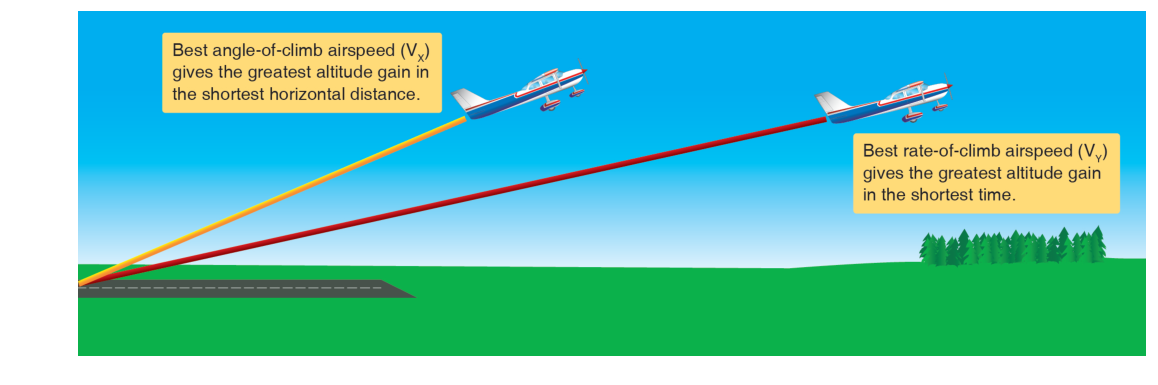
Every pilot eventually faces a question that sounds simple but has real safety consequences: how do you get the airplane climbing as efficiently as possible? The answer depends on what you mean by "efficient." Two FAA-defined airspeeds — Vx (best angle of climb) and Vy (best rate of climb) — each solve a different problem, and choosing the wrong one at the wrong moment can leave you skimming a tree line or watching an engine overheat. Understanding the aerodynamic logic behind these speeds, not just the numbers themselves, will make you a safer pilot and help you ace the FAA knowledge test.
This article covers the physics of climb performance, how Vx and Vy are derived from the airplane's power and drag curves, when to use each in actual flight, how weight and altitude affect both speeds, and the most common traps the FAA uses to catch unprepared students.
The Physics of Climbing Flight
An airplane climbs because thrust exceeds drag. The excess thrust — the energy left over after drag is overcome — is available to raise the airplane's potential energy (altitude). This concept is central to understanding both Vx and Vy.
There are two ways to measure climb "efficiency." First, you can measure how much altitude you gain for every foot of horizontal distance traveled — that is climb angle. Second, you can measure how many feet of altitude you gain every minute — that is climb rate. These two goals require different airspeeds because the relationship between thrust, drag, and airspeed is curved, not linear.
At very low airspeeds, induced drag (the drag created by generating lift) is extremely high. At very high airspeeds, parasite drag (skin friction, form drag, and interference drag) dominates. Between these extremes lies the L/D MAX speed, where the ratio of lift to drag peaks. The power available from the engine also changes with airspeed and throttle setting, and the difference between power available and power required — called excess power — is what ultimately determines climb rate.
Best Angle of Climb: Vx
Vx is the airspeed that produces the greatest gain in altitude for the least horizontal distance. In practical terms, Vx gets you over an obstacle in the shortest horizontal space. It is flown at a steeper nose-high attitude than Vy, and it results in a slower ground speed.
Aerodynamically, Vx occurs at the airspeed where the difference between thrust available and thrust required (excess thrust) is greatest. On a thrust vs. airspeed graph, Vx sits at the point where that gap is widest. Note that this thrust-curve explanation is a simplified model commonly used for propeller aircraft; the precise shape of the thrust and power curves differs between propeller and jet aircraft, but the underlying principle — Vx corresponds to maximum excess thrust — holds for explaining the concept at the private pilot level. For most normally-aspirated piston singles, Vx is noticeably slower than Vy — often 5 to 15 knots slower, depending on the design. Check your Pilot's Operating Handbook (POH) for the exact figures for your specific aircraft.
The tradeoff at Vx is significant: the airplane is flying slowly with a high angle of attack, engine cooling airflow is reduced, and visibility over the nose is limited. Vx should therefore be used only for as long as necessary — typically until you have cleared the obstacle or reached a safe altitude — then you should accelerate to Vy or cruise climb speed.
Best Rate of Climb: Vy
Vy is the airspeed that produces the greatest gain in altitude per unit of time (feet per minute). It is the speed most pilots use for normal climbs because it gets you to your cruising altitude in the least time, keeps engine temperatures in a healthier range than Vx, and provides a better forward view.
Aerodynamically, Vy occurs where the difference between power available and power required (excess power) is greatest. On a power vs. airspeed graph, Vy sits at the peak of the excess power curve. Because power and thrust differ in their relationships with airspeed, Vy is always faster than Vx for normally-aspirated aircraft at the same conditions.
Most light trainer aircraft have a published Vy somewhere in the 70–85 knot range, though this varies widely by aircraft model. Again, always confirm the value in your POH — the FAA knowledge test uses specific POH data for performance questions, and the published value for a given aircraft is the authoritative number.
How Altitude Affects Vx and Vy
Here is a concept that surprises many students: Vx increases slightly with altitude, while Vy decreases slightly with altitude. As a result, the two speeds converge as you climb. At a specific altitude — called the absolute ceiling — Vx and Vy meet. At that altitude, there is only one airspeed that will sustain level flight, and the airplane cannot climb at all.
In practice, the more relevant number is the service ceiling, which is commonly defined, per the Pilot's Handbook of Aeronautical Knowledge, as the altitude at which the airplane's maximum rate of climb is 100 feet per minute. This 100 fpm figure is the standard textbook convention for most light aircraft rather than a fixed universal regulatory value, and some sources or aircraft may reference different criteria. Well before reaching the absolute ceiling, the pilot notices that even at Vy, the climb rate is sluggish and the airplane feels "mushy."
This convergence also explains why, for turbocharged or turbine aircraft, the relationship between Vx and Vy behaves differently — the turbocharger maintains sea-level manifold pressure to a certain altitude (the critical altitude), so the curves shift. For the private pilot exam, the key takeaway is the convergence behavior: Vx goes up, Vy goes down, they meet at the absolute ceiling.
Effect of Weight on Climb Performance
Heavier airplanes climb more poorly. Increased weight means more induced drag (because the wing must generate more lift), which shifts both Vx and Vy to higher airspeeds and reduces the excess thrust and excess power available. The practical result: climb rate decreases, climb angle decreases, and the airplane needs more runway and more horizontal distance to clear obstacles. This is why the FAA's performance charts in the POH are typically based on maximum gross weight — a student who interpolates chart values correctly for actual weight will find better numbers than the chart's worst-case, but must use chart inputs accurately.
Cruise Climb
A third common climb technique — not defined by a single FAA designator like Vx or Vy, but addressed in the Airplane Flying Handbook — is the cruise climb. This is a higher-speed climb (typically 5–10 knots faster than Vy) that sacrifices some climb rate in exchange for better engine cooling, improved forward visibility, and faster en-route progress. Instructors commonly use cruise climb for extended climbs en route. It is not used for obstacle clearance or maximum efficiency — just a practical compromise for comfort and engine longevity.
Why It Matters: Real-World Consequences
Selecting the wrong climb speed in a critical situation is genuinely dangerous. Consider a short-field takeoff from a mountain strip with trees at the departure end. Using Vy instead of Vx means the airplane travels more horizontal distance before reaching obstacle-clearing altitude — potentially into the trees. Conversely, using Vx for an extended climb on a hot day with a heavy load risks engine overheating, reduced airflow over the cowling, and a deteriorating climb rate that could leave you in a dangerous nose-high, low-energy state.
The FAA's Airplane Flying Handbook (FAA-H-8083-3) specifically addresses these scenarios in its takeoff and departure climb sections. Short-field and obstacle-clearance procedures call for Vx until clear of obstacles, then a transition to Vy. Normal takeoff procedures recommend accelerating to Vy shortly after liftoff and maintaining it throughout the climb to cruise altitude.
Key Numbers and Rules
- Vx = best angle of climb; maximum altitude gained per horizontal distance; used for obstacle clearance.
- Vy = best rate of climb; maximum altitude gained per unit of time (fpm); used for normal climbs.
- Vx is always slower than Vy for normally-aspirated aircraft at sea level.
- Vx increases with altitude; Vy decreases with altitude — they converge at the absolute ceiling.
- Service ceiling: altitude where maximum climb rate equals 100 fpm (the standard PHAK convention for most light aircraft).
- Absolute ceiling: altitude where Vx = Vy and climb rate = 0 fpm.
- Increased weight raises both Vx and Vy slightly and reduces overall climb performance.
- Always verify Vx and Vy from the specific aircraft's POH — these numbers vary by aircraft model and configuration (e.g., flaps up vs. flaps down).
Memory Aid
A widely-used memory device: think of the letters themselves. Vx — "X" marks the spot on the ground (shortest ground distance to clear an obstacle). Vy — "Y" points upward (fastest climb up per minute of time). While not an official FAA mnemonic, this visual association is reliable and consistent with how the POH defines each speed. Another version: "X for eXit over the fence, Y for whY am I not at altitude yet?"
Common Test Traps
- Confusing angle with rate: The FAA frequently asks which speed to use for "clearing an obstacle" (Vx) versus "reaching cruise altitude in the shortest time" (Vy). The words "angle" and "distance" signal Vx; "rate" and "time" signal Vy.
- Altitude effect reversal: Students often say "Vx decreases with altitude" — the opposite is true. Vx increases; Vy decreases. They meet at the absolute ceiling.
- Assuming Vx and Vy are fixed: Both speeds change with altitude, weight, and configuration (flaps, gear). Always use POH data for the specific flight conditions.
- Confusing service ceiling and absolute ceiling: Service ceiling is where climb rate drops to 100 fpm; absolute ceiling is where it reaches 0. The FAA tests both definitions.
- Ignoring configuration: Vx and Vy values published in most POHs assume a clean configuration (flaps up, gear up if retractable). Using flaps inappropriately during a climb degrades performance from the published values.