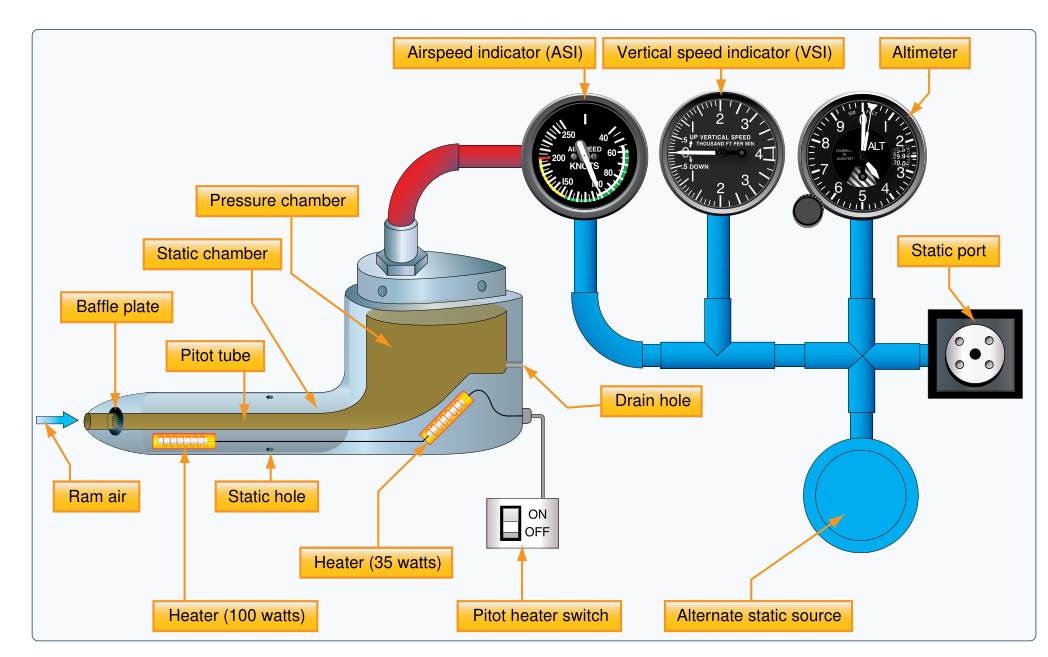
Every pilot relies on the pitot-static instrument system for three of the most critical flight instruments in the cockpit: the airspeed indicator, the altimeter, and the vertical speed indicator (VSI). All three derive their indications from air pressure — either ram air from the pitot tube, static air pressure from the static ports, or both. If the static portion of that system develops a leak, every one of those instruments will feed the pilot inaccurate information, potentially with fatal consequences. For aircraft maintenance technicians (AMTs), understanding and properly performing a static system leak test is therefore not just a regulatory requirement — it is a fundamental safety responsibility.
This article covers the regulatory basis for static system leak testing, the physics that make the test work, the step-by-step procedure, acceptable leakage limits, common failure points, and the traps that appear on the FAA Airframe Knowledge Test.
Regulatory Basis for Static System Leak Testing
Title 14 CFR Part 91, Section 91.411 establishes the overarching requirement: no person may operate an airplane or helicopter in controlled airspace under instrument flight rules (IFR) unless the static pressure system, altimeter, and automatic pressure altitude reporting equipment have been tested and inspected within the preceding 24 calendar months. That test must be performed in accordance with 14 CFR Part 43, Appendix E by an appropriately certificated repair station or a certificated mechanic holding an airframe rating — there is no separate "instrument rating" for mechanics — but AMTs performing maintenance must understand when a fresh leak test is required even outside the 24-month cycle.
Specifically, 14 CFR Part 43, Appendix E sets out the standards for the altimeter and static system tests. Any time the static system is opened — meaning any line, fitting, or component in the static plumbing is disconnected or disturbed — the system must be tested for leaks before the aircraft is returned to IFR service. This includes situations such as replacing a static port, replacing or repairing static lines, installing a new altimeter or VSI, routing wiring that required disturbing static tubing, or performing an avionics upgrade that touches the static system. The AMT must also annotate the maintenance record with the date of the test, the result, and the name and certificate number of the person performing the work, in accordance with 14 CFR Part 43.9.
How the Static System Works
Before testing, it helps to understand what you are protecting. The static system consists of one or more static ports — small flush openings on the fuselage skin, usually located aft of the cabin on both sides — connected by tubing to the three pitot-static instruments. The ports sense ambient (outside) atmospheric pressure. As the aircraft climbs, atmospheric pressure decreases; the altimeter interprets that pressure decrease as an increase in altitude. The VSI measures the rate of pressure change. The airspeed indicator compares static pressure to ram (pitot) pressure to determine airspeed.
If the static system has a leak, outside air at a pressure slightly different from true static pressure can enter the system — or the sealed pressure inside the system during testing can escape. Even a tiny leak path changes the reference pressure seen by all three instruments simultaneously. A leak in the cockpit area, for example, tends to feed cabin pressure (which is often slightly higher than ambient at altitude in pressurized or partially sealed fuselages) into the system, causing the altimeter to read lower than actual altitude — a dangerous error on an approach.
Equipment Required
The leak test requires a static system tester, sometimes called a pitot-static tester or a manometer-based test set. These are calibrated devices that connect to the static port(s) and allow the technician to apply a precise vacuum (reduced pressure) to simulate altitude, then monitor whether that vacuum holds. Common shop equipment includes dedicated pitot-static ramp testers with digital displays, or simpler hand-pump devices with calibrated gauges. The key feature is the ability to both apply a known pressure differential and measure any decay in that differential over time.
You will also need appropriate adapters to seal the static ports without damaging them, along with tubing to connect the test set. On aircraft with alternate static sources, the alternate source valve must be in the normal (primary) static position during the test, or both positions must be tested per the aircraft maintenance manual (AMM). On aircraft with a static system drain, ensure the drain is closed before testing.
Step-by-Step Leak Test Procedure
While specific steps vary by aircraft model — always consult the AMM — the general FAA-prescribed procedure follows this sequence:
- Prepare the aircraft. Ensure all pitot-static instrument connections are secure and that any previously disturbed fittings have been properly reinstalled. Make certain the cockpit static source valve (if installed) is in the correct position per the AMM.
- Seal or connect the pitot system separately. If the test set connects only to the static system, cap the pitot tube to prevent accidental pressurization of the pitot instruments. If using a combined pitot-static tester, connect as a complete system per the tester's operating instructions.
- Connect the test set to the static ports. Using the correct adapters, seal all static ports and connect the test set tubing. On twin-port static systems (one port per side), both ports must be connected and sealed.
- Evacuate the system to simulate altitude. Slowly apply a vacuum equivalent to 1,000 feet above the aircraft's current field elevation, or as specified in the AMM. Do this slowly — typically no faster than 100 feet per second as indicated on the altimeter — to avoid damaging the instruments, especially the VSI capsule, which is sensitive to rapid pressure changes.
- Stabilize and then isolate the test set. Allow the system pressure to stabilize for approximately one minute before closing the test set valve to isolate the system from the pump.
- Monitor for leakage. With the system isolated, observe the altimeter reading for one minute. Per 14 CFR Part 43, Appendix E, the maximum allowable leakage for unpressurized aircraft is a loss of no more than 100 feet of indicated altitude in one minute. For pressurized aircraft, the standard is more stringent and varies with certification, so always consult the specific AMM.
- Slowly release the vacuum. After the test — pass or fail — gradually restore pressure to ambient. Again, do this slowly to protect the VSI capsule.
- Inspect for leaks if the system fails. If the altimeter drops more than 100 feet in one minute, methodically trace the static lines, checking all fittings, connections, drain valves, and instrument connections. A common technique is to use a slightly soapy water solution at suspected joints while under vacuum — bubbles indicate the leak path. Never use compressed air to pressurize (rather than evacuate) the static system, as over-pressurization can destroy instrument capsules.
Common Leak Locations
Experience shows that certain areas are most prone to leaks. Instrument connections at the back of the altimeter, VSI, and airspeed indicator are frequent culprits, especially after any avionics work where instruments were bumped or jostled. Fitting unions in the static tubing, particularly if the aircraft uses older compression-type fittings or if the tubing has age-related brittleness, are another common failure point. Static ports themselves can develop leaks if the mounting hardware is not properly torqued or if the port sealing gasket has degraded. Finally, alternate static source valves can pass air if their seals are worn, allowing cockpit air to contaminate the primary static system.
Why It Matters: Safety and Certification
An undetected static system leak can cause insidious instrument errors — the kind that build gradually and may not be noticed until a pilot is deep inside the clouds. A leaking static system tends to cause the altimeter to lag behind actual altitude changes, VSI to display false trends, and airspeed to read inaccurately. In a non-radar environment on an IFR approach, even a 100–200 foot altimeter error can place an aircraft below a minimum descent altitude or decision height. The FAA's 24-month recurrency requirement and the requirement to retest after each system disturbance exist precisely because even a single loose fitting can introduce this hidden hazard.
For the AMT, returning an aircraft to service with a failed or untested static system after maintenance that disturbs the plumbing is a violation of 14 CFR Part 43 and can expose both the mechanic and the operator to certificate action.
Key Numbers and Rules
- 24 calendar months: Maximum interval between static system and altimeter tests for IFR operations (14 CFR 91.411).
- 100 feet per minute: Maximum allowable altitude loss during the one-minute static leak test for unpressurized aircraft (14 CFR Part 43, Appendix E).
- Slow evacuation rate: Apply vacuum at no more than approximately 100 feet per second on the altimeter to protect the VSI capsule — confirm exact rate in the AMM.
- Both static ports: On aircraft with dual static ports, both must be sealed and connected during the test.
- Alternate static valve in primary position: Must be positioned per the AMM before and during testing.
- Maintenance record entry required: Date, result, and technician certificate number per 14 CFR 43.9.
- Who may perform: The 91.411 test must be performed in accordance with Part 43 Appendix E by a certificated repair station or a certificated mechanic holding an airframe rating; there is no such thing as an "instrument rating" for mechanics.
Common Test Traps
- Confusing the 24-month rule with annual inspection timing. The static system test interval is 24 calendar months and is entirely separate from the annual inspection. An aircraft can be current on its annual but overdue for its 91.411 test.
- Forgetting the alternate static source. Failing to ensure the alternate source valve is in its correct position during the test can allow a false pass — the alternate path bypasses the leak, and the system appears tight when it is not.
- Applying vacuum too quickly. Rapid evacuation can damage or rupture the sensitive VSI capsule, a common shop error that results in a costly instrument replacement.
- Pressurizing instead of evacuating. Some technicians mistakenly attempt to push air into the static system to find leaks. Pressurizing pitot-static instruments can destroy them; the correct method is always evacuation (pulling a vacuum).
- Stopping at one instrument. Because the static system feeds multiple instruments simultaneously, a leak found at the altimeter connection does not mean that is the only leak. The full system must be retested after any repair to confirm total system integrity.