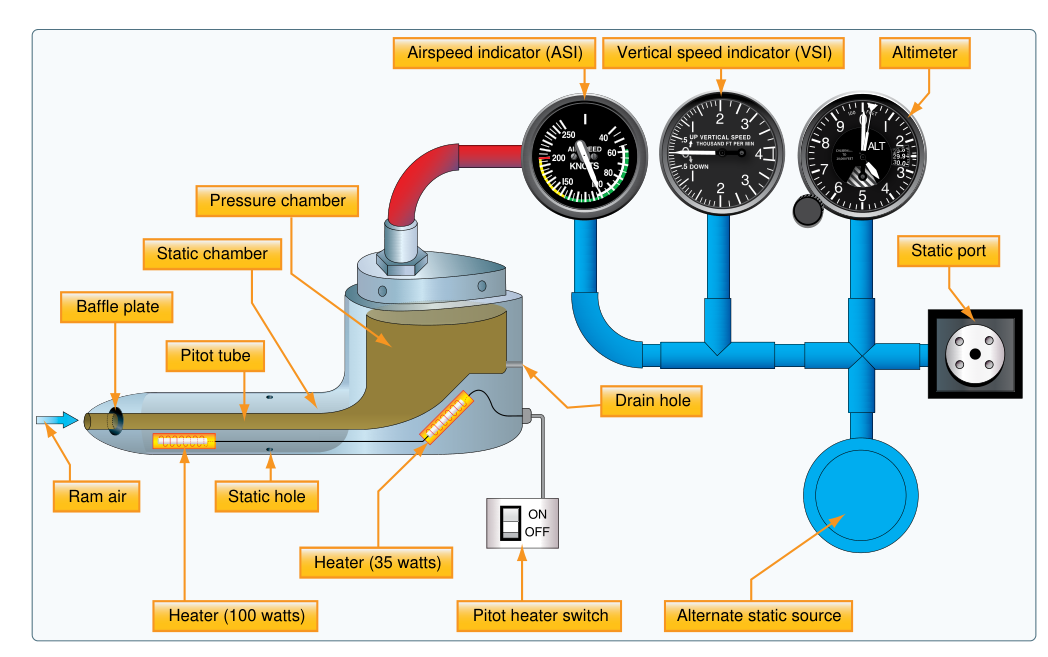
Every time a pilot glances at the airspeed indicator, altimeter, or vertical speed indicator (VSI), they are reading the result of a carefully engineered pressure-sensing system that has been collecting, routing, and comparing two distinct air pressures since before the airplane left the ground. That system — the pitot-static system — is deceptively simple in concept but demands precise construction, routing, and maintenance to remain accurate and safe. For the AMT Airframe candidate, mastering the physical components, the plumbing rules, and the inspection requirements is both an exam priority and a genuine airworthiness responsibility.
This article walks through the complete pitot-static system from the air-sensing probes to the instrument faces, explaining how each component works, why the plumbing details matter, and what the Federal Aviation Regulations and FAA handbooks require of the technician who maintains it.
The Two Pressure Sources
The pitot-static system captures two physically different pressures from the atmosphere. Understanding the distinction between them is the foundation of everything that follows.
Ram air pressure (pitot pressure / impact pressure) is collected by the pitot tube — a forward-facing open tube that stagnates the airflow inside it. Because the air is brought to a stop within the tube, its kinetic energy converts to pressure energy. The magnitude of that extra pressure above ambient is directly related to airspeed. The pitot tube senses total pressure (static + dynamic), but only the dynamic (ram) component changes with aircraft speed.
Static pressure is the ambient atmospheric pressure acting equally in all directions. It changes with altitude (decreasing as the aircraft climbs) but is theoretically independent of airspeed if sampled correctly from a location with undisturbed airflow. Static pressure is collected at one or more static ports — flush openings in the fuselage skin, usually located on the fuselage sides or on the pitot mast itself.
System Components in Detail
The Pitot Tube
The pitot tube is typically a hollow metallic tube (often aluminum alloy or stainless steel on high-performance aircraft) mounted on the wing leading edge, fuselage nose, or a mast below the wing. Its forward-facing opening captures total pressure. A small drain hole is machined in the underside of the tube near its base; this hole allows moisture condensation and rainwater to escape without entering the instrument lines. The drain hole is sized small enough that the slight pressure loss it causes is negligible, but large enough to prevent water accumulation. A technician who accidentally blocks this drain with sealant creates a water trap and a calibration error — a common maintenance mistake to avoid.
Many pitot tubes contain an electrical heating element wound around the inner chamber. Controlled by a cockpit switch (and in some aircraft, automatically activated), pitot heat prevents ice from forming over the opening or inside the tube. Ice blockage at the pitot opening is particularly insidious: an iced-over pitot with open static ports causes the airspeed indicator to behave like an altimeter — reading higher as the aircraft climbs and lower as it descends.
Static Ports
Static ports are flush-mounted orifices in the fuselage skin, usually located at a carefully selected position where local airflow disturbances are minimal. Most transport-category and many general aviation aircraft use dual static ports on both sides of the fuselage, plumbed together. This bilateral arrangement averages out small pressure asymmetries caused by sideslip or yaw and improves accuracy across a range of flight attitudes. Light aircraft may use a single port, though this introduces greater positional error during slipping flight.
Some pitot tubes are combined pitot-static probes that collect both pressures from the same mast. In this design, the forward-facing tube carries ram pressure while an annular ring of holes around the mast or a separate port further back captures static pressure. This configuration is common on general aviation aircraft and simplifies installation, though it can be more susceptible to combined contamination.
Alternate Static Source
Most certificated aircraft include an alternate static source — a valve in the cockpit that, when opened, connects the static line to cockpit interior air as an emergency substitute for the blocked or failed primary static port. Cockpit air is typically at a slightly lower pressure than the true ambient static pressure (because the pressurized cabin airflow creates a slight venturi effect), so instruments will read slightly in error when the alternate source is used. Specifically: the altimeter will read higher than actual altitude, airspeed will read slightly higher, and the VSI will momentarily deflect before stabilizing. The Pilot's Operating Handbook (POH) for each aircraft specifies the correction factors. On unpressurized aircraft, breaking the glass of the VSI has been used as a last resort to admit cockpit air into the static system, though this destroys the VSI and must be treated as an emergency measure only.
Plumbing and Line Routing
The tubing connecting the probes to the instruments is as important as the probes themselves. FAA-acceptable plumbing practices, detailed in the Aviation Maintenance Handbook series (FAA-H-8083-30 and FAA-H-8083-32), include the following principles:
- Material: Lines are commonly aluminum alloy tubing, though some aircraft use nylon or other non-metallic tubing approved in the aircraft's type design. All materials must be compatible with moisture and must not corrode in a way that introduces contaminants.
- Moisture traps: Lines must be routed with a slight downward slope toward a moisture trap or drain at the lowest point. If a low point collects water, the altimeter can freeze or slug-respond in cold weather. Drain valves at low points allow maintenance personnel to purge accumulated moisture.
- No sharp bends: Kinks in the tubing restrict flow and alter pressure readings. Bends must use the minimum bend radius specified for the tubing diameter to avoid work-hardening cracks.
- Leak-free fittings: All fittings must be airtight. A leak in the static line — especially one located inside a pressurized area — will cause the static pressure in the line to equalize toward the ambient pressure inside that space rather than true atmospheric pressure, producing altitude and airspeed errors.
- Separation from other systems: Pitot and static lines must be physically separated from hydraulic, fuel, and electrical lines to prevent contamination or chafing damage.
- Identification: Lines should be labeled or color-coded at connection points to prevent incorrect reassembly during maintenance. Connecting a pitot line to the static port of an instrument will produce dangerously erroneous readings.
The Three Pitot-Static Instruments
Three cockpit instruments rely on pitot-static pressure inputs:
- Airspeed Indicator (ASI): Connected to both pitot and static lines. A flexible diaphragm inside the instrument expands when pitot pressure exceeds static pressure; the difference (dynamic pressure) moves a mechanical linkage to display indicated airspeed. With only the pitot blocked (static open), airspeed freezes at the speed at the moment of blockage. With only the static blocked (pitot open), airspeed reads incorrectly as altitude changes.
- Altimeter: Connected to the static line only. Aneroid wafers inside expand and contract as static pressure changes with altitude, driving a series of gears to the pointer display. A blocked static port freezes the altimeter at the altitude where blockage occurred.
- Vertical Speed Indicator (VSI): Connected to the static line only. A calibrated leak in the VSI case allows static pressure to equalize slowly; the difference between instantaneous static pressure at the port and the lagging pressure inside the case drives the needle. The VSI has an inherent 6-to-9-second lag. A static blockage freezes the VSI at zero.
Why It Matters: Safety and Regulatory Requirements
Under 14 CFR Part 91.411, aircraft operated under instrument flight rules (IFR) must have the altimeter and static system tested and inspected within the preceding 24 calendar months. This test, performed by an appropriately rated repair station or certificated person, uses a pitot-static test set to apply precise known pressures and verify that leakage rates stay within tolerances — for the static system, no more than 100 feet of equivalent altitude loss per minute at a test altitude of 1,000 feet above the airport elevation. For the pitot system, no leakage is permissible beyond what is specified in the aircraft maintenance manual.
14 CFR Part 91.413 requires transponders with Mode C (altitude encoding) to be tested every 24 calendar months as well, and because the encoder reads from the static system, static system integrity directly affects transponder accuracy — a fact that underscores how broadly a single system failure can cascade.
Key Numbers and Rules
- Static system leak test: altitude loss must not exceed 100 feet per minute at the test pressure equivalent of 1,000 feet AGL (per 14 CFR Part 91 Appendix E).
- Pitot-static and transponder/encoder tests required every 24 calendar months for IFR operations (14 CFR 91.411 and 91.413).
- Pitot heat check: verify the element draws correct amperage and the tube warms to the touch; do not leave pitot heat ON for extended periods on the ground as overheating can damage the element.
- Alternate static source: airspeed and altitude will read higher than actual when using cockpit static on an unpressurized aircraft.
- Drain holes in pitot tubes must remain clear and unobstructed; verify during preflight and post-maintenance inspection.
Common Test Traps
- Pitot blocked, static open: Many candidates confuse which failure freezes the airspeed versus which makes it act like an altimeter. Remember: a completely sealed pitot (no drain hole) traps a fixed pressure, causing airspeed to rise on climb and fall on descent — exactly the opposite of what the pilot needs to know. A frozen reading occurs only when the static is also blocked.
- Alternate static source errors: Students often remember that alternate static causes errors but forget the direction — on an unpressurized aircraft both altitude and airspeed read higher, not lower.
- VSI lag: The VSI does not give an instantaneous reading; it lags 6–9 seconds. Some questions describe a situation where the VSI reads zero during a slow climb — this is normal lag behavior, not a system failure.
- Drain hole sealant: After any pitot tube removal and reinstallation, applying sealant over the drain hole is a recurring maintenance error. This is the kind of detail the AMT written exam tests directly.
- Static leak inside pressurized zone: A leak where the static line passes through a pressurized fuselage section causes the system to sense cabin pressure (higher than ambient at altitude), making the altimeter read lower than actual — a dangerously deceptive error during instrument approaches.