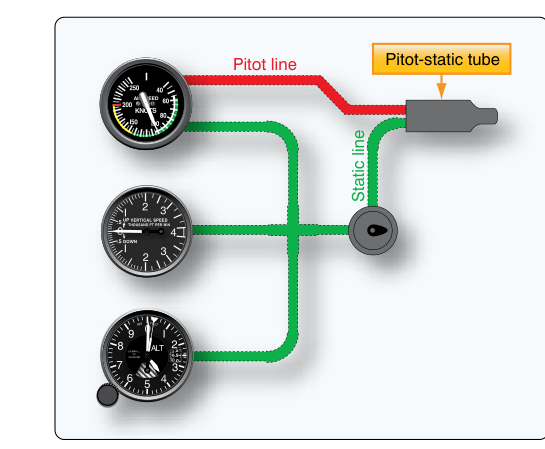
Every time a pilot pulls back on the yoke and climbs into the sky, three of the most important instruments on the panel are silently doing their job: the airspeed indicator, the altimeter, and the vertical speed indicator (VSI). All three depend entirely on one interconnected plumbing system — the pitot-static system. Unlike engine instruments or navigation radios, these instruments require no electrical power to function under normal conditions; they run on air pressure alone. That elegant simplicity is also their vulnerability: a blocked port or cracked line can render all three instruments unreliable at once, often without an obvious warning to the pilot.
Understanding how the pitot-static system works — and how it fails — is not just an FAA knowledge test topic. It is a survival skill. Accidents caused by blocked pitot tubes and static ports appear regularly in NTSB reports, and the FAA expects every private pilot candidate to understand both the physics and the practical implications.
How the Pitot-Static System Works
The system has two distinct pressure sources: the pitot tube, which senses ram air pressure (also called impact pressure or total pressure), and one or more static ports, which sense ambient atmospheric pressure (static pressure). These two pressures are routed through dedicated lines to the instruments on the panel.
Pitot Tube
The pitot tube is typically mounted on the leading edge of a wing or on the fuselage nose, pointed directly into the relative wind. As the aircraft moves forward, air rams into the open end of the tube, creating a pressure that is higher than the surrounding atmosphere. This ram pressure equals static pressure plus dynamic pressure — with the dynamic component increasing as airspeed increases. The pitot tube is usually heated electrically to prevent ice from blocking the opening. Most light trainers have a pitot heat switch in the cockpit that the pilot activates in visible moisture or near-freezing conditions.
Static Ports
Static ports are small, flush-mounted openings on the side of the fuselage (or sometimes on the pitot mast itself) where the airflow is relatively undisturbed. They sense only the ambient air pressure at the aircraft's current altitude, with minimal influence from airspeed. Most aircraft have at least two static ports — one on each side of the fuselage — to average out any small pressure variations caused by sideslip or yaw. These ports connect to a common static line that feeds all three pitot-static instruments simultaneously.
How Each Instrument Uses the Pressures
Each of the three pitot-static instruments uses these pressure sources differently:
- Airspeed Indicator (ASI): Compares ram (pitot) pressure against static pressure. The difference — called dynamic pressure — is displayed as indicated airspeed. When the aircraft is stationary, ram and static pressures equalize and the ASI reads zero. As speed increases, ram pressure rises while static pressure stays the same for that altitude, and the needle deflects.
- Altimeter: Uses static pressure only. A sealed aneroid wafer stack inside the instrument expands as static pressure decreases (as altitude increases) and contracts as static pressure increases (as altitude decreases). The kollsman window allows the pilot to set the current local altimeter setting (QNH) so that the instrument reads pressure altitude corrected for local sea-level pressure.
- Vertical Speed Indicator (VSI): Also uses static pressure only, but does so through a calibrated leak. Static pressure enters both a reference chamber (through the leak) and a direct port. When the aircraft climbs or descends, static pressure changes faster on the direct side than through the restricted leak, creating a pressure differential that drives the needle. In level flight, the pressures equalize and the VSI reads zero — but this equalization takes up to several seconds, which is why the VSI has a characteristic lag.
Why the Pitot-Static System Matters
Because all three instruments share the same pressure sources, a single blockage can simultaneously affect multiple instruments — and in unpredictable ways depending on which port is blocked and whether the drain hole is also obstructed. This cascading failure potential is exactly why FAA examiners expect pilots to understand the failure modes cold before they ever fly solo cross-country.
From a practical standpoint, a pilot who misreads an airspeed indicator due to a blocked pitot tube may accelerate into overspeed or, conversely, reduce power and stall trying to "fix" an instrument that appears to show excessive speed. Incorrect altimeter readings can cause controlled flight into terrain (CFIT). These are not theoretical concerns — they are the specific scenarios that preflight inspections and pitot heat procedures are designed to prevent.
Failure Modes in Detail
Blocked Pitot Tube (Ram Pressure Port Only)
If the pitot tube's forward-facing opening is blocked by ice, insects, or debris — but the small drain hole on the bottom of the tube remains open — ram pressure bleeds away and equalizes with static. The airspeed indicator then reads zero (or very near zero), regardless of actual airspeed. The altimeter and VSI are unaffected because they use only static pressure. This is the most common pitot blockage scenario and the one pitot heat is designed to prevent.
If both the main opening and the drain hole are blocked (for example, by ice that seals the entire tube), ram pressure is trapped inside the pitot line. In this scenario, the ASI behaves like an altimeter: as the aircraft climbs, static pressure decreases, the trapped ram pressure now exceeds static, and the ASI reads higher — even though actual airspeed may be unchanged or decreasing. Descending causes the ASI to read lower. This is the most insidious failure because the ASI appears to be working, just displaying wrong and misleading information.
Blocked Static Port
When the static port is blocked, static pressure is frozen at whatever value existed at the moment of blockage. All three instruments are affected:
- Altimeter: Freezes and reads the altitude at the time of blockage. Climbing above that altitude causes the altimeter to under-read (stuck low); descending causes it to over-read (stuck high).
- VSI: Reads zero regardless of actual climb or descent rate, because there is no longer a changing pressure differential to drive the needle.
- Airspeed Indicator: Behaves erratically. If the aircraft climbs (actual static pressure decreasing), but the blocked static reference remains at a higher pressure value, the instrument senses a larger-than-real pressure differential and over-reads airspeed. Descending produces the opposite — an under-reading of airspeed.
For this reason, most aircraft are equipped with an alternate static source — a valve the pilot can open to connect the static system to cabin air instead of the blocked external port. Because cabin pressure is typically slightly lower than outside static pressure (due to aerodynamic suction around openings), instruments using the alternate source will read slightly in error: the altimeter will indicate slightly higher than actual, airspeed will read slightly higher, and the VSI will momentarily show a brief climb when the alternate source is first selected. Pilots must know these errors exist and consult the Pilot's Operating Handbook (POH) for specific correction values.
Key Numbers and Rules
- Pitot heat required in IMC: 14 CFR 91.527 addresses icing-related equipment provisions for turbine-powered airplanes, but for all aircraft, pitot heat should be activated in visible moisture at or near freezing temperatures as a best practice.
- Altimeter setting: Below 18,000 feet MSL, pilots set the current altimeter setting (QNH) in the kollsman window. At and above 18,000 feet MSL in the US, all aircraft use 29.92 in. Hg (standard pressure altitude, or FL).
- VSI lag: The VSI typically lags actual vertical speed by 6–9 seconds, making it most useful as a trend instrument and for stabilized climbs and descents.
- "High to low, look out below": Flying from high pressure to low pressure while holding a constant altimeter reading means the aircraft is actually lower than indicated — a critical terrain-clearance consideration.
- Pitot tube location: Always check and remove the pitot tube cover during preflight. Also visually inspect static ports for obstructions such as tape, insects, or ice.
- Alternate static source errors: Using the alternate static source causes altimeter and ASI to read slightly high; consult the POH for exact corrections.
Memory Aid
For remembering what a blocked static port does to all three instruments, use: "All Three Freeze and Fib." The altimeter freezes at the blocked altitude. The VSI freezes at zero. The ASI fibs — it keeps moving but lies, over-reading in a climb and under-reading in a descent. While not an official FAA mnemonic, this phrase captures the essential behavior of a static blockage across all three instruments clearly enough to build lasting memory.
Common Test Traps
- Blocked pitot with drain hole open vs. both blocked: The FAA loves to test the distinction. Drain hole open = ASI reads zero. Both blocked = ASI climbs as you climb (acts like an altimeter). Mixing these up is a very common mistake.
- Which instruments are affected: A blocked pitot tube affects only the ASI. A blocked static port affects all three instruments. Many students assume the pitot tube feeds multiple instruments — it does not.
- Alternate static source errors: Students often assume alternate static gives perfect readings. It does not — expect a slightly high altimeter and airspeed reading, and a brief spurious VSI climb indication when first selected.
- VSI lag vs. altimeter: The altimeter reflects instantaneous static pressure changes, while the VSI lags by several seconds. The VSI is not a good instrument for detecting rapid altitude excursions quickly — a nuance tested in scenario-based questions.
- "High to low" altimetry error: Many students know the rhyme but reverse its implication. Flying into lower atmospheric pressure (without updating the altimeter setting) means you are actually lower than the altimeter reads — the dangerous direction for terrain clearance.