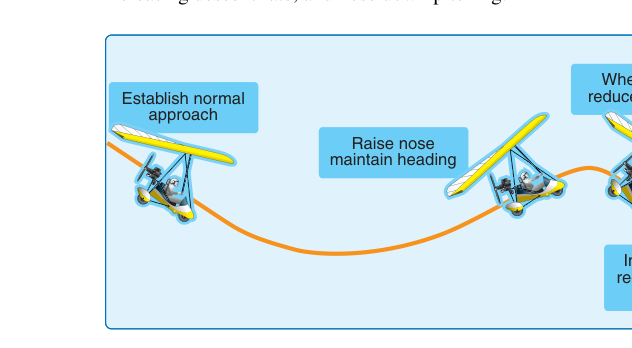
Among the fundamental maneuvers every student pilot must master, the power-off stall holds a special place in flight training — not because it is the most dramatic, but because it mirrors one of aviation's most dangerous real-world scenarios: inadvertently stalling during the approach and landing phase. The FAA requires private pilot applicants to demonstrate competency in power-off stalls precisely because the conditions that produce them — a slow airspeed, a high angle of attack, and reduced power — occur naturally in the traffic pattern every single flight. Understanding what causes a power-off stall, how to recognize it before it bites, and how to recover decisively can make the difference between a safe landing and a fatal loss of control.
This article walks through the aerodynamics, the step-by-step procedure, the recognition cues, and the recovery technique for power-off stalls, grounded in FAA guidance from the Airplane Flying Handbook (FAA-H-8083-3) and the Pilot's Handbook of Aeronautical Knowledge (FAA-H-8083-25).
Aerodynamic Foundation: What Is a Stall?
A stall is not about airspeed — it is about angle of attack (AOA). Every wing has a critical angle of attack, typically around 15–20 degrees depending on the airfoil, beyond which the smooth, attached airflow over the upper wing surface separates into turbulent, chaotic flow. When that separation occurs, lift collapses dramatically. The airplane does not simply stop flying gently; it pitches down (usually) and begins to sink, sometimes rolling toward the more-stalled wing.
In a power-off stall, the engine is at idle or near idle — simulating a base-to-final turn or final approach configuration where the pilot has already reduced power. With less thrust available to maintain airspeed, the pilot must rely on proper pitch management. If the nose is held too high while the airplane slows down, the critical angle of attack is exceeded and a stall results. Flaps are often partially or fully extended during this maneuver, since that replicates the actual approach-to-landing scenario most closely.
Setup and Entry Procedure
The power-off stall is practiced at a safe altitude — the Airplane Flying Handbook recommends a minimum altitude sufficient to allow full recovery above 1,500 feet AGL, and many training programs use 3,000 feet AGL or higher. Before beginning, perform the pre-maneuver checklist (often called a clearing turn), consisting of two 90-degree turns or one 180-degree turn to scan for traffic.
Entry steps typically proceed as follows:
- Reduce power to idle (or the manufacturer-specified approach power setting) while maintaining altitude. This simulates the approach configuration.
- Slow the airplane to approach speed. Apply back pressure gradually to hold altitude as the airplane decelerates. Add flaps in increments as appropriate for your aircraft, typically extending them in stages to simulate a normal approach sequence.
- Establish approach attitude and trim. Some instructors have students trim for approach speed to make the stall more realistic — untrimmed aircraft can mask the natural stall warning cues.
- Continue raising the nose slowly past the normal approach attitude, maintaining coordinated flight (ball centered), until the stall occurs. The goal is a slow, deliberate pitch increase — not a sharp yank — so you train yourself to recognize the progressive cues before the break.
Recognizing the Stall: The Warning Cues
The FAA emphasizes that pilots must learn to recognize a stall by its symptoms, not just wait for the aerodynamic break. Recognition cues appear in a predictable sequence:
- Stall warning horn or light: Most light training aircraft are equipped with a stall warning device — typically a vane or slot on the leading edge — that activates roughly 5–10 knots above the actual stall speed. This is the first and most important cue. Hearing the horn should trigger immediate awareness that the stall is imminent.
- Mushy controls: As the wing approaches the critical AOA, control effectiveness degrades. The airplane feels sluggish, and the controls — especially the ailerons and elevator — require larger inputs for the same effect.
- Buffet or shudder: Turbulent, separated airflow over the wing begins to buffet the tail. This physical vibration through the airframe is a direct tactile warning that the stall is very close or occurring.
- Nose pitch-down: When the stall fully breaks, many aircraft naturally pitch down as the center of lift moves aft. This is not a malfunction — it is the airplane trying to reduce the angle of attack and recover lift. Do not fight it instinctively by pulling back.
- Rapid airspeed decay: The airspeed indicator will be unwinding quickly. Cross-check it, but do not rely on it alone — by the time the airspeed is very low, the stall may already have occurred.
Recovery Procedure
Recovery from a power-off stall follows a specific sequence designed to minimize altitude loss while restoring controlled flight. The Airplane Flying Handbook describes the standard recovery as:
- Reduce angle of attack: This is the first and most critical step. Release back pressure on the elevator — and if necessary, apply slight forward pressure — to reduce the AOA below the critical value. The instinctive reaction to pitch down feels counterintuitive when close to the ground, which is exactly why practice at altitude is so important. Pilots who pull back harder at the stall break will deepen the stall and risk a secondary stall or spin.
- Apply full power: Simultaneously (or immediately after) reducing AOA, advance the throttle to full power. Power helps arrest the descent and accelerates the airplane back to flying speed. In a real approach scenario, this is the go-around decision point.
- Level the wings with coordinated controls: If a wing has dropped at the stall break, use rudder — not aileron — to pick it up. Applying aileron to a stalled wing can aggravate the stall on that side (because deflecting the aileron increases the effective AOA on the down-going aileron side), potentially leading to a spin. The rudder is the primary roll-correcting tool during the recovery.
- Retract flaps incrementally: Once a positive rate of climb is established, retract flaps in stages, per the POH/AFM guidance. Retracting all flaps at once at low airspeed causes an abrupt loss of lift that can drive the airplane back toward the ground — a well-documented trap in go-around accidents.
- Return to desired flight path: Once a safe airspeed and positive climb are confirmed, maneuver back toward the original heading and altitude, or continue the go-around procedure.
Why It Matters: The Real-World Connection
The NTSB and FAA have consistently identified stall/spin accidents during the approach and landing phase as a leading category of fatal general aviation accidents. The classic scenario: a pilot overshoots final approach, makes a low, slow, steeply banked turn back to the runway, and stalls. At 300 feet AGL, there is no altitude for recovery. This is precisely the scenario power-off stall training is designed to prevent — by building the muscle memory and mental habits to recognize the stall onset early and recover immediately, even when the instinct is to hold the nose up.
Coordinated flight during the turn to final is equally critical. An uncoordinated skidding turn at low altitude — ball to the outside — produces a higher effective stall speed and promotes the outside (lower) wing to stall first, causing a sudden roll toward the ground. This is why the FAA stresses keeping the ball centered throughout all stall practice.
Key Numbers and Rules
- Minimum recovery altitude: Recover no lower than 1,500 feet AGL; most trainers begin the maneuver at 3,000 feet AGL or higher.
- Stall warning activation: Typically 5–10 knots above actual stall speed (aircraft-specific; check the POH).
- Critical angle of attack: Generally 15–20 degrees for most light aircraft airfoils — independent of airspeed, weight, or attitude.
- Bank angle consideration: Stall speed increases in a turn. At 60 degrees of bank, stall speed increases by approximately 41% over wings-level stall speed.
- Flap retraction: Always retract flaps in increments per the POH, not all at once, after establishing a positive rate of climb.
- First recovery action: Reduce angle of attack — always. Power is important but cannot unstall a wing.
Memory Aid
"Push, Power, Rudder, Climb" — a practical four-step memory sequence for stall recovery:
- Push: Reduce back pressure (or apply slight forward pressure) to decrease the angle of attack and break the stall.
- Power: Advance throttle to full power to minimize altitude loss and accelerate back to flying speed.
- Rudder: Use coordinated rudder to level wings; avoid adverse aileron input on the stalled wing.
- Climb: Establish a positive climb, then retract flaps incrementally and return to the desired flight path.
Common Test Traps
- "The stall is caused by low airspeed." False — the stall is caused by exceeding the critical angle of attack. You can stall at any airspeed in a steep enough turn or pull.
- "Use aileron to pick up the dropped wing." Wrong during recovery — use rudder first. Aileron input on a stalled or partially stalled wing can aggravate the stall and initiate a spin.
- "Retract all flaps immediately after power application." A common go-around error — flaps should be retracted in stages after establishing a positive climb rate, not all at once.
- "Full stall must occur before you recover." The FAA actually requires the applicant to demonstrate recognition of an imminent stall and allow the full stall break, but in real operations, recovery at the first stall warning cue (horn/buffet) is ideal and results in less altitude loss.
- "Power-off stalls only happen at slow cruise speeds." In reality, the most dangerous stalls occur during the approach and landing phase — at normal approach speeds but with a dangerously high angle of attack created by an excessive nose-up attitude or a steep, uncoordinated turn.