A spin is one of the most dramatic — and historically deadly — events in general aviation. Unlike a simple stall, which a pilot can correct with a straightforward nose-down input and power adjustment, a spin involves the aircraft rotating around its vertical axis while simultaneously descending steeply in a nose-low, spiraling attitude. What makes spins so dangerous is that they often begin at low altitude during the traffic pattern, where there is little time and even less altitude to recover. The FAA requires all private pilot applicants to demonstrate spin awareness, and while actual spins are not required to be performed by pilot applicants for certificates other than flight instructor, understanding the aerodynamics, phases, recognition, and recovery is an absolute requirement — both for the knowledge test and for your life.
This article breaks down everything you need to know about spins: how they develop, what is happening aerodynamically at each phase, how to recognize the warning signs before they become an emergency, and how to execute the FAA-approved recovery when one does occur.
The Aerodynamic Foundation: Stall Comes First
A spin cannot happen without a stall, and a stall cannot happen without exceeding the wing's critical angle of attack. Every spin begins as a stall. What converts an ordinary stall into a spin is the introduction of yaw — a rolling or turning tendency — while the wings are fully or partially stalled. This is the critical distinction: if both wings stall simultaneously and symmetrically, the result is a straight-ahead stall. But if one wing drops or a rudder input is applied asymmetrically during the stall, one wing stalls more deeply than the other.
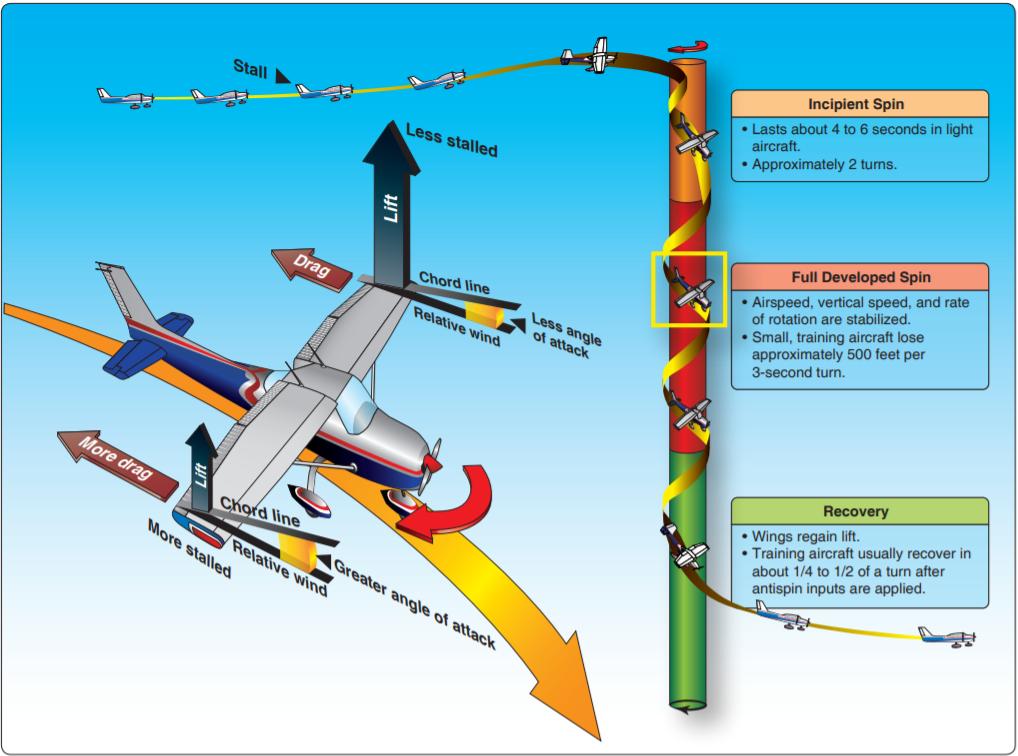
The descending (more deeply stalled) wing produces significantly less lift and significantly more drag than the rising wing. Because it has a higher angle of attack, it is further past the critical angle of attack. The asymmetric lift and drag create a rolling and yawing moment that causes the aircraft to autorotate — meaning the rotation becomes self-sustaining. This autorotation is the defining characteristic of a spin.
The Four Phases of a Spin
The FAA's Airplane Flying Handbook (FAA-H-8083-3) describes the spin as having four distinct phases. Understanding each phase helps you recognize where you are in a spin and what to expect from control inputs.
Phase 1: Incipient Spin
The incipient phase begins the moment the aircraft stalls and starts to autorotate. The nose drops, one wing falls sharply, and rotation begins. This is the most critical phase from a recovery standpoint because the spin has not yet fully developed — the aircraft is most responsive to control inputs here. The incipient phase typically lasts one to three turns, depending on the aircraft type. Recovering during the incipient phase requires the least altitude. Many fatal low-altitude stall/spin accidents happen here because the pilot either does not recognize what is occurring or does not have enough altitude to complete any recovery at all.
Phase 2: Developed Spin
After the first one to three turns, the spin enters the developed phase. The aircraft's rotation rate, pitch attitude, and descent rate all stabilize. The nose is pointed steeply downward, often 45 to 90 degrees below the horizon depending on the aircraft type and whether it is in an upright or inverted spin. Autorotation is fully established. The airspeed in a developed spin is typically low and relatively constant — well below normal cruise or even approach speeds — because the high drag of the stalled wings limits acceleration. This phase continues until the pilot applies recovery inputs or the aircraft reaches the ground.
Phase 3: Recovery
Recovery begins the moment the pilot applies the correct control sequence. The aircraft transitions from autorotation back toward a coordinated, wings-level flight path. This phase takes altitude — sometimes substantial altitude, especially in aircraft with more inertia or in spins that have been allowed to develop for multiple turns. Altitude loss during recovery varies widely by aircraft type and must be referenced in the Pilot's Operating Handbook (POH) for the specific aircraft. As a rule of thumb often cited in training, recovery from a fully developed spin in a typical trainer may require 500 feet or more per turn of additional spin, plus the recovery itself.
Phase 4: Pull-Out
Once autorotation stops and the nose is pointed steeply downward in a spiral dive, the final phase is the pull-out. The pilot applies back pressure to return to level flight. Care must be taken here: if the pilot pulls too aggressively, the aircraft can exceed its structural limits or induce a secondary stall. The pull-out should be smooth and firm, keeping the load factor within the aircraft's limits.
Common Causes: The Stall/Spin Accident Scenario
The most common scenario for an unintentional spin is the base-to-final turn in the traffic pattern. Picture this: the pilot overshoots the final approach course while turning from base leg to final. Instead of going around, the pilot tries to tighten the turn using opposite rudder or by increasing bank angle. The combination of increased angle of attack (nose high from back pressure in a steep turn), uncoordinated rudder input, and low airspeed is a perfect setup for an asymmetric stall and spin entry — at an altitude from which recovery is virtually impossible.
Other common causes include:
- Distraction during slow flight — attention divided between cockpit tasks and aircraft control during approach or departure phases.
- Improperly coordinated turns — using top rudder to hold the nose up in a bank (skidding turn) generates exactly the yaw asymmetry that initiates a spin.
- Stall with power — engine torque and propeller effects in a power-on stall tend to yaw the nose left, increasing the likelihood of asymmetric stall entry.
- Wake turbulence — a sudden wing-drop from a vortex encounter can throw the aircraft into an incipient spin before the pilot can react.
FAA-Approved Recovery: PARE
The FAA-recommended spin recovery technique is taught using the acronym PARE, derived from the Airplane Flying Handbook and reinforced in AC 61-67 (Stall and Spin Awareness Training). Before using this mnemonic in any actual aircraft, confirm the specific recovery procedure in that aircraft's POH, as some aircraft have different or additional steps.
Memory aid
P — Power: Reduce throttle to idle. Power contributes to torque effects and can worsen autorotation. Removing it helps arrest the spin.
A — Ailerons: Neutralize the ailerons. Aileron inputs during a spin can actually deepen the stall on one wing and make the spin worse. Keeping ailerons neutral removes this complication.
R — Rudder: Apply full rudder opposite to the direction of rotation — briskly and fully. This is the primary control for stopping autorotation. Hold it until rotation stops.
E — Elevator: Move the elevator control forward (nose down) to reduce the angle of attack below the critical angle of attack and break the stall. In some aircraft a slight pause after rudder input before applying forward elevator is necessary; again, the POH governs.
Once rotation stops, neutralize the rudder and smoothly pull out of the resulting dive. Do not yank back on the controls — a smooth recovery preserves structural integrity and prevents a secondary stall.
Key Numbers and Rules
- Spin training requirement: 14 CFR 61.87 and 61.107 require that private pilot applicants receive and log ground and flight training in spin awareness, stall recognition, and recovery techniques. Actual spin maneuvers are required for flight instructor (CFI) applicants under 14 CFR 61.183.
- Parachute requirement: Under 14 CFR 91.307, intentional spins require each occupant to wear an approved parachute unless the flight is conducted by a flight instructor for training purposes in an aircraft certified for spins.
- Aircraft certification: Not all aircraft are certified for intentional spins. The POH/AFM will state whether the aircraft is approved for spins in the limitations section. Never intentionally spin an aircraft that is not certified for it.
- Altitude buffer: Most instructors recommend a minimum entry altitude of 1,500 AGL for intentional spin training, though individual aircraft POHs and instructor standards may specify more.
- Load factor in pull-out: Pulling out too aggressively can impose g-forces that exceed the aircraft's normal category limit of 3.8 g, risking structural damage.
Common Test Traps
- Confusing a spin with a spiral dive: A spin involves autorotation with stalled wings and relatively low, constant airspeed. A spiral dive involves un-stalled wings, increasing airspeed, and increasing g-forces in the pull-out. The recovery is different — do not apply forward elevator to a spiral dive.
- Thinking ailerons stop the spin: A common instinct is to use ailerons to level the wings. This can worsen the spin by increasing the angle of attack on the down-going wing. Neutralize ailerons; use rudder opposite the rotation.
- Forgetting that all spins begin as stalls: The FAA knowledge test may describe a scenario and ask what initiated the spin. The answer always traces back to exceeding the critical angle of attack plus asymmetric yaw.
- Misidentifying the direction of rotation: To apply correct opposite rudder, the pilot must know which way the aircraft is spinning. In the panic of an unintentional spin, this is harder than it sounds — training builds the habit of checking rotation direction before applying rudder.
- Assuming any aircraft can be spun intentionally: Only aircraft with an approved spin entry in the limitations section of the POH may be intentionally spun. Flying an unapproved aircraft into a spin can result in an unrecoverable situation.
Spin awareness is not just a knowledge test topic — it is a survival skill. The vast majority of fatal stall/spin accidents are unintentional, occur below 1,000 feet AGL, and happen to pilots who never saw the spin coming. By understanding the aerodynamics, recognizing the conditions that breed spins, and ingraining the PARE recovery sequence, you build the mental architecture to either avoid the situation entirely or survive it if it happens. Stay coordinated, fly at safe airspeeds near the ground, and never let a missed approach become a final one.