Every flight ends with a descent, and the way a pilot manages that descent — from a simple power reduction to a banked descending turn onto final approach — reveals the depth of their aeronautical skill. Descents and descending turns are among the most frequently practiced and tested maneuvers in private pilot training because they integrate all the fundamental control inputs: pitch, power, trim, and coordination. Understanding the aerodynamics, the technique, and the common errors not only prepares you for the FAA knowledge test and the checkride, but also builds the habit patterns that keep flights safe in real-world conditions.
This article covers normal descents, gliding descents, and descending turns — including how to enter and roll out precisely, why coordination is especially critical in a descending bank, and the most common mistakes the FAA expects you to recognize and avoid.
The Aerodynamics of a Descent
An airplane descends when the component of gravity acting along the flight path exceeds the excess thrust available to maintain level flight. In a powered descent, the pilot reduces thrust below what is needed for level flight at that airspeed, and gravity accelerates the airplane along a downward flight path. In a glide (power-off descent), gravity alone provides the propulsive force — the airplane trades altitude for airspeed and distance.
The key variable the pilot controls is the pitch attitude. Unlike level flight, where pitch primarily controls airspeed and power primarily controls altitude, the relationship during a descent is nuanced. At a fixed power setting, lowering the nose increases airspeed and rate of descent; raising the nose (up to a point) decreases both. The Airplane Flying Handbook (FAA-H-8083-3) emphasizes that the pilot must develop a clear mental model of pitch-power-performance relationships and resist the instinct to pull back whenever the ground gets closer.
Normal (Partial-Power) Descent
A normal descent is flown at a reduced but not idle power setting. The procedure follows a simple sequence:
- Reduce power to the desired descent power setting (consult the Pilot's Operating Handbook for your specific aircraft).
- Adjust pitch attitude to hold the target descent airspeed — typically cruise descent speed, which is at or below VNO and well above VS.
- Retrim to remove control pressure so the airplane holds the attitude hands-off.
- Monitor airspeed and vertical speed; make small corrections as needed.
A typical training aircraft might use 500–700 feet per minute (fpm) as a comfortable descent rate for passenger comfort and situational awareness. Steeper rates (1,000 fpm or more) are perfectly normal operationally but require more active traffic scanning because altitude changes quickly. Always lean the mixture appropriately if descending into higher-density air after a cruise at altitude, following your POH guidance.
Gliding Descent (Power-Off)
The best glide speed (VG or sometimes labeled VBG in the POH) produces the maximum glide ratio — the greatest horizontal distance for each foot of altitude lost. This is the airspeed a pilot should immediately establish after an engine failure. Flying faster or slower than best glide reduces glide range.
The Airplane Flying Handbook notes that best glide speed is based on the maximum gross weight; if the aircraft is lighter, the actual best-glide airspeed will be slightly lower, though the published POH value is appropriate for most training scenarios. Headwinds reduce glide range over the ground; a headwind component equal to one-third of best glide airspeed can significantly shorten where you land, so penetrating into a headwind at a slightly higher airspeed can sometimes optimize over-the-ground glide distance — but for the knowledge test, use the published best glide speed.
During a power-off glide, carb heat (if equipped) should be applied as recommended because the cold, low-power airflow through a carburetor is prime conditions for carburetor ice. The engine should be kept warm with periodic power applications (clearing turns) to prevent shock cooling and to confirm the engine will respond if power is needed.
Descending Turns
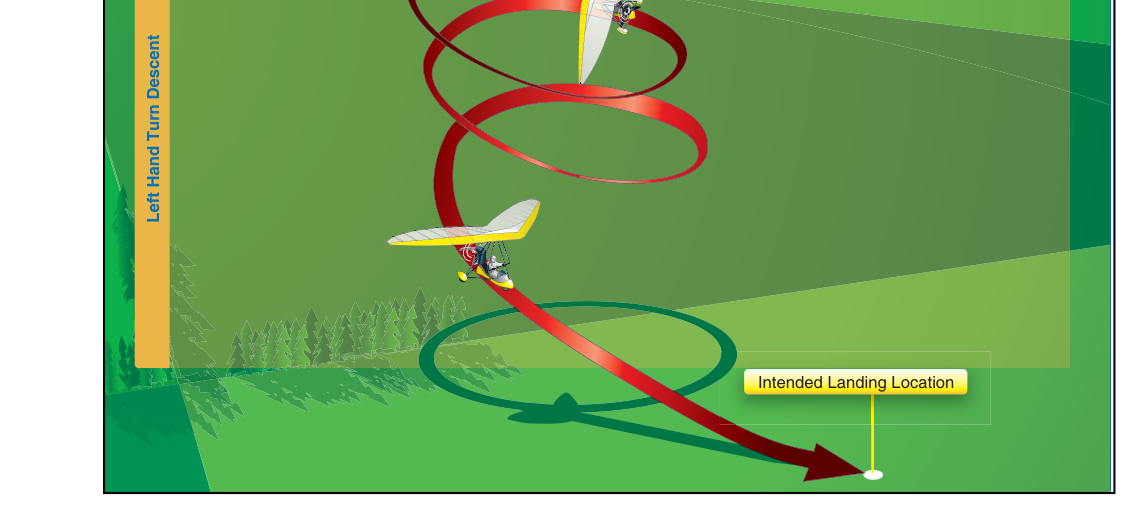
A descending turn simply combines a banked turn with a descent. The airplane simultaneously loses altitude and changes heading. While the concept is simple, the execution demands careful coordination because several aerodynamic tendencies converge:
Load Factor and Stall Speed
Whenever an airplane banks, the wings must generate more lift to support the same weight, which increases the load factor. This raised load factor also raises the stall speed. In a 30° banked descending turn, stall speed increases by roughly 7% above the wings-level value; at 45° of bank the increase is approximately 19%. During a descending turn, airspeed may already be reduced, so the pilot must be alert to the elevated stall risk. The FAA knowledge test regularly tests whether students understand that stall speed increases with bank angle — regardless of whether the airplane is climbing, level, or descending.
Coordination in the Descent
Coordination — keeping the ball centered in the inclinometer — is always important, but it becomes especially critical in descending turns for two reasons. First, an uncoordinated (slipping or skidding) turn in a descent can lead rapidly to a cross-controlled stall, one of the most dangerous situations in aviation because it can occur at unexpectedly low altitude and at airspeeds above the published VS. Second, the descending flight path means altitude margin is already being consumed, leaving little room to recover from a departure from controlled flight.
The Airplane Flying Handbook describes the skidding turn as particularly hazardous on base-to-final turns: the pilot overshoots final approach, applies rudder to yaw the nose back, and inadvertently loads the outside wing while the inside wing stalls — leading to an incipient spin at pattern altitude. This scenario kills pilots every year. Coordination is not a nicety; in descending turns near the ground, it is life-critical.
Entering and Rolling Out a Descending Turn
To enter a descending turn, the pilot combines the descent entry (power reduction, pitch adjustment) with a coordinated roll to the desired bank angle. For training, 30° of bank is standard. Once established, the pilot holds the pitch attitude that maintains the target airspeed — note that the nose position relative to the horizon will be lower in a bank than in a wings-level descent at the same airspeed, because the horizontal component of lift is now providing the centripetal force for the turn.
To roll out on a specific heading, begin the roll-out approximately half the bank angle before reaching the target heading (e.g., 15° early for a 30° bank). Simultaneously, return to the level-descent or level-flight pitch attitude as appropriate. Apply rudder to coordinate the roll-out and cross-check the heading indicator, altimeter, and airspeed indicator to confirm the desired state.
Key Numbers and Rules
- Best glide speed: Published in the POH; must be established immediately after engine failure for maximum glide range.
- Stall speed increase: Approximately 7% at 30° bank, 19% at 45° bank, 41% at 60° bank — all relative to wings-level stall speed.
- Roll-out lead: Begin rolling out of a turn approximately half the bank angle before the target heading.
- Carburetor heat: Apply during power-off or low-power descents in carburetor-equipped engines to prevent carb ice.
- Airspeed limits: Maintain descent airspeed below VNO (maximum structural cruising speed) in smooth air and below VFE if flaps are extended; never exceed VNE.
- ACS descent standards: The Airman Certification Standards for Private Pilot require maintaining the target airspeed within ±10 knots and rollout heading within ±10° during turns to headings.
Why It Matters
Descending turns are not just a checkride box to check — they appear in every traffic pattern flown for the rest of a pilot's flying life. The downwind-to-base and base-to-final turns are descending turns. Energy management on an instrument approach is a controlled descending turn. Canyon exits in mountainous terrain often demand steep descending turns. The pilot who has truly internalized pitch-power coordination, stall awareness in a bank, and precise roll-out technique will be dramatically safer across all phases of flight.
The FAA Risk Management Handbook (FAA-H-8083-2) identifies loss of control in flight (LOC-I) as a leading cause of fatal general aviation accidents, and a significant fraction of those accidents involve uncoordinated descending turns at low altitude. Practicing these maneuvers to ACS standards — and understanding why each element of technique matters — is one of the most high-value investments a student pilot can make.
Common Test Traps
- Confusing best glide with best rate-of-climb speed (VY): They are different airspeeds with different purposes. Best glide gives maximum range; VY gives maximum altitude gain per unit of time. Know which your aircraft's POH specifies for power-off glides.
- Assuming stall speed is fixed: Many students memorize the wings-level stall speed and forget it rises with bank angle. The FAA knowledge test will ask about stall speed in various bank angles — remember the load factor increases with the cosine relationship.
- Thinking power controls airspeed in a descent: In a stabilized descent, pitch controls airspeed and power controls rate of descent (or glide angle). This is the classic inversion of the normal climb relationship and is frequently tested.
- Neglecting trim during descent: Student pilots often hold back-pressure rather than retrimming when power is reduced. This causes fatigue and imprecision and is a common checkride debrief item.
- Ignoring carburetor heat: On knowledge test questions about power-off or low-power flight in carburetor-equipped engines, carb heat application is almost always part of the correct procedure. Skipping it in an answer is a reliable way to miss the question.