Of all the fundamental flight maneuvers a private pilot must master, the climb and climbing turn are among the first introduced and the last truly perfected. They look deceptively simple from the ground: pull back, add power, and go up. In practice, however, a well-executed climb demands precise coordination of pitch, power, trim, and rudder pressure, while a climbing turn adds the complexity of bank angle management and torque effects acting simultaneously. Understanding the aerodynamics, the technique, and the common traps will help you both fly better and ace the FAA knowledge test.
This article draws on the Airplane Flying Handbook (FAA-H-8083-3) and the Pilot's Handbook of Aeronautical Knowledge (FAA-H-8083-25) to give you a thorough, practical foundation.
The Aerodynamics of a Climb
In straight-and-level flight, thrust equals drag and lift equals weight. When you transition into a climb, that balance shifts. The airplane must now overcome not only drag but also a rearward component of gravity acting along the flight path. Because weight has a component opposing forward motion during a climb, thrust must be greater than drag to sustain the climb. The steeper the climb angle, the larger that opposing gravity component becomes.
Two climb speeds are critical to understand. Vy (best rate of climb speed) gives the greatest gain in altitude in the least amount of time — it maximizes the surplus of power over the power required for level flight. Vx (best angle of climb speed) gives the greatest gain in altitude over a given horizontal distance — useful for clearing obstacles after takeoff. Vx is always slower than Vy and requires a nose-high pitch attitude that reduces forward visibility. Both speeds are published in the Pilot's Operating Handbook (POH) for your specific airplane and vary with altitude: as density altitude increases, Vx and Vy converge until, at the airplane's absolute ceiling, they become the same speed.
A third common climb configuration is the cruise climb, which uses a slightly higher airspeed than Vy. The cruise climb sacrifices some rate of climb in exchange for better engine cooling, improved forward visibility, and more comfortable passenger experience. Many pilots use cruise climb during long cross-country flights once obstacles are no longer a factor.
Technique: Entering a Straight Climb
The standard entry sequence taught in most training programs is pitch-power-trim, though some instructors teach power-pitch-trim. Either approach is acceptable as long as all three elements are coordinated and the result is stable. Here is the pitch-power-trim method step by step:
- Pitch: Smoothly raise the nose to the approximate climb attitude. For Vy in most trainers, this is a pitch attitude of roughly 6–10 degrees above the horizon, though the exact value depends on the airplane. Use a visual reference on the windscreen aligned with the horizon rather than fixating on the vertical speed indicator.
- Power: Advance the throttle to the climb power setting specified in the POH — typically full throttle for normally aspirated engines during the climb phase. Do this smoothly to avoid shock-cooling concerns on descent or abrupt thrust changes.
- Trim: After the airspeed stabilizes near the target climb speed, apply back-pressure trim to relieve the steady stick force. Attempting to trim before the speed stabilizes leads to a series of over-corrections.
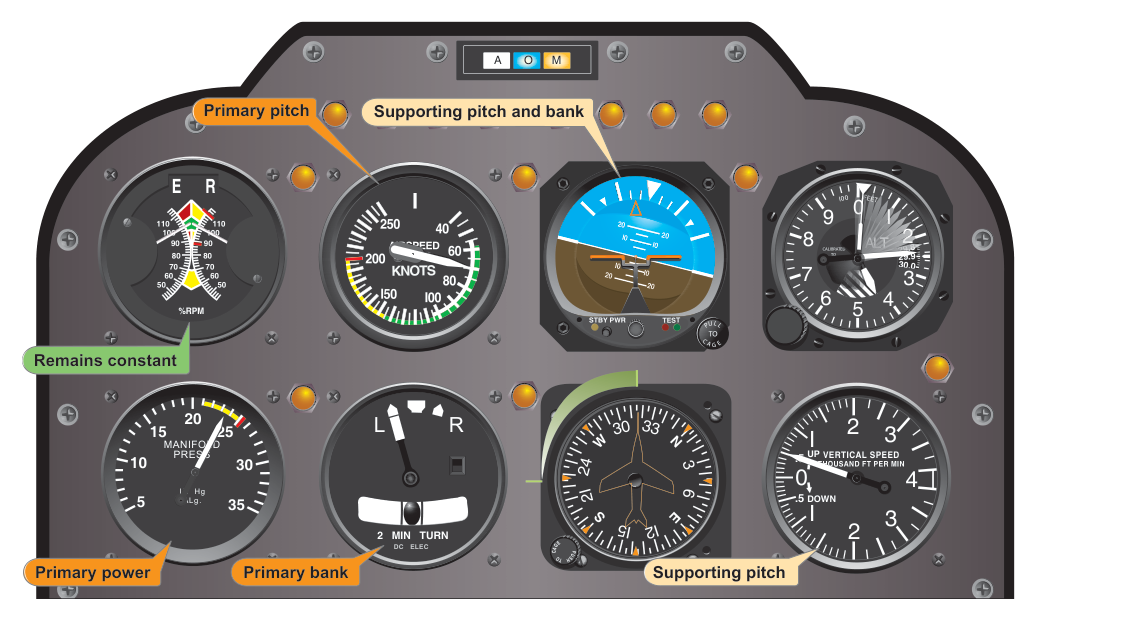
Once established, monitor airspeed against your target. If airspeed is too low, slightly lower the nose; if too high, raise it. Do not chase the altimeter or VSI — the primary pitch reference in a climb is the attitude indicator and outside visual references.
Right rudder pressure is essential throughout the climb in most single-engine propeller aircraft. Four left-turning tendencies act during high-power, low-speed flight: torque, P-factor, spiraling slipstream, and gyroscopic precession. Without right rudder correction, the airplane will yaw left, producing a skid and degrading climb performance. A coordinated climb keeps the ball centered in the inclinometer and the slip-string straight.
Technique: Climbing Turns
A climbing turn combines a banked turn with an established climb, and it intensifies every challenge present in each maneuver individually. The FAA's Airplane Flying Handbook notes that during a climbing turn, the airplane's ability to climb is reduced because the vertical component of lift is diminished as bank angle increases. This means the rate and angle of climb will decrease as bank angle increases.
For this reason, climbing turns are generally executed at shallow bank angles — typically no more than 15 to 20 degrees. A steep bank in a climb can cause the aircraft to lose significant climb gradient; in extreme cases with a heavily loaded or underpowered airplane near Vx, a steep climbing turn can actually cause a descent.
Entry technique mirrors the straight climb: establish the climb first, then roll into the bank smoothly. Maintain coordinated flight with right rudder as needed (more rudder may be needed when turning right than left because of left-turning tendencies). Hold the same pitch attitude as in the straight climb — resist the temptation to raise the nose further to compensate for the reduced vertical lift component, as this risks reducing airspeed dangerously close to stall speed. The pitch attitude remains relatively constant; the reduced climb performance is accepted as a natural consequence of the bank.
When rolling out of a climbing turn, lead the rollout by approximately half the bank angle before reaching the target heading. For a 15-degree bank, begin rollout about 7–8 degrees before the desired heading. As the wings level, continue to climb at the established attitude until reaching the desired altitude, then transition to level flight.
Leveling Off from a Climb
A proper level-off is often where student pilots make their most obvious errors. The technique is lead the level-off altitude — begin the transition to level flight approximately 10% of the climb rate before reaching target altitude. If climbing at 500 fpm, begin leveling off about 50 feet below the target altitude. This prevents overshooting.
The sequence for leveling off is: lower the nose to the level-flight attitude first, allow airspeed to build to cruise speed, and then reduce power to the cruise setting. Reducing power before lowering the nose causes the airplane to slow dramatically and can result in a mushy, inefficient transition. After power is set, re-trim for level flight.
Why It Matters: Safety and Performance
Understanding climbs is not merely academic. Attempting to climb with insufficient power, at the wrong speed, or with too steep a bank can place the airplane dangerously close to an aerodynamic stall — particularly during the takeoff and departure phase when altitude is low and recovery options are limited. Many fatal accidents occur when pilots attempt steep climbing turns at low altitude following engine problems or when departing over rising terrain.
Furthermore, if you are clearing obstacles on takeoff, selecting Vx rather than Vy can mean the difference between clearing a tree line and striking it. Conversely, climbing at Vx for an extended time generates more heat in the engine and reduces visibility, so transitioning to Vy or cruise climb as soon as obstacles are cleared is good practice.
Key Numbers and Rules
- Vx vs. Vy: Vx (best angle) is always slower than Vy (best rate); both are published in the POH and decrease with altitude increase.
- Bank angle in climbing turns: Generally limit to 15–20 degrees to preserve climb performance.
- Level-off lead: Lead the target altitude by approximately 10% of the climb rate (e.g., 50 feet at 500 fpm).
- Left-turning tendencies: Right rudder is required in most single-engine aircraft during full-power climbs to maintain coordinated flight.
- Vx and Vy converge: At the airplane's absolute ceiling, the two speeds become equal — there is only one speed that will maintain altitude at all.
- Cruise climb: Uses a higher airspeed than Vy; traded for better cooling, visibility, and comfort on long climbs.
Memory Aid
For the four left-turning tendencies, remember the mnemonic PAST:
- P — P-factor (asymmetric propeller thrust at high angle of attack)
- A — Asymmetric slipstream (spiraling propwash striking the vertical stabilizer)
- S — Spiraling slipstream (same concept, sometimes listed separately from P-factor)
- T — Torque (engine/propeller rotation pushes the left wing down, yawing left)
Some instructors add gyroscopic precession as a fifth factor (prominent during tailwheel aircraft rotation), but PAST covers the core four. Any time you see high power and low speed — the classic climb condition — these tendencies are at their strongest, and right rudder is your primary correction.
Common Test Traps
- Confusing Vx and Vy: Vx gives the best angle (most altitude over distance); Vy gives the best rate (most altitude over time). The FAA loves to flip the definitions in answer choices.
- Bank angle in a climbing turn: Some students assume they can maintain the same climb performance regardless of bank angle. Wrong — the vertical component of lift decreases with bank, directly reducing the climb gradient.
- Level-off sequence: The correct order is lower the nose first, then reduce power after airspeed builds. Students often reduce power too early and create a slow, sloppy transition.
- Trim timing: Trying to trim during the entry before airspeed stabilizes leads to oscillation and imprecise altitude control. Trim after the speed is established.
- Ignoring left-turning tendencies: On the knowledge test and during a checkride, failure to anticipate and correct with right rudder in a climb results in uncoordinated flight. A slipping or skidding climb also degrades performance and moves the airplane closer to a potential stall-spin scenario.