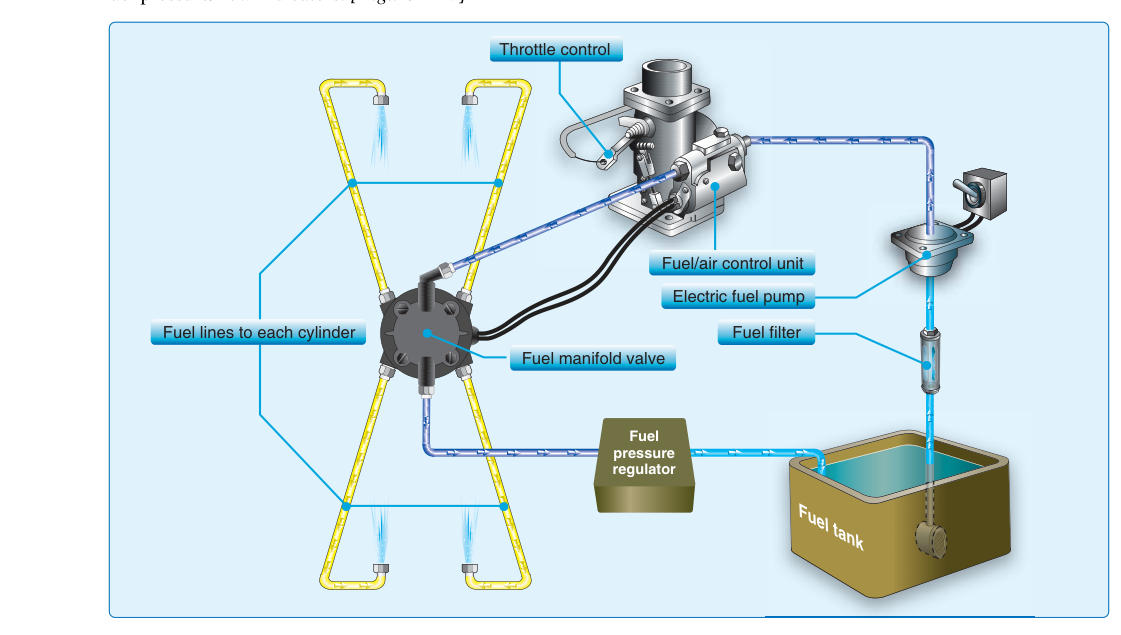
Walk up to many modern single-engine trainers and light aircraft, and you will find a fuel injection system rather than a traditional carburetor under the cowling. Understanding how fuel injection works, why it was developed, and — most importantly — how its failure modes differ from carburetor systems is essential knowledge for the FAA Private Pilot Knowledge Test and for safe real-world operations. This article takes you through the mechanics, the advantages, the quirks, and the cockpit procedures you need to know cold before your checkride.
How Fuel Injection Works
A fuel injection system replaces the single carburetor with a network of components that meter and deliver fuel individually to each cylinder's intake port, bypassing the need to mix fuel and air inside a venturi before they reach the engine. Although there are several designs used in general aviation, the most common type found in Lycoming and Continental engines is the continuous-flow fuel injection system. In this design, fuel does not fire in discrete pulses like automotive port injection; instead, it flows continuously at a metered rate that matches the engine's demand at any given moment.
Major Components
- Engine-driven fuel pump: This is the primary fuel pump. It draws fuel from the tanks and pressurizes the system. Fuel-injected engines are generally more sensitive to fuel pressure fluctuations than carbureted engines, which also require adequate fuel flow but tend to tolerate pressure variation more readily, making pressure monitoring especially important on injected systems.
- Fuel/air control unit (fuel control unit): Sometimes called the fuel control or fuel metering unit, this device sits at the throttle body and regulates how much fuel is delivered based on throttle position and mixture control input from the cockpit. It is the analog brain of the system.
- Fuel manifold valve (flow divider): After metering, fuel travels to this central valve, which distributes equal quantities of fuel to each individual fuel injector line. It also acts as a check to prevent fuel from draining out of the lines when the engine is shut down.
- Fuel injector nozzles: These small, precisely sized nozzles are positioned at each cylinder's intake port. They spray atomized fuel directly into the incoming air charge just before it enters the cylinder, promoting thorough mixing and combustion.
- Auxiliary (electric boost) pump: This electrically powered backup pump is a critical component in fuel injection systems. Because the engine-driven pump cannot prime a dry fuel system on start-up, and because hot-start and vapor lock scenarios can interrupt fuel flow, the electric boost pump is used for starting, takeoff, landing, and any time the engine-driven pump fails or fuel pressure drops.
Starting a Fuel-Injected Engine
One of the most immediately noticeable differences between a carbureted and fuel-injected aircraft is the starting procedure, and this is a favorite area for FAA knowledge test questions. Because the injector nozzles are small and the fuel lines have no float chamber to hold reserve fuel, cold starts and hot starts present different challenges.
Cold starts are usually straightforward. You prime the system by briefly running the electric boost pump with the mixture set to rich, which fills the lines and forces a small amount of fuel into the intake ports. Then you set the mixture to idle cutoff, crank the engine, and advance the mixture to rich once the engine fires. Exact procedures vary by aircraft and Pilot's Operating Handbook (POH), so always follow the specific checklist.
Hot starts are the notorious challenge. After a fuel-injected engine has been running and is shut down, residual heat in the engine compartment can vaporize the fuel sitting in the injector lines — a phenomenon called vapor lock. The fuel manifold valve helps prevent drainage but cannot stop vaporization. When you return to the aircraft shortly after shutdown on a warm day, you may find the engine extremely difficult to start using the normal procedure. The standard technique involves using a high-boost-pump, lean-mixture or even idle-cutoff procedure to push the vapor out and re-establish liquid fuel flow before cranking. The precise hot-start checklist varies by engine manufacturer and model — this is another reason the POH is not optional reading. The key takeaway: if you force a normal start procedure on a heat-soaked fuel-injected engine, you risk flooding the cylinders or simply failing to start at all.
Advantages Over Carburetor Systems
Fuel injection systems offer several meaningful operational and safety benefits, which is why they have become standard on higher-performance general aviation aircraft.
- No carburetor ice: Carburetor icing occurs when the venturi effect and fuel vaporization drop temperatures dramatically, sometimes freezing water vapor in the throat of the carburetor. Fuel injection systems have no venturi or low-pressure mixing chamber of this type, so they are not susceptible to carburetor ice. This eliminates a major inflight emergency scenario.
- More precise fuel metering: Because each cylinder receives its own metered fuel supply, mixture distribution is more even across all cylinders. This improves combustion efficiency and allows more accurate leaning, which can reduce fuel consumption and extend engine life.
- Improved throttle response: Fuel injection responds more crisply to throttle inputs, with less tendency for rich surges or lean stumbles during rapid power changes.
- Better performance at altitude: More precise mixture control makes high-altitude cruise leaning more effective, contributing to improved range and efficiency.
- Enhanced reliability: Fewer moving parts in the fuel-air path and no float bowl mean fewer mechanical failure points under normal conditions.
Disadvantages and Failure Modes
While the advantages are significant, fuel injection systems are not without their own risk profile. Understanding these failure modes is critical for safe operations and for the knowledge test.
- Vapor lock: As described above, heat can vaporize fuel in the lines, especially during hot-weather operations or after a short shutdown. Vapor lock can cause a failed start or — in extreme cases — an interruption of fuel flow to a running engine.
- Engine-driven pump failure: If the primary engine-driven fuel pump fails in flight, fuel pressure will drop and the engine will begin to run rough or quit. The pilot must immediately switch the electric boost pump ON to restore fuel pressure. Many POHs call for continuous fuel pressure monitoring and require electric boost pump use during takeoff and landing, though these requirements are aircraft-specific rather than a universal FAA rule — always follow your specific POH/AFM.
- Clogged injector nozzles: The tiny orifices in the injector nozzles can become partially blocked by contaminants or residue. A partially clogged nozzle causes that cylinder to run lean, which can lead to rough engine operation, detonation, and potential cylinder damage. Regular maintenance and fuel filter inspection are essential.
- No carburetor heat equivalent: While the absence of carb ice is an advantage, fuel-injected engines do have an alternate air source (alternate air door) that allows the engine to induct air if the main induction air filter becomes blocked by ice or debris. Unlike carburetor heat, this alternate air is not heated, and its availability and operation vary by aircraft — check the POH.
Key Numbers and Rules
- Fuel pressure monitoring: Fuel-injected engines require continuous fuel pressure monitoring. Acceptable pressure ranges are specified in the POH/AFM and on the fuel pressure gauge markings. Operating outside these ranges signals a problem.
- Electric boost pump use: Typically required ON for engine start, takeoff, landing, and any time fuel pressure drops below the normal operating range. Refer to the specific POH for mandatory use procedures.
- Mixture management: Fuel-injected engines benefit from proper leaning during cruise operations, generally referenced around 3,000 to 5,000 feet density altitude and above as a rule of thumb, and precise leaning is often accomplished using an exhaust gas temperature (EGT) gauge. There is no single FAA-mandated altitude threshold — always check your aircraft's POH for approved leaning procedures.
- Vapor lock risk: Greatest risk occurs when the engine is hot and ambient temperatures are high, typically after a relatively short ground stop before the engine has fully cooled. FAA references do not specify an exact time window, so treat any specific minute range as a rule of thumb rather than a hard limit, and consult your POH for guidance.
Common Test Traps
- Fuel injection is immune to ALL icing: False. Fuel-injected engines are not susceptible to carburetor ice, but induction system icing (ice blocking the air filter or inlet) can still occur. The alternate air system addresses this, but it is not the same as carburetor heat.
- Hot starts use the same procedure as cold starts: This is a common source of flooded engines and failed starts. The hot-start procedure is deliberately different — often involving high boost pump flow to purge vapor before cranking. Always use the POH checklist.
- If the engine runs rough, the carb heat fixes it: A fuel-injected aircraft has no carburetor heat. If the engine runs rough, the pilot should check alternate air, fuel pressure, mixture setting, and consider a possible injector clog or pump issue.
- The electric boost pump is only for emergencies: On fuel-injected aircraft, the electric boost pump is a normal-operations item required for starting, takeoff, and landing — not just for emergencies. Confusing it as an emergency-only item leads to critical omissions on checklists.
- Fuel injection eliminates all starting difficulties: In reality, hot starts on fuel-injected engines are more complex and potentially harder than starting a carbureted engine. The system trades one set of challenges (carb ice, poor mixture distribution) for another (vapor lock, hot-start procedures).
Mastering fuel injection systems means understanding both what the system does well and where it demands extra pilot vigilance. Study your specific aircraft's POH, practice the start sequences under instructor supervision until they become second nature, and keep a close eye on fuel pressure at all times. These habits will serve you well on the knowledge test and throughout your flying career.