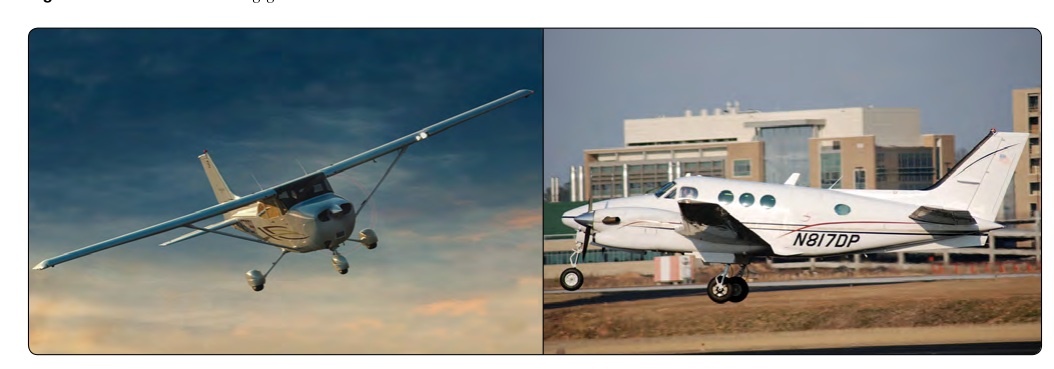
The landing gear is one of the most fundamental systems on any airplane, yet its design varies widely depending on the aircraft's intended mission. As a student pilot, you will almost certainly begin your training in an aircraft with fixed landing gear — gear that stays extended at all times. As you advance, you may transition to aircraft with retractable landing gear, which tucks away into the airframe during flight to reduce drag. Understanding the mechanical differences, operational procedures, and safety implications of each type is essential both for passing your FAA knowledge test and for flying safely throughout your career.
Beyond the basic question of whether the gear moves, there are also configuration variations — tricycle gear versus conventional (tailwheel) gear — that affect ground handling and pilot technique. This article covers all of these distinctions and the key facts the FAA expects every private pilot to know.
Basic Landing Gear Configurations
Before diving into fixed versus retractable, it helps to understand the two primary geometric arrangements of landing gear found on general aviation aircraft.
Tricycle (Nosewheel) Gear
The vast majority of modern training aircraft use tricycle gear, which features two main wheels roughly under the aircraft's center of gravity and a single nosewheel forward of the CG. This arrangement gives the aircraft a level or slightly nose-low stance on the ground. Tricycle gear offers significant advantages for student pilots: it provides inherently stable ground handling, reduces the tendency to groundloop, and gives the pilot better forward visibility during taxi and rollout. When a pilot lands with excessive speed or a slight crab angle, tricycle gear is generally more forgiving than its tailwheel counterpart.
Conventional (Tailwheel) Gear
Conventional gear, often called a taildragger, places the two main wheels forward of the CG and uses a small tailwheel or tail skid at the aft end of the fuselage. This puts the aircraft in a nose-high attitude on the ground. Historically, tailwheel designs were standard before nosewheel aircraft became dominant. They still appear on many bush planes, aerobatic aircraft, and older classic designs. Because the main gear sits ahead of the CG, any yawing tendency during landing or takeoff can be amplified into a groundloop — a rapid, uncontrolled rotation about the main gear — making tailwheel aircraft considerably more demanding to taxi, take off, and land. The FAA recognizes this added complexity, which is why a separate logbook endorsement is required to act as pilot-in-command of a tailwheel airplane.
Fixed Landing Gear
Fixed landing gear is permanently extended — there is no mechanism to raise or lower it. This simplicity is its greatest virtue. With no hydraulic actuators, uplocks, downlocks, squat switches, or warning systems required, the fixed-gear aircraft is lighter, mechanically simpler, and less expensive to purchase and maintain.
The trade-off is aerodynamic drag. The exposed wheels, struts, and fairings create significant parasite drag that increases with airspeed. Wheel fairings (also called wheelpants or speed fairings) are sometimes added to reduce this drag, but the penalty compared to retractable gear is always present. For aircraft designed for training, short cross-country flying, or modest cruise speeds, the drag penalty is entirely acceptable. A typical fixed-gear trainer like a Cessna 172 cruises around 120–130 knots, where the drag of exposed gear is a manageable fraction of total aircraft drag.
From a pilot-technique standpoint, fixed gear requires no action during climb or approach — there is no gear handle to move, and no gear-up or gear-down checklist item in the traditional sense. This reduces pilot workload and eliminates one category of procedural error entirely.
Retractable Landing Gear
As aircraft designs pushed for higher cruise speeds and greater efficiency, engineers developed retractable gear systems that allow the wheels to fold up into dedicated wheel wells in the wing, fuselage, or engine nacelles during flight. By eliminating the exposed gear from the airstream, a retractable-gear aircraft can achieve substantially higher cruise speeds for the same engine power, or achieve the same speed with less fuel burn. The drag reduction from retracting the gear can account for 20–40 knots of additional cruise speed in many light aircraft.
How Retractable Systems Work
Most light aircraft retractable gear systems use either hydraulic or electric actuators. Hydraulically actuated systems use fluid pressure — often generated by an engine-driven pump or a hand pump — to push the gear up or down. Electrically actuated systems use an electric motor to drive the gear through a series of mechanical linkages. Regardless of the method, the gear must be positively locked in both the up (retracted) and down (extended) positions. These locks prevent the gear from collapsing under load or from accidentally extending into the airstream.
A key safety feature of all retractable gear aircraft is the gear position indicating system. This typically consists of three green lights (one per gear) that illuminate when each gear is fully down and locked, and in many aircraft, a red or amber light or an absence of lights indicates gear in transit or not locked. Pilots must verify three green lights before landing. Many aircraft also include a gear warning horn that sounds when the throttle is retarded below a certain power setting and the gear is not down and locked — a critical reminder during approach.
Emergency Gear Extension
Because the primary gear extension system can fail, regulations and aircraft design standards require an alternate or emergency means of extending the gear. Depending on the aircraft, this may be a hand pump, a mechanical free-fall release, a CO₂ bottle, or a gravity-drop system. Pilots transitioning to retractable-gear aircraft must be thoroughly familiar with the specific emergency extension procedure for their aircraft type, as described in the Aircraft Flight Manual (AFM) or Pilot's Operating Handbook (POH).
Why It Matters — Safety and Regulatory Implications
The most costly and embarrassing retractable-gear accident is the gear-up landing — touching down with the gear retracted. Gear-up landings cause significant airframe damage, propeller strikes, possible engine damage, and occasionally injury. They are almost always the result of pilot error: distraction, checklist deviation, or failure to verify the gear position indication. The FAA emphasizes that thorough use of checklists and sterile cockpit discipline on approach are the primary defenses against this type of accident.
From a regulatory perspective, 14 CFR Part 61 requires a logbook endorsement from a qualified instructor before a pilot may act as pilot-in-command of a high-performance airplane (one with an engine of more than 200 horsepower) or a complex airplane. A complex airplane is specifically defined as one that has a retractable landing gear, flaps, AND a controllable-pitch propeller. Many retractable-gear aircraft also meet the high-performance definition. Pilots must have both endorsements if the aircraft qualifies for both categories.
Key Numbers and Rules
- Complex airplane definition (14 CFR 61.31): retractable landing gear + flaps + controllable-pitch propeller — all three features must be present.
- Tailwheel endorsement (14 CFR 61.31(i)): required before acting as PIC in a tailwheel aircraft; training must include normal and crosswind takeoffs and landings, wheel landings (if applicable), and go-arounds.
- Three green lights: standard indication of gear down and locked on most retractable-gear aircraft; always verify before landing.
- Gear warning horn: activates when throttle is reduced below a threshold power setting and gear is not down and locked — treat it as a mandatory action item, not background noise.
- Airspeed limitations: every retractable-gear aircraft has a VLO (maximum speed for operating — extending or retracting — the gear) and a VLE (maximum speed with the gear extended). Exceeding VLO during extension or retraction, or VLE with gear down, can cause structural damage to gear doors and actuators.
- Wheel fairings on fixed gear: improve aerodynamic efficiency but must be properly maintained; a loose or damaged fairing can cause handling problems or jam a nosewheel.
Common Test Traps
- Confusing complex with high-performance: A retractable-gear aircraft is not automatically complex — it must also have flaps AND a controllable-pitch propeller. Similarly, high-performance refers only to engine horsepower, not gear type. You need separate endorsements for each.
- VLO versus VLE: The FAA test frequently asks students to distinguish between these two speeds. Remember: VLO is the speed limit for the operation (movement) of the gear; VLE is the limit for flying with the gear extended. VLO is often lower than VLE.
- Groundloop misconception: Some students think any crosswind can cause a groundloop. In reality, groundloops are primarily a concern with conventional (tailwheel) gear, not tricycle gear, due to the CG being aft of the main wheels.
- Gear-up landing prevention: The FAA emphasizes that relying solely on the warning horn is insufficient. Positive visual confirmation of three green lights on every approach is the required standard.
- Tailwheel endorsement requirement: Many students are surprised that even a fully certificated private pilot needs an additional endorsement to fly a tailwheel aircraft. This is a commonly missed regulatory fact on the knowledge test.