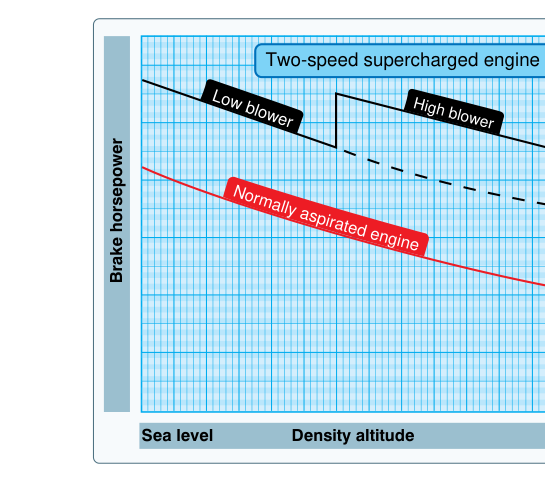
Every piston aircraft engine needs air and fuel to produce power. The critical variable is air density: the more air molecules packed into each intake stroke, the more fuel can be burned, and the more power the engine produces. At sea level, standard atmospheric pressure delivers plenty of dense air. As an aircraft climbs, however, air pressure and density drop steadily, and a normally aspirated engine simply cannot maintain its sea-level power output. Turbocharged engines solve this problem by using a compressor to force denser air into the engine regardless of altitude — at least up to a design limit called the critical altitude. Knowing how these two engine families differ helps you make smarter decisions about aircraft selection, performance planning, and day-to-day operation.
How a Normally Aspirated Engine Works
A normally aspirated (or naturally aspirated) engine relies entirely on atmospheric pressure to push air into the cylinders. On each intake stroke, the descending piston creates a partial vacuum, and outside air flows in — but only at whatever pressure the atmosphere happens to be providing at that altitude. At sea level under standard conditions (29.92 in. Hg, 59 °F / 15 °C), this works well, and the engine produces its rated horsepower. As the aircraft climbs, atmospheric pressure decreases roughly 1 inch of mercury for every 1,000 feet, so each intake stroke draws in progressively thinner air. As a rule of thumb, a normally aspirated engine loses approximately 3 percent of its power for every 1,000 feet of altitude gain. Using that approximation, the engine might be producing roughly 76 percent of its sea-level rated power by 8,000 feet, and roughly 64 percent by 12,000 feet — though this rule of thumb is not an FAA-published precise figure, and actual power loss varies by engine and is better determined from the aircraft's actual power charts. The throttle can be wide open and the mixture leaned correctly, yet the engine simply cannot produce its rated output because the air is too thin.
Density altitude is the critical concept here. When temperature is higher than standard, density altitude is higher than pressure altitude, meaning the engine behaves as though it is even higher than the altimeter shows. A hot summer day at a high-elevation airport can create density altitude conditions that reduce takeoff performance dramatically — even on a normally aspirated engine that felt perfectly adequate at a sea-level airport.
How a Turbocharged Engine Works
A turbocharger addresses the density problem by adding a compressor driven by energy that would otherwise be wasted out the exhaust pipe. Hot exhaust gases spin a turbine wheel; that turbine is mounted on the same shaft as a compressor (impeller) on the intake side. The compressor draws in outside air and squeezes it before delivering it to the engine's induction system, increasing its pressure and density. Because the engine now receives denser air, it can burn proportionally more fuel and maintain power output at altitude.
The critical altitude is the highest altitude at which the turbocharger can compress intake air enough to maintain sea-level manifold pressure (typically around 29–30 in. Hg). Below the critical altitude, the pilot uses the throttle to control manifold pressure, just as in a normally aspirated engine; the turbocharger is doing extra work but the throttle plate limits airflow. Above the critical altitude, the compressor is operating at maximum capacity, and power begins to drop off, similar to a normally aspirated engine — only from a much higher starting point. Many general aviation turbocharged aircraft have critical altitudes in the range of 16,000 to 20,000 feet, though exact figures vary by model.
Turbocharging vs. Turbo-Normalizing
It is worth noting a distinction that appears in FAA materials. A turbonormalized engine is designed only to restore sea-level power at altitude — the compressor is sized so that at sea level and low altitude, manifold pressure cannot significantly exceed ambient levels. A true turbocharged (or over-boosted capable) engine can push manifold pressure well above sea-level standard, producing power that exceeds the engine's sea-level normally aspirated rating. Overboosting a turbo engine — exceeding the manufacturer's maximum manifold pressure — can cause serious internal damage, so pilots of turbocharged aircraft must monitor the manifold pressure gauge carefully, particularly during rapid throttle advances.
Key Operational Differences in the Cockpit
Flying a turbocharged aircraft requires habits that differ noticeably from flying a normally aspirated type:
- Throttle response: In a normally aspirated engine, opening the throttle at altitude simply opens the throttle plate — the response is gentle because there is less air available. In a turbocharged engine, the compressor is already spinning; rapid throttle advancement can spike manifold pressure beyond limits before the pilot realizes it.
- Manifold pressure monitoring: The manifold pressure gauge is critical in turbocharged aircraft. Pilots must never exceed the maximum allowable manifold pressure listed in the Pilot's Operating Handbook (POH). Common limits are 30–36 in. Hg depending on the engine, but always use the specific aircraft's POH.
- Mixture management: Both engine types require leaning as altitude increases. However, because a turbocharged engine maintains higher manifold pressure at altitude, the combustion environment is different. At high altitude, mixture control is equally important, and the risk of detonation from an excessively lean mixture or inadequate cooling at high power settings demands attention — a properly rich mixture actually helps cool the cylinders and reduce detonation risk.
- Engine cooling: Turbochargers produce significant heat — both from the exhaust-driven turbine and from the compressed air (compressing air raises its temperature). Many turbocharged aircraft include an intercooler (charge air cooler) to reduce the temperature of compressed air before it enters the cylinders, which also increases its density and reduces the risk of detonation.
- Turbocharger cool-down: After landing, a turbocharged engine should be allowed to idle for several minutes before shutdown. The turbocharger turbine spins at extremely high RPM and operates at very high temperatures. Shutting down immediately traps hot oil in the bearings; that oil can coke (carbonize), damaging bearings over time. Oil continues to flow and cool the bearings during idle — this is not an issue in normally aspirated engines.
- Altitude capability: Turbocharged aircraft are often certified for higher cruise altitudes, which means pilots may need to use supplemental oxygen for flight above 12,500 feet (as required by 14 CFR Part 91) and carry oxygen systems for passengers as well.
Why It Matters — Safety and Performance
Understanding the difference between these engine types is not just academic. A pilot transitioning from a normally aspirated Cessna 172 to a turbocharged Beechcraft Bonanza or Cessna T210 is operating with a fundamentally different powerplant that punishes careless throttle handling and poor systems knowledge. The higher altitudes enabled by turbocharging also introduce new weather concerns, oxygen requirements, and instrument flying demands.
Conversely, pilots of normally aspirated aircraft operating at high-elevation airports must understand that their engine's effective power at field elevation can be significantly less than its sea-level rating. Density altitude calculations are not optional — they are essential for safe takeoff distance and climb performance planning. A 6,000-foot airport on a hot afternoon may present the engine with a density altitude above 9,000 feet, cutting available power substantially and extending the required runway distance significantly.
Key Numbers and Rules
- Power loss, normally aspirated: Approximately 3% per 1,000 feet of altitude.
- Critical altitude: The altitude above which a turbocharger can no longer maintain sea-level manifold pressure; varies by aircraft but commonly 16,000–20,000 ft for GA turbocharged types.
- Oxygen requirements (14 CFR 91.211): Required crew use of supplemental oxygen above 12,500 ft MSL for more than 30 minutes; required above 14,000 ft MSL at all times; passengers must be provided oxygen above 15,000 ft MSL.
- Overboost damage: Exceeding maximum manifold pressure, even briefly, can cause preignition, detonation, and mechanical damage — always advance the throttle smoothly and monitor the gauge.
- Turbo cool-down: Idle the engine for 2–5 minutes (or as specified in the POH) before shutdown to prevent oil coking in turbocharger bearings.
- Density altitude effect: As a commonly cited rule of thumb, every 1°C above standard temperature at a given pressure altitude raises density altitude approximately 120 feet — this is an approximation that varies with pressure altitude, not a fixed FAA constant.
Common Test Traps
- Confusing manifold pressure limits: Test questions sometimes describe a pilot advancing the throttle rapidly in a turbocharged aircraft. The correct concern is overboosting — exceeding maximum manifold pressure — not carburetor icing or mixture issues.
- Critical altitude vs. service ceiling: Critical altitude is specific to the turbocharger's ability to maintain sea-level manifold pressure — it is not the same as the aircraft's service ceiling or absolute ceiling. Above critical altitude, power decreases, but the aircraft can still climb higher.
- Normally aspirated power at altitude: Questions may ask what happens when a normally aspirated pilot opens the throttle fully at altitude. The answer is the engine cannot produce rated power regardless of throttle position — air density, not throttle position, is the limiting factor.
- Turbo cool-down omission: Shutting down a turbocharged engine immediately after landing without an idle period is a common error on written questions and in real operations — it causes bearing damage due to oil coking.
- Oxygen requirement thresholds: Students frequently confuse the 12,500 ft (30-minute rule), 14,000 ft (crew always), and 15,000 ft (passengers must be provided) thresholds. These are commonly tested in the context of high-altitude turbocharged operations.