The reciprocating engine is the heartbeat of most general aviation aircraft, and understanding how it works is more than a test-day formality. When you know what happens inside each cylinder during the four strokes of the engine cycle, you can make smarter decisions about throttle management, mixture control, engine starts, and troubleshooting rough-running symptoms. The FAA expects every private pilot candidate to understand this cycle, and the practical benefits extend throughout your flying career.
A four-stroke engine completes one full power cycle over two complete revolutions of the crankshaft — four strokes of the piston, two down and two up. Each cylinder fires once per every two crankshaft revolutions. In a typical six-cylinder Lycoming or Continental engine, the cylinders are timed to fire in sequence so that power pulses overlap smoothly, producing what feels like a steady, continuous output at the propeller.
The Four Strokes in Detail
Stroke 1: Intake
The cycle begins with the piston moving downward from top dead center (TDC) toward bottom dead center (BDC). As it descends, it creates a low-pressure area inside the cylinder. The intake valve opens and a mixture of vaporized fuel and air is drawn in from the carburetor or fuel injection system. The exhaust valve remains closed during this stroke. By the time the piston reaches BDC, the cylinder is filled with a combustible charge. One practical note: the intake valve actually opens slightly before TDC (valve lead) and closes slightly after BDC (valve lag) — this intentional overlap maximizes cylinder filling, especially at higher RPM.
Stroke 2: Compression
With both the intake and exhaust valves now closed, the piston travels back upward toward TDC, compressing the fuel-air mixture into a much smaller volume. The ratio of the cylinder volume at BDC to the volume at TDC is called the compression ratio. Most aircraft engines use compression ratios in the range of about 7:1 to 8.5:1 — high enough to extract good energy from the charge, but low enough to avoid detonation when using the correct aviation fuel. As the mixture is compressed, its temperature rises significantly. This is why the correct fuel grade matters: a mixture that auto-ignites before the spark plug fires (pre-ignition or detonation) can destroy an engine quickly.
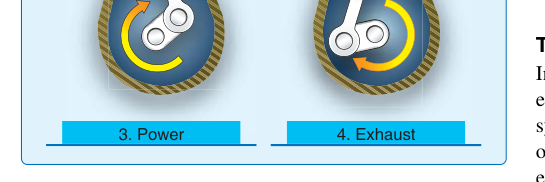
Stroke 3: Power
Just before the piston reaches TDC on the compression stroke, the spark plugs fire — actually, the two plugs fire at nearly (but not perfectly) the same instant in most aircraft engines, which have a dual ignition system (two independent magnetos, each powering one plug per cylinder). The spark ignites the compressed mixture, which burns rapidly and expands. This expanding gas pushes the piston downward with considerable force, rotating the crankshaft through a connecting rod. This is the only stroke that produces power; the other three strokes are necessary but are driven by the engine's momentum (and by other cylinders firing in sequence). The dual-plug design not only provides redundancy but also promotes more complete combustion, which improves efficiency and reduces operating temperatures.
Stroke 4: Exhaust
As the piston approaches BDC at the end of the power stroke, the exhaust valve opens. The piston then travels back upward, pushing the spent combustion gases out of the cylinder and through the exhaust system. The intake valve remains closed. When the piston reaches TDC again, the exhaust valve closes, the intake valve opens, and the entire cycle begins again. Like the intake valve, the exhaust valve uses timing overlap — it opens just before BDC and closes just after TDC — to scavenge as much exhaust gas as possible and maximize fresh charge intake.
How the Engine Translates Piston Motion into Propeller Thrust
The linear (up-and-down) motion of the piston is converted to rotary motion by the crankshaft via the connecting rod. The crankshaft's offset journals convert each downward power stroke into rotation. That rotary output connects directly — or through a reduction gearbox on some engines — to the propeller, which converts the rotational energy into thrust. The entire system is elegantly simple, which is one reason the reciprocating engine has been so reliable in aviation for over a century.
The Role of the Magneto and Ignition Timing
Aircraft engines use magnetos rather than a battery-powered ignition system. A magneto is a self-contained AC generator that produces high-voltage pulses to fire the spark plugs. Because it generates its own electricity, the ignition system operates independently of the aircraft's electrical system — the engine keeps running even if the battery or alternator fails. This is why the engine must be shut down with the mixture or fuel shutoff rather than the magneto switch alone: turning off the magnetos disables spark, but a hot cylinder with fuel still flowing could potentially fire again if the propeller is moved.
Ignition timing refers to how early before TDC the spark fires. The mixture takes a brief moment to fully ignite and build peak pressure, so the spark is timed to occur slightly before TDC so that maximum pressure acts on the piston just after TDC, producing the most efficient power stroke. Advancing the timing too far can cause detonation; retarding it too far reduces power and raises exhaust temperatures.
Why It Matters for Pilots
Understanding the four-stroke cycle has direct practical consequences in the cockpit:
- Mixture management: The fuel-air charge drawn in during the intake stroke must be properly proportioned. As altitude increases, air density decreases, so the same throttle position pulls in less air mass. Leaning the mixture (reducing fuel flow to match reduced air) keeps the ratio correct, prevents fouled spark plugs from an overly rich mixture, and saves fuel. Leaning toward peak EGT can raise cylinder head temperatures (CHT) and risk detonation, though leaning further past peak often reduces CHT again — the mixture-temperature relationship is more nuanced than a simple 'leaner is hotter' rule.
- Carburetor heat: During the intake stroke, fuel vaporizes and the temperature drop can cause ice to form in the carburetor venturi. Applying carb heat introduces warm air to prevent or clear this ice — understanding the intake process explains why this matters.
- Detonation awareness: Detonation occurs when the compressed fuel-air mixture auto-ignites before or after the normal spark event, creating uncontrolled pressure spikes. Causes include excessively lean mixture, low-grade fuel, high engine temperatures, or excessive manifold pressure. Symptoms include rough engine operation and elevated CHT. Immediate correction (enrichen mixture, reduce power, increase airspeed for cooling) is essential.
- Pre-ignition: Distinct from detonation, pre-ignition occurs when a hot spot in the cylinder (such as a glowing carbon deposit) ignites the mixture before the spark plugs fire. It can occur even when the magnetos are off, which underscores safe propeller-handling procedures on the ground.
- Engine run-up: The magneto check during run-up tests each ignition system independently. A small RPM drop (typically around 50–125 RPM, per the specific aircraft's POH) when switching to one magneto is normal and expected — it confirms both plugs were firing and now only one is. An excessive drop or rough running indicates a problem requiring maintenance before flight.
Key Numbers and Rules
- The four-stroke cycle requires two full crankshaft revolutions to complete.
- Each cylinder fires once per two crankshaft revolutions.
- Aircraft engines typically use dual magnetos with two spark plugs per cylinder for redundancy and combustion efficiency.
- Typical compression ratios for normally-aspirated aircraft engines: approximately 7:1 to 8.5:1.
- Magneto RPM drop during run-up: acceptable drop values vary by aircraft and are defined in the specific aircraft's POH/AFM — there is no single FAA-mandated limit, so always check the POH for the exact figures.
- The power stroke is the only one of the four strokes that produces work; the others consume energy stored in the rotating crankshaft and flywheel.
Memory Aid
A classic mnemonic for the four strokes in order is "Suck, Squeeze, Bang, Blow" — informal but highly effective:
- Suck — Intake stroke: the piston draws the fuel-air mixture into the cylinder.
- Squeeze — Compression stroke: the piston compresses the mixture with both valves closed.
- Bang — Power stroke: the spark plugs fire, igniting the mixture and driving the piston down.
- Blow — Exhaust stroke: the piston pushes burned gases out through the open exhaust valve.
Once you have these four words locked in order, you can reconstruct every detail of what the valves, pistons, and spark plugs are doing at each phase.
Common Test Traps
- Confusing which stroke produces power: The FAA knowledge test may ask which stroke generates the useful work output. Only the power (combustion) stroke drives the piston down with force; the intake, compression, and exhaust strokes are preparatory or scavenging phases.
- Crankshaft revolutions per cycle: A common distractor is one revolution. Remember: two complete crankshaft revolutions are required to complete all four strokes.
- Valve positions during compression: Both intake and exhaust valves are closed during the compression stroke. Test questions may imply the exhaust valve opens to release pressure — it does not; it stays closed so the mixture can be properly compressed and ignited.
- Magneto independence: Students sometimes assume that turning off the magneto switch cuts all ignition risk. In fact, if a magneto is internally grounded incorrectly (a "hot mag"), it can still fire when the propeller is turned even with the switch off — a key reason for never casually hand-propping an aircraft and always treating the propeller as live.
- Detonation vs. pre-ignition: These are distinct phenomena. Detonation is explosive, uncontrolled combustion of the end-gases after the spark fires. Pre-ignition is ignition of the charge before the spark fires, caused by a hot spot. Both are dangerous, but they have different causes and slightly different cockpit signatures.