Few in-flight emergencies are more preventable — or more misunderstood — than engine failure caused by fuel problems. The FAA accident record is filled with cases where pilots ran engines to silence not because the airplane had no fuel on board, but because a simple procedural mistake denied the engine the fuel that was sitting right there in the tanks. Understanding the precise distinction between fuel exhaustion and fuel starvation is not just a knowledge-test requirement; it is a survival skill that separates prepared pilots from statistics.
This article breaks down both failure modes — how they happen, how they feel from the cockpit, and exactly what you do about each. It also highlights the common misconceptions that cost pilots their lives and that the FAA loves to exploit on the written exam.
Fuel Exhaustion: Running the Tanks Dry
Fuel exhaustion is the simpler concept of the two: the airplane has consumed all of its usable fuel and the engine stops because there is literally nothing left to burn. "Usable fuel" is the operative phrase. Every aircraft's fuel system contains some amount of unusable fuel — fuel trapped below the fuel-outlet fitting or elsewhere in the system that cannot be drawn by the fuel pump under normal flight attitudes. This unusable quantity is listed in the Pilot's Operating Handbook (POH) and is factored out of the total fuel capacity when you compute range and endurance. You never get to burn it.
Exhaustion is almost always a preflight or planning failure. The Pilot's Handbook of Aeronautical Knowledge (PHAK, FAA-H-8083-25) emphasizes that pilots must visually verify fuel quantity rather than relying solely on fuel gauges, which are notoriously imprecise in light aircraft. A gauge reading one-quarter full may be optimistic due to tank contamination, a faulty sender, or fuel expansion and contraction with temperature. The only reliable measurement is a direct visual check with a calibrated drip stick or by visually inspecting the tank and cross-referencing against a known calibration mark.
Planning Minimums That Prevent Exhaustion
Under 14 CFR Part 91, VFR day flights must carry enough fuel to reach the first intended landing point plus, assuming normal cruising speed, at least 30 minutes of additional fuel. VFR night flights require at least 45 minutes of reserve under the same standard. IFR flights must carry enough fuel to fly to the first airport of intended landing, then to an alternate (if one is required), and then for 45 minutes at normal cruising speed (14 CFR 91.167). These are minimums — experienced pilots routinely plan for more cushion, and the FAA's risk management guidance (FAA-H-8083-2) explicitly identifies fuel reserves as a critical personal minimums item. Winds aloft that are stronger than forecast, an unplanned detour around weather, or a lengthy ATC hold can devour a thin reserve with alarming speed.
The symptom of fuel exhaustion is straightforward: the engine begins to run rough as the last dregs of fuel are consumed, then loses power progressively and stops. There may be brief sputtering or surging as air enters the fuel lines. By the time this happens, no in-cockpit action will restart the engine with power — you are committed to a forced landing. Your priorities shift immediately to best-glide speed, selecting a suitable landing area, and running the emergency checklist (which includes attempting a restart only if altitude permits and the cause is confirmed).
Fuel Starvation: Fuel Aboard, Engine Starved
Fuel starvation is fundamentally different and, in many ways, more insidious. The airplane has usable fuel on board — sometimes full tanks — but the engine is not receiving it. The interruption occurs somewhere between the tank and the engine: a closed fuel selector, a mispositioned valve, a clogged fuel line, a failed mechanical fuel pump, or a vapor lock condition.
The most common cause by a wide margin is an incorrectly positioned fuel selector valve. Many training aircraft (the Cessna 172 being the quintessential example) have a selector with positions for LEFT tank, RIGHT tank, BOTH, and OFF. Pilots who inadvertently leave the selector on a tank that has run dry — or who accidentally bump it to OFF — will experience sudden engine silence even with the other tank full. This is the scenario that makes fuel starvation so tragic: the fuel is there, the pilot just cannot access it.
Other starvation causes include:
- Fuel boost pump failure combined with vapor lock: In hot weather or at high altitude, fuel can vaporize in the lines before reaching the engine. The electric boost pump is the pilot's first tool to overcome this. Failing to turn on the boost pump during takeoff and climb in high-temperature or high-altitude conditions (as specified in the POH) leaves the engine vulnerable.
- Contaminated fuel strainer or gascolator: Water, sediment, or ice can block the main fuel strainer, restricting flow even with full tanks. This is why the POH requires sump draining during preflight — not just checking for water, but ensuring flow is unobstructed.
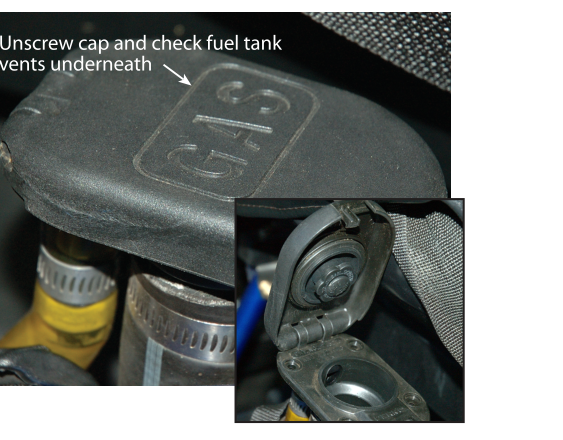
- Improper fuel cap seating: A poorly seated or missing fuel cap creates a partial vacuum (siphon effect) in the tank on some aircraft designs, or allows fuel to vent overboard, reducing available fuel faster than planned.
- Fuel selector left on BOTH during aerobatics or unusual attitudes (where applicable): On aircraft where the BOTH position is not approved for certain maneuvers, unporting of one tank's outlet can allow air ingestion.
How to Tell Them Apart — and Why It Matters for Your Response
In the cockpit, both emergencies announce themselves the same initial way: engine roughness, loss of rpm, and ultimately engine stoppage. The critical difference emerges the moment you begin working the emergency checklist. The PHAK and the Airplane Flying Handbook (AFH, FAA-H-8083-3) both describe the standard engine-out emergency checklist sequence, which includes checking the fuel selector position and switching tanks, turning on the auxiliary fuel pump, and verifying/adjusting the mixture to full rich (or leaning appropriately at high density altitude per the POH).
If the cause is starvation, these checklist actions — particularly switching the fuel selector to a tank that has fuel — will often restore engine power relatively quickly, sometimes within seconds as fuel reaches the engine-driven pump. This is why proper checklist execution can be the difference between a miraculous in-flight restart and an off-airport landing.
If the cause is exhaustion, no amount of selector switching will help; all usable fuel is gone. Recognizing this quickly allows the pilot to stop troubleshooting and focus entirely on executing the best-glide forced landing, which requires full attention. Wasting altitude on futile restart attempts when all fuel is gone can cost you the only good landing spot within reach.
Key Numbers and Rules
- VFR day fuel reserve (14 CFR 91.151): Fuel to destination plus, assuming normal cruising speed, at least 30 minutes.
- VFR night fuel reserve (14 CFR 91.151): Fuel to destination plus, assuming normal cruising speed, at least 45 minutes.
- Unusable fuel: Listed in the Limitations or Weight and Balance section of a GAMA-format POH (the exact section number varies by aircraft); must never be counted in flight planning calculations.
- Best glide speed: Published in the Emergency Procedures section of the POH (commonly Section 3, though numbering varies by aircraft); fly this speed immediately after any power loss to maximize distance and time to select a landing area.
- Fuel cap check: Required during preflight — visually confirm caps are secure and vents are unobstructed.
- Fuel selector: Check position (BOTH or correct tank) before every takeoff and landing per most POHs; many require BOTH for takeoff and landing.
Why It Matters: The Accident Record
The NTSB and FAA have identified fuel mismanagement as one of the leading causes of general aviation accidents for decades. What makes these accidents especially tragic is their preventability. A pilot who departs with confirmed usable fuel, monitors consumption against a flight plan, switches tanks on schedule, and runs the emergency checklist in the correct order has an enormous statistical advantage over one who relies on gauges and habits alone. The Airplane Flying Handbook devotes significant attention to fuel management precisely because experience has shown that knowledge of the system — not luck — determines outcomes.
From an aeronautical decision-making perspective (ADM, covered in depth in FAA-H-8083-2 and FAA-H-8083-9), fuel management involves ongoing situational awareness: knowing how much fuel you started with, how long you have been flying, what power setting you are using, and what the gauges suggest compared to your mental model. When these inputs diverge, the correct response is to land and verify — not press on and hope.
Common Test Traps
- "No fuel on board" assumption: The exam may describe a scenario where the engine quits but fuel is on board. Students who assume engine failure always means empty tanks will miss that this is a starvation scenario requiring a selector check, not just a forced landing drill.
- Unusable vs. total fuel confusion: Questions often provide a total fuel capacity and ask about range. Failing to subtract unusable fuel from the calculation produces an optimistic — and dangerous — answer.
- Reserve minimums as trip totals: Some students think 30 minutes is the total legal fuel for a VFR day trip. It is the reserve beyond the fuel needed to reach the destination.
- Boost pump omission: Starvation from vapor lock is associated with NOT using the boost pump during takeoff and climb. Questions about engine roughness on initial climb in hot weather often test this concept.
- Selector position complacency: The exam frequently presents a scenario where a pilot takes off with the selector on an empty or nearly empty tank. The correct first action after an engine anomaly is to run the checklist — which starts with verifying fuel selector position — before declaring the situation unrecoverable.