The United States National Airspace System (NAS) is divided into distinct categories, each designed to balance the needs of air traffic control, safety, and efficient flight operations. For both manned aircraft pilots and FAA Part 107 remote pilots, understanding these airspace classes is not optional — it is a fundamental legal and safety requirement. The FAA has structured airspace into two broad categories: controlled airspace (Classes A, B, C, D, and E) and uncontrolled airspace (Class G). Each class carries specific requirements for entry, equipment, communication, and weather minimums that every aviator — remote or otherwise — must know cold before ever lifting off.
This article walks through each airspace class systematically, explaining what it is, where it exists, what is required to operate within it, and why those rules exist. For Part 107 remote pilots in particular, this knowledge directly governs where you can legally fly your sUAS and what authorizations you may need to obtain.
The Big Picture: Why Airspace Is Classified
The FAA classifies airspace primarily based on the complexity and density of aircraft operations in a given area. Busy terminal environments around major commercial airports demand the strictest control so that controllers can sequence dozens of aircraft safely. Rural areas far from airports, by contrast, see little traffic and need minimal oversight. The classification system — which follows the International Civil Aviation Organization (ICAO) framework — creates a layered, predictable structure that all pilots can learn once and apply everywhere in the country.
For remote pilots, the stakes are especially high because small unmanned aircraft systems (sUAS) are largely invisible to air traffic controllers and may be difficult for manned aircraft to see and avoid. This is precisely why Part 107 prohibits operating in certain airspace classes without prior FAA authorization, and why understanding boundaries is so critical.
Class A: The High-Altitude Superhighway
Class A airspace extends from 18,000 feet mean sea level (MSL) up to and including Flight Level 600 (FL600), which is 60,000 feet MSL. This airspace covers the continental United States, Alaska, and certain offshore areas. All operations in Class A are conducted under Instrument Flight Rules (IFR). Pilots must be instrument-rated, the aircraft must be properly equipped, and ATC clearance is required before entry.
For Part 107 remote pilots, Class A is essentially irrelevant in practice — sUAS operations are limited by regulation to a maximum of 400 feet above ground level (AGL) in most circumstances, placing them nowhere near Class A airspace. Still, understanding its existence rounds out your airspace knowledge for the exam.
Class B: The Busiest Airspace on Earth
Class B airspace surrounds the nation's busiest airports — think Atlanta Hartsfield, Los Angeles International, Chicago O'Hare, and similar large commercial hubs. It is depicted on sectional charts as solid blue lines and is often described as an upside-down wedding cake: a layered structure with a large outer ring at lower altitudes and a smaller core extending from the surface up to a ceiling that is typically 10,000 feet MSL, though exact dimensions vary by location.
Entry into Class B requires an explicit ATC clearance — not just a radio call, but actual approval. For manned aircraft, a student pilot certificate alone is not enough; student pilots must receive specific training and an endorsement to operate in Class B. All aircraft must have a Mode C transponder (altitude-reporting) and ADS-B Out equipment.
For Part 107 remote pilots, Class B airspace requires FAA authorization before flight. This is typically obtained through the LAANC (Low Altitude Authorization and Notification Capability) system or through DroneZone if LAANC is unavailable. Flying in Class B without authorization is a federal violation.
Class C: Major Regional Airports
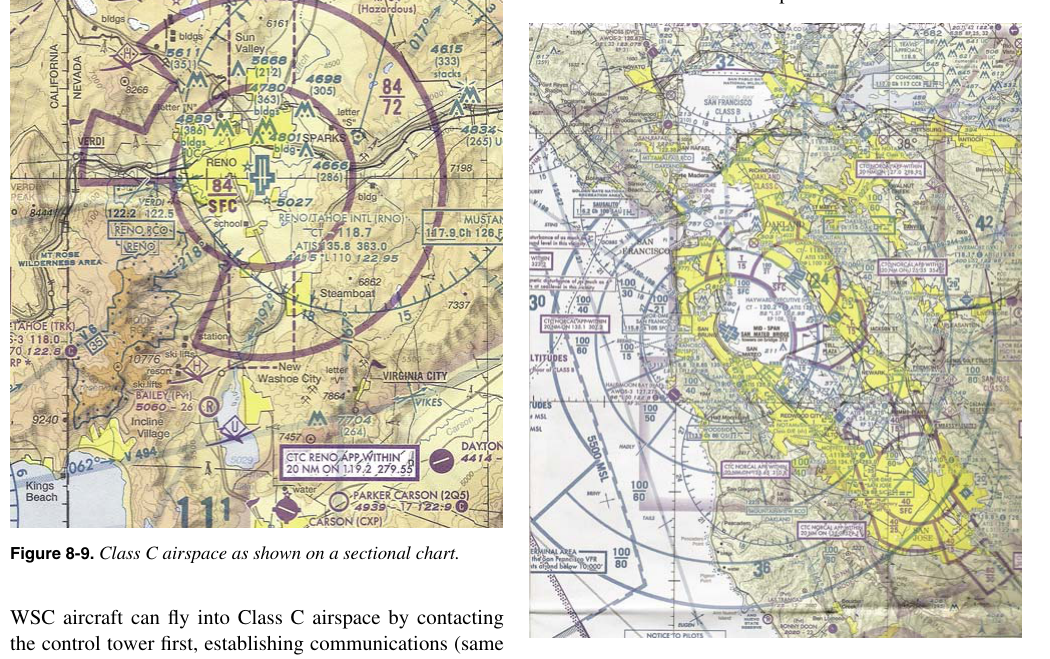
Class C surrounds airports with an operational control tower, radar approach control, and a certain level of scheduled airline service — airports like Portland, Tucson, or Raleigh-Durham. It is depicted on sectional charts as solid magenta circles and generally consists of two rings: an inner surface area with a 5 nautical mile (NM) radius from the surface up to 4,000 feet above the airport elevation, and an outer ring with a 10 NM radius from 1,200 feet up to 4,000 feet above the airport elevation. Because these ceilings are referenced to the airport's elevation (charted as MSL values) rather than a generic AGL measurement, exact numbers can vary somewhat by location. An outer area of 20 NM radius exists for radar sequencing but does not carry the same entry requirements.
Manned aircraft must establish two-way radio communication with approach control before entering Class C. Required equipment includes a two-way radio, Mode C transponder, and ADS-B Out. For remote pilots, Class C airspace requires the same FAA authorization process as Class B — LAANC or DroneZone approval before operations.
Class D: Towered Airports
Class D airspace surrounds airports with an operating control tower that do not qualify for Class B or C designation. It is shown on sectional charts as dashed blue lines and generally extends from the surface to 2,500 feet AGL, with a lateral radius of approximately 4 to 5 NM, though exact dimensions are published in the Chart Supplement.
Manned pilots must establish two-way radio communication with the tower before entering. No specific transponder or ADS-B equipment is mandated solely for Class D entry, though many situations trigger those requirements anyway. Critically, when the tower is not in operation, Class D typically reverts to Class E or Class G airspace — a fact frequently tested on FAA knowledge exams.
Part 107 remote pilots need FAA authorization to fly in Class D airspace. LAANC handles many Class D authorizations automatically and near-instantaneously. Always check whether the tower is actually operational at the time of flight, because airspace class can change with tower hours.
Class E: The Workhorse of Controlled Airspace
Class E is the most expansive controlled airspace category, filling in the gaps between the surface-based Classes B, C, and D and the high-altitude Class A. It exists in several forms:
- Surface-level Class E: Depicted by a dashed magenta line, it begins at the surface around certain airports that have instrument approaches but no control tower. This is a frequent exam trap — pilots assume uncontrolled airspace at untowered airports, but surface-level Class E tells a different story.
- Class E beginning at 700 feet AGL: Shown by a fuzzy magenta vignette (shaded edge) on sectional charts. Common around airports with instrument approach procedures, it transitions from Class G below 700 feet to Class E above.
- Class E beginning at 1,200 feet AGL: The default airspace over most of the continental United States where no other designation applies.
- Class E beginning at 14,500 feet MSL: Covers areas where Class G extends unusually high in remote terrain.
For Part 107 remote pilots, Class E airspace that begins at the surface requires FAA authorization, just like B, C, and D. Class E that begins at 700 feet or 1,200 feet AGL does not require authorization for sUAS flying below those floors, since your operations typically occur within Class G beneath those ceilings — but you must verify the actual airspace floor at your specific location and altitude.
Class G: Uncontrolled Airspace
Class G is uncontrolled airspace — the FAA does not provide air traffic separation services here. It generally exists from the surface up to the base of whatever controlled airspace begins above it (commonly 700 feet or 1,200 feet AGL, depending on location). In remote areas, Class G can extend up to 14,500 feet MSL.
For Part 107 remote pilots, Class G is the most permissive environment. No FAA authorization is required to fly in Class G airspace, making it the default operating environment for most routine sUAS flights. However, all other Part 107 rules still apply: maximum 400 feet AGL, visual line of sight, daylight or civil twilight with anti-collision lighting, and so on. Class G is not a regulatory free-for-all — it simply means you don't need airspace-specific clearance.
Key Numbers and Rules
- Class A: 18,000 feet MSL to FL600; IFR only; ATC clearance required.
- Class B: Surface to ~10,000 feet MSL (varies); ATC clearance required; Mode C and ADS-B Out required; sUAS needs LAANC/DroneZone authorization.
- Class C: Surface to ~4,000 feet above airport elevation; two-way radio contact required; 5 NM inner / 10 NM outer rings; sUAS needs authorization.
- Class D: Surface to ~2,500 feet AGL; two-way radio contact required; reverts when tower closes; sUAS needs authorization.
- Class E (surface): Dashed magenta line; sUAS needs authorization.
- Class E (700 AGL / 1,200 AGL): No sUAS authorization needed below the floor.
- Class G: Surface to overlying controlled airspace; no sUAS authorization required.
- Part 107 altitude ceiling: 400 feet AGL maximum (or up to 400 feet above a structure when within 400 feet of that structure).
Common Test Traps
- Class D reverts when the tower closes. The FAA knowledge test loves to ask what class of airspace a towered airport becomes after the tower shuts down. The answer is usually Class E or Class G — check the Chart Supplement for the specific designation.
- Surface-level Class E is still controlled. An untowered airport surrounded by a dashed magenta line is in Class E from the surface — it is controlled airspace, and sUAS pilots need authorization to fly there, just as they would at a towered airport.
- Class C outer area is not Class C. The 20 NM outer area surrounding Class C provides radar services but is not itself Class C. Two-way communication is not legally required for entry into the outer area, though it is strongly recommended.
- Authorization ≠ clearance ≠ radio call. For remote pilots, authorization comes from LAANC or DroneZone — not from calling the tower. Part 107 pilots are not required to communicate with ATC during flight even with authorization, unless local conditions or the authorization itself requires it.
- Class B requires an explicit clearance, not just contact. For manned aircraft, entering Class B without hearing the words "cleared into the Class Bravo airspace" — even if you are in communication with ATC — is a violation. Remote pilots should remember that their analog to this is approved LAANC authorization or DroneZone approval.