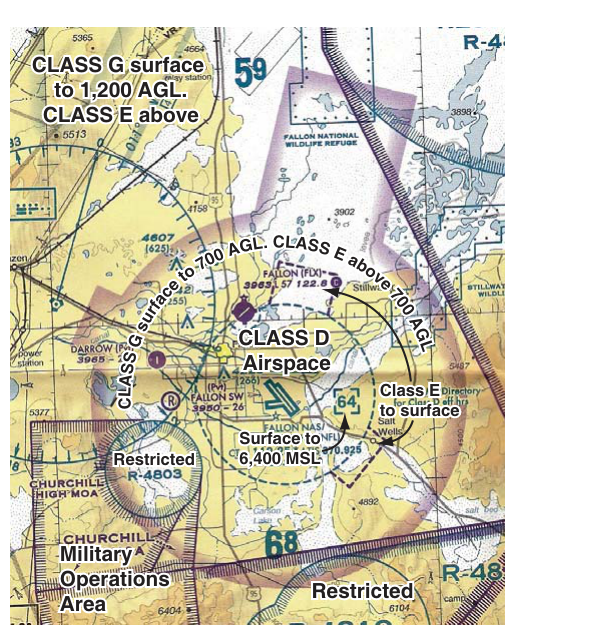
Class D airspace is one of the most commonly encountered controlled airspace designations in the United States. It typically surrounds airports that have an operating control tower but do not have the traffic volume or complexity to warrant Class B or Class C airspace. Understanding Class D airspace is essential for every student pilot and Part 107 remote pilot — not only to pass the FAA knowledge test, but to operate safely in the real-world airspace environment where general aviation and commercial activity intersect daily.
For remote pilots certificate holders operating under 14 CFR Part 107, Class D airspace requires prior authorization before any UAS operation may take place. That distinction — authorization versus simple radio communication — makes it critically important to understand both the structure of Class D airspace and the rules that govern access to it, whether you are flying a manned aircraft or a small unmanned aircraft system (sUAS).
Structure of Class D Airspace
Class D airspace is depicted on sectional aeronautical charts as a blue dashed line forming a circle or modified circle around the associated airport. This dashed blue boundary distinguishes it clearly from Class C airspace (solid magenta circle) and Class B airspace (solid blue circle with multiple rings). When you see that blue dashed ring, you immediately know you are approaching Class D airspace.
The lateral dimensions of Class D airspace are tailored to the instrument approach procedures used at the specific airport. The standard radius is approximately 4 nautical miles from the primary airport, though the actual boundary is drawn to include instrument approach corridors, so the shape is rarely a perfect circle. Extensions may jut outward to accommodate final approach courses, and these extensions are also depicted on sectional charts.
The vertical dimensions of Class D airspace extend from the surface up to 2,500 feet above the airport elevation (this figure is referenced to the airport's elevation, essentially an AGL-based limit, even though the chart displays the resulting ceiling as an MSL altitude for operational use). The ceiling of Class D airspace is shown on the sectional chart inside the blue dashed circle as a two-digit number in brackets — for example, [25] means the ceiling is 2,500 feet MSL. Above that ceiling, the airspace transitions to Class E or Class G, and controlled airspace rules no longer apply in the same way. This upper boundary is important: an aircraft flying at 3,000 feet MSL above a Class D airport with a ceiling of 2,500 feet MSL is technically above the Class D and is not required to contact that tower — though awareness of traffic below remains a prudent practice.
Class D airspace exists only while the control tower is in operation. Many smaller airports with towers operate only during certain hours — for example, 0700–2200 local time. Outside of those published hours, the Class D airspace reverts to Class E or Class G, depending on the chart depiction and the existence of an instrument approach. Pilots must check current NOTAMs and the Airport/Facility Directory (now called the Chart Supplement) to confirm tower operating hours before flight.
Entry Requirements for Manned Aircraft
The fundamental requirement for manned aircraft to enter Class D airspace is the establishment of two-way radio communication with ATC prior to entry. This is codified in 14 CFR §91.129. The rule does not require ATC to issue a clearance or explicit permission — it simply requires that the pilot make contact and receive an acknowledgment that includes the aircraft's call sign. If the controller responds with something like "N12345, standby," two-way communication has been established and the pilot may enter.
If ATC does not respond using the aircraft's call sign — for example, responding with "aircraft calling, standby" — two-way communication has not been established, and the pilot must not enter the airspace. This is a classic test question and a common real-world source of confusion. The specific call sign acknowledgment is the legal threshold.
Once inside Class D airspace, pilots flying VFR must comply with any instructions from ATC, maintain the appropriate traffic pattern altitude unless otherwise instructed, and follow standard operating procedures for the airport. Communication must be maintained throughout the transit or operation within the Class D.
Entry Requirements for Part 107 Remote Pilots (sUAS)
For remote pilots operating under 14 CFR Part 107, the entry requirement is fundamentally different. A UAS cannot communicate over radio frequencies with ATC in the conventional sense, so the two-way radio communication requirement does not apply. Instead, Part 107 remote pilots must obtain prior airspace authorization from ATC before operating in Class D airspace.
The FAA provides two primary mechanisms for obtaining this authorization:
- LAANC (Low Altitude Authorization and Notification Capability): An automated system that provides near-real-time airspace authorization for UAS operations below established ceiling altitudes in participating Class D (and other controlled) airspace. LAANC is available through FAA-approved UAS service suppliers and is the fastest way to get authorization.
- DroneZone: The FAA's online portal (faadronezone.faa.gov) where remote pilots can submit a formal airspace authorization request for operations that LAANC cannot accommodate — such as those above the published LAANC ceiling or at airports without LAANC coverage.
Authorizations granted through LAANC or DroneZone specify the maximum altitude approved for the operation, the geographic area, and the time window. The remote pilot must operate strictly within those parameters. Receiving an authorization does not suspend other Part 107 requirements — visual line of sight, daylight operations (or waiver), and all other rules still apply.
VFR Weather Minimums Inside Class D
Manned aircraft operating VFR within Class D airspace must comply with specific weather minimums under 14 CFR §91.155. Inside Class D airspace, the minimums are:
- Ceiling: 1,000 feet above the airport
- Visibility: 3 statute miles
- Cloud clearance: 500 feet below, 1,000 feet above, and 2,000 feet horizontally from clouds
These minimums apply within the lateral boundaries and up to the ceiling of the Class D. They are more restrictive than the minimums in Class G airspace below 1,200 feet AGL, which reinforces why Class D is considered controlled airspace — the proximity of IFR traffic to the runway environment demands greater separation buffers.
Why Class D Airspace Matters
Class D airports are often regional hubs that serve both general aviation and scheduled commercial commuter operations. The presence of a control tower means that IFR traffic is being sequenced in and out — sometimes in instrument meteorological conditions — directly along the same approach paths where VFR pilots (and UAS operators) might otherwise wander without coordination. The controlled environment protects everyone by ensuring ATC has situational awareness of all traffic in the vicinity.
For remote pilots specifically, unauthorized operations in Class D airspace carry significant legal risk. Operating in Class D without authorization violates 14 CFR Part 107 and can result in certificate revocation, civil penalties, and in egregious cases, criminal charges. Beyond the legal consequences, an uncoordinated sUAS operating near an active runway approach corridor could pose a genuine collision hazard to manned aircraft at low altitudes during final approach — precisely where pilots have limited time to react.
Key Numbers and Rules
- Chart depiction: Blue dashed line on sectional charts
- Standard radius: Approximately 4 nautical miles (modified for approach corridors)
- Vertical limit: Surface to 2,500 feet above the airport elevation (exact MSL altitude shown in brackets on chart)
- Manned aircraft entry: Two-way radio communication established before entry (14 CFR §91.129)
- sUAS entry: Prior airspace authorization required (LAANC or FAA DroneZone)
- VFR minimums: 3 SM visibility, 1,000-foot ceiling, 500 below/1,000 above/2,000 horizontal cloud clearance
- Effective hours: Only active while the control tower is operating; reverts to Class E/G when tower closes
- Regulatory basis for manned aircraft: 14 CFR §91.129; for sUAS: 14 CFR Part 107
Memory Aid
A widely used memory aid for airspace chart depictions is "Magenta for Charlie, Blue for Delta" — magenta solid circles for Class C, blue dashed circles for Class D. This simple color-and-line-style association prevents one of the most common chart-reading errors on the knowledge test, where students confuse the two controlled airspace types.
Another helpful way to remember Class D entry: think of it as needing to "make a call before you walk through the door." For manned aircraft, that call is a literal radio call to the tower. For Part 107 remote pilots, that call is made digitally through LAANC or DroneZone before you ever leave the ground.
Common Test Traps
- Standby does not equal contact: If the controller responds without using your specific call sign (e.g., "aircraft calling, standby"), two-way communication has NOT been established. Do not enter until your call sign is acknowledged.
- Confusing chart symbols: Blue dashed = Class D; solid magenta rings = Class C; solid blue rings = Class B. Getting these backward is a leading cause of missed test questions.
- Assuming Class D is always active: Class D only exists while the tower is operating. After hours, it may revert to Class E (with an instrument approach) or Class G. Always check the Chart Supplement and NOTAMs for tower hours.
- Altitude ceiling confusion: The bracketed number on the chart is in hundreds of feet MSL, not AGL. At an airport with a field elevation of 800 feet MSL and a Class D ceiling of [27], the ceiling is 2,700 feet MSL — approximately 1,900 feet AGL. Don't forget to account for airport elevation.
- Part 107 authorization vs. communication: Remote pilots often mistakenly believe they need to call the tower by phone or radio. The actual requirement is an FAA airspace authorization — not a direct radio call. LAANC or DroneZone is the proper process, not a phone call to the tower (though facilities may also accept direct contact in some cases, LAANC/DroneZone is the standard Part 107 pathway).