Every instrument-rated pilot eventually faces the scenario: you are vectored into a lengthy arrival sequence, the controller issues holding instructions, and the destination weather is marginal. Meanwhile, the fuel gauges edge lower. The ability to anticipate fuel consumption during extended arrivals — and to pre-plan a credible alternate — is not just a regulatory checkbox. It is one of the most consequential skills you will exercise in actual IMC. Understanding the regulations, the arithmetic, and the decision-making process together forms the foundation of sound IFR fuel planning.
This article walks through the FAA's fuel reserve rules for IFR flight, how to realistically calculate fuel burn during holds and extended vectors, how to select and brief an alternate airport, and how to recognize the moment when a diversion is no longer optional — it is overdue.
The IFR Fuel Reserve Requirements
Under 14 CFR 91.167, no person may operate a civil aircraft in IFR conditions unless it carries enough fuel to complete the flight to the first airport of intended landing, then fly from that airport to the alternate airport (if one is required), and after that still have enough fuel to fly for 45 minutes at normal cruising speed. That 45-minute reserve is the absolute regulatory floor — not a comfortable buffer you can plan down to.
The alternate airport requirement itself is governed by the 1-2-3 rule: if, for the period from one hour before to one hour after your estimated time of arrival, the destination airport's forecast ceiling is at least 2,000 feet and visibility is at least 3 statute miles, you are not required by regulation to file an alternate. However, "not required" does not mean "not wise." Marginal forecasts are routinely wrong, and a prudent pilot briefs a candidate alternate regardless.
When an alternate is required, the alternate airport must meet specific weather minimums at your estimated time of arrival there. If the alternate has an instrument approach with approved alternate minimums published (indicated by an "A" with an inverted triangle on approach charts), those apply. If the airport uses standard alternate minimums, the criteria are: for a precision approach, ceiling 600 feet and visibility 2 statute miles; for a non-precision approach, ceiling 800 feet and visibility 2 statute miles. An airport with only a VOR approach, for example, must forecast at least 800-2 to serve as your IFR alternate.
How Fuel Burn Compounds During Extended Arrivals
Flight planning fuel calculations are made at cruise power settings, but the arrival environment introduces additional variables that can erode your margins faster than you expect.
Holding patterns are the most significant consumer. A standard holding pattern at published speed burns fuel at approximately your normal cruise rate, but the distance covered is zero toward the destination. Every additional circuit — typically four to six minutes per leg depending on wind — accumulates. Two hours of unexpected holding can consume the fuel you planned to use cruising the last 300 miles of a trip.
Speed reductions and vectoring also add time. Controllers routinely issue 250-knot restrictions below 10,000 feet, and terminal area vectors may add 20–40 miles to your effective route. At lower altitudes where engines burn more fuel per hour than at cruise altitude, those extra miles cost more than you might intuit from a simple time calculation.
Go-arounds and missed approaches are brief but intense fuel events. Full power for a missed approach followed by a climb back to the holding fix or an alternate burns fuel at a high rate. If conditions at your destination force multiple approaches, each attempt drains the reserve that is supposed to protect your alternate leg.
The practical lesson: when you receive an "expect further clearance" (EFC) time that pushes your arrival significantly later, pull out the E6B or your flight calculator and recompute. Take the current fuel on board, subtract the fuel to fly to your alternate plus 45 minutes reserve, and you have your actual usable time in the hold. Fly beyond that time and you are borrowing from the reserve the regulation requires you to have on arrival at the alternate.
Selecting and Briefing a Credible Alternate
An alternate airport chosen purely to satisfy the filing requirement — selected because it was nearby on the chart at preflight — may be completely unsuitable by the time you actually need it. A sound alternate selection process considers several factors simultaneously.
Weather independence: Your alternate must not be under the same weather system as your destination. A destination socked in by a slow-moving frontal system will often affect airports within a 50–100 mile radius equally. Pushing the alternate further away — even if that increases the fuel requirement — is strategically sound when the same weather that grounds you at destination will also affect closer airports.
Approach capability: Select an alternate with the most capable approach available — an ILS with a precision approach is preferable to an airport that only has a GPS LNAV approach. Your alternate's approach minimums, combined with the forecast weather, determine whether you can actually land there.
NOTAMs and airport services: A NOTAM-closed ILS, an unplowed runway, or an airport with no fuel available overnight can turn a planned alternate into another emergency. Check NOTAMs for the alternate specifically, not just for the destination.
Fuel planning to the alternate: Calculate the actual fuel burn from your destination (assuming a missed approach there) to your alternate. Add the 45-minute reserve on top. This total, subtracted from fuel on board at engine start, defines how much you can legitimately use en route and in the hold. Write that number down before departure and monitor it in flight.
In-Flight Fuel Monitoring: The Practical Discipline
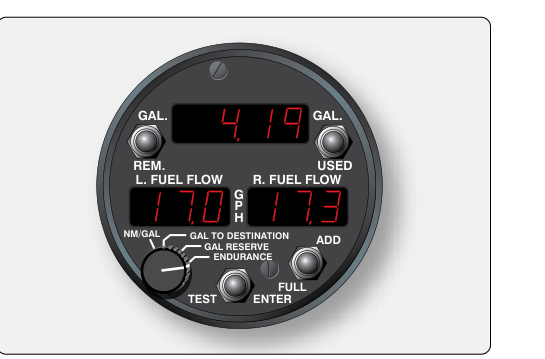
Regulations establish minimums, but professional fuel management requires active in-flight monitoring. Compare your actual fuel burn against your planned burn at each waypoint or fix. Many modern avionics provide fuel flow in real time; even analog aircraft with simple fuel gauges can be monitored against an elapsed-time fuel log.
Establish personal decision points before flight. For example: "If I reach the initial approach fix with less than X pounds (or gallons) of fuel, I will declare minimum fuel and proceed direct to the alternate." Declaring minimum fuel to ATC is not an emergency declaration — it is an advisory that informs the controller that any undue delay will cause an emergency situation. It prompts the controller to expedite your sequence. If your fuel state degrades further, declaring fuel emergency under 14 CFR 91.3 obligates ATC to provide immediate priority handling.
The FAA's Risk Management Handbook (FAA-H-8083-2) emphasizes that fuel emergencies are among the most preventable aviation accidents. The chain almost always begins with optimistic preflight planning, continues with a failure to monitor in flight, and ends with a decision point reached too late. Aeronautical Decision Making (ADM) frameworks like PAVE and IMSAFE are useful at preflight, but in-flight fuel management requires an equally systematic mental model.
Key Numbers and Rules
- 14 CFR 91.167: IFR fuel reserve — destination fuel, plus alternate fuel, plus 45 minutes at normal cruise speed.
- 1-2-3 Rule: No alternate required if destination forecasts ≥2,000 ft ceiling and ≥3 SM visibility from 1 hour before to 1 hour after ETA.
- Precision approach alternate minimums (standard): 600 ft ceiling, 2 SM visibility.
- Non-precision approach alternate minimums (standard): 800 ft ceiling, 2 SM visibility.
- Minimum fuel advisory: Not an emergency; informs ATC that further delay will create an emergency.
- Fuel emergency declaration: Invokes priority handling under 14 CFR 91.3; pilot-in-command authority and responsibility.
- Holding speed limits: 200 KIAS at or below 6,000 ft MSL; 230 KIAS 6,001–14,000 ft MSL; 265 KIAS above 14,000 ft MSL (per the AIM).
Memory Aid
For alternate minimums, use "Precision 6-2, Non-precision 8-2" — the ceiling doubles from 600 to 800 feet when you step down from a precision to a non-precision approach, but the visibility stays at 2 statute miles in both cases. When you hear 6 or 8, pair it instantly with "precision" or "non-precision" and the 2-mile visibility stays constant.
Common Test Traps
- Confusing "no alternate required" with "no alternate needed": Passing the 1-2-3 rule means you are not legally required to file an alternate — it does not mean skipping alternate planning entirely is safe. The FAA knowledge test may present scenarios where conditions are exactly on the edge of the 1-2-3 rule to test whether you understand the legal threshold versus prudent practice.
- Applying VFR fuel reserves to IFR questions: VFR day and night reserves (30 and 45 minutes respectively under 14 CFR 91.151) are different from the IFR 45-minute reserve. The IFR reserve applies after flying to the alternate — it is the final buffer, not the entire reserve.
- Forgetting the missed approach in fuel calculations: Many students plan fuel to the destination and then direct to the alternate. They omit the fuel for a missed approach climb. On the test and in real flight, account for the missed approach fuel before the alternate leg begins.
- Alternate minimums that differ from standard: When an approach chart shows the inverted-A triangle symbol, standard alternate minimums do NOT apply. The published alternate minimums in the chart's notes govern instead, and they may be higher or may prohibit the airport as an alternate entirely.
- Holding speed limits as hard limits: Holding speed limits are maximums, not targets. Slowing below them is permitted and may reduce fuel burn — a useful option when holding is extended and fuel is becoming a concern.