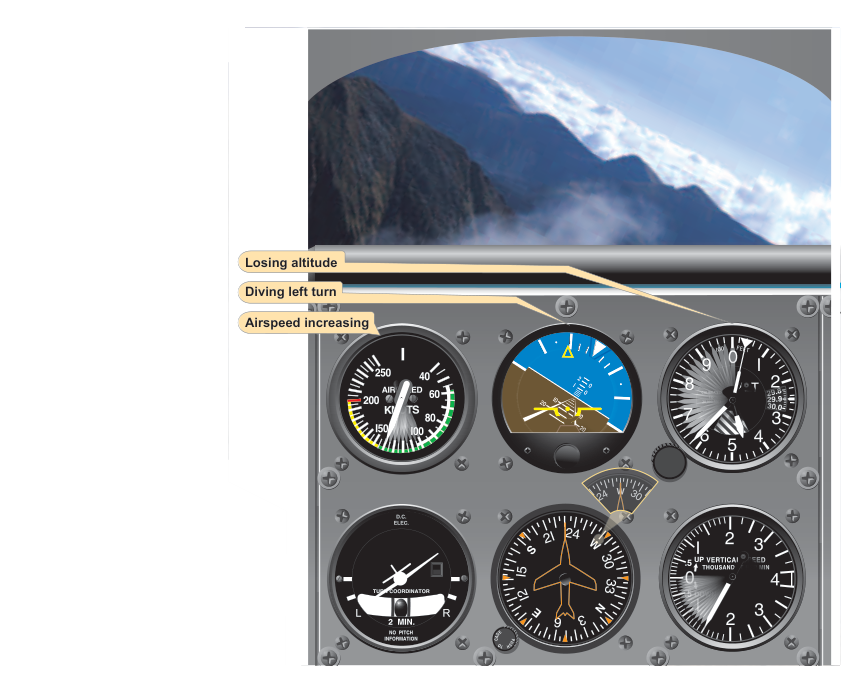
Imagine you are cruising in the clouds, hand-flying an ILS approach, when the attitude indicator suddenly tumbles and the heading indicator spins uselessly. Both gyroscopic instruments have failed — a scenario that, while uncommon in modern cockpits, is a defining test of an instrument pilot's core competency. Partial panel flying is the ability to maintain controlled flight and recover from unusual attitudes using only the instruments that remain functional: the altimeter, the airspeed indicator (ASI), the vertical speed indicator (VSI), the turn coordinator, and the magnetic compass. These remaining instruments, when read together and cross-checked methodically, give you everything you need to survive and navigate to a safe landing.
The FAA Instrument Flying Handbook (FAA-H-8083-15) treats partial panel proficiency as a core instrument skill, not an optional add-on. Understanding exactly which instruments fail, which survive, and how to extract reliable information from what's left is essential for both the instrument rating knowledge test and the practical exam — and, more importantly, for staying alive in IMC.
Which Instruments Are Lost — and Which Survive
Gyroscopic instruments are powered either by a vacuum (suction) system or by an electrical system, depending on the aircraft. The attitude indicator and the heading indicator (directional gyro) are almost always the two instruments driven by the vacuum system. If a single vacuum pump fails — as vacuum pumps are prone to do without warning — both of these instruments become unreliable at roughly the same time, though they may take a minute or two to wind down and begin displaying errors.
The turn coordinator, by contrast, is typically electrically powered (it contains a gyro that senses rate of roll and yaw). This is a deliberate design choice: it provides redundancy precisely so that at least one gyroscopic reference survives a vacuum failure. The turn coordinator shows whether you are turning and, if so, at what rate — but it does NOT show bank angle directly, and it does not show pitch attitude.
The pitot-static instruments — the altimeter, the ASI, and the VSI — require no gyros at all. They operate on air pressure and are unaffected by vacuum or electrical failure (assuming the pitot-static system itself is intact and heated if necessary). These three instruments become the primary pitch reference on partial panel.
So your partial panel toolkit is: airspeed indicator, altimeter, VSI, turn coordinator, and magnetic compass. Each tells you something different, and together they create a complete (if less intuitive) picture of your aircraft's attitude and flight path.
How Partial Panel Instrument Cross-Check Works
On a full panel, the attitude indicator is the primary instrument — it directly shows pitch and bank, and all other instruments are supporting or cross-check instruments. On partial panel, you must build your attitude picture indirectly, by reading the effects of attitude rather than attitude itself. This requires a disciplined, faster scan and a deeper understanding of what each instrument actually measures.
Pitch Control Without the Attitude Indicator
Pitch attitude determines airspeed trend and altitude trend. On partial panel, you control pitch using the airspeed indicator as the primary pitch instrument and the altimeter and VSI as supporting instruments. If your nose is too high, airspeed will decrease and the VSI will show a climb — you see the effect before it becomes a problem if your scan is active. If your nose drops, airspeed increases and you see a descent on the altimeter and VSI. The key discipline is to make small pitch corrections and wait for the airspeed to respond, rather than chasing the needle with large control inputs.
Bank Control Without the Attitude Indicator
Bank attitude is controlled using the turn coordinator as the primary bank instrument. The turn coordinator's miniature aircraft indicates roll direction and, more usefully, shows the standard-rate turn (3 degrees per second, 180 degrees per minute) when the wing tip aligns with the lower index mark. To fly straight, you keep the miniature aircraft wings-level on the turn coordinator. Be aware that the turn coordinator shows rate of turn and rate of roll — it does NOT indicate the degree of bank directly. You will also monitor the magnetic compass for heading, but you must understand its well-known errors before trusting it in turns.
Unusual Attitude Recovery on Partial Panel
An unusual attitude is any pitch or bank attitude not intended for the phase of flight — nose-high or nose-low, with or without significant bank. On a full panel, recovery is straightforward with the attitude indicator. On partial panel, you must identify the unusual attitude from the pitot-static instruments and the turn coordinator, then recover using precise, coordinated control inputs.
Nose-High Unusual Attitude
The signature of a nose-high unusual attitude on partial panel is: decreasing airspeed, climbing altimeter, climbing VSI, and the turn coordinator showing a turn or wings level. If airspeed is decreasing toward stall, the priority is to lower the nose before stall occurs. The recovery sequence: add full power, simultaneously lower the nose by releasing back pressure and applying forward pressure, roll wings level using the turn coordinator, and accelerate to a safe maneuvering airspeed. The reason power comes first in a nose-high situation is that power prevents further airspeed decay and reduces the risk of a stall during recovery.
Nose-Low Unusual Attitude
The signature of a nose-low unusual attitude is: increasing airspeed, descending altimeter, descending VSI, and likely a turn shown on the turn coordinator. The danger here is a rapidly increasing bank and dive — the classic graveyard spiral — where the airspeed and descent rate build rapidly. The Instrument Flying Handbook recovery is: reduce power (if airspeed is increasing) and level the wings using the turn coordinator essentially together, then raise the nose to a level pitch attitude to stop the descent. Correcting bank and power together, before raising the pitch, is critical: if you pull the nose up while still in a steep bank, you will only tighten the spiral, dramatically increase the load factor, and risk structural damage or stall. Level the wings before pulling, always.
The Magnetic Compass on Partial Panel
With the heading indicator gone, the magnetic compass becomes your only heading reference. Unfortunately, it is subject to several errors that you must compensate for mentally. Northerly turning error causes the compass to lag behind the aircraft heading when turning through north in the northern hemisphere, and to lead when turning through south. The mnemonic ANDS summarizes this: Acceleration causes a North indication on the compass; Deceleration causes a South indication. There is also oscillation error caused by turbulence, making the compass swing. To use the compass effectively in a turn, roll out of a standard-rate turn before the compass reaches your desired heading — by approximately the number of degrees equal to your latitude when turning through north, and overshooting slightly when turning through south.
Why Partial Panel Proficiency Matters
Vacuum system failures are among the most insidious in-flight emergencies. Unlike an engine failure, a vacuum failure has no dramatic sound or sensation — the gauges simply begin to slowly drift toward errors. A pilot who does not recognize the failure early may chase a tumbling attitude indicator deeper into an unusual attitude until recovery becomes impossible. The FAA cites loss of control in IMC as one of the leading causes of fatal general aviation accidents, and spatial disorientation following instrument failure is a significant contributor. Partial panel proficiency is not just a checkride item — it is a survival skill.
Key Numbers and Rules
- Standard-rate turn: 3 degrees per second (180°/minute); this is what the turn coordinator's index marks represent.
- Bank angle for standard rate (approximate): true airspeed in knots divided by 10, plus 7 — for example, at 120 knots, about 19 degrees of bank.
- Scan speed: on partial panel, your scan must be faster and more methodical, typically anchored to the airspeed indicator for pitch and the turn coordinator for bank.
- Vacuum failure indication: suction gauge (if installed) will drop below approximately 4.5–5.2 inches Hg (check the POH for your aircraft's normal range).
- Nose-low recovery order: Power — Wings Level — Pitch (never pitch first in a steep bank).
- Nose-high recovery order: Power Up — Pitch Down — Wings Level.
Memory Aid
For the nose-low recovery sequence, remember "PWP" — Power, Wings, Pitch: reduce Power to prevent further airspeed buildup, level the Wings using the turn coordinator, then raise Pitch gently to stop the descent. This prevents the fatal mistake of pulling the nose up while still banked steeply.
Common Test Traps
- Confusing the turn coordinator with the attitude indicator: The turn coordinator does NOT show bank angle in degrees — it shows rate of turn and rate of roll. Many students assume it gives the same information as the attitude indicator's bank display. It does not.
- Wrong recovery sequence for nose-low: The FAA test commonly asks which action comes FIRST in a nose-low recovery. The correct answer is to reduce power and roll wings level BEFORE raising the nose. Pulling back first in a steep bank increases load factor dangerously.
- Ignoring the compass lead/lag error: On questions involving heading recovery using only the magnetic compass, failing to account for northerly turning error (ANDS) leads to overshooting or undershooting headings.
- Assuming gyros fail instantly: Vacuum-driven gyros do NOT fail immediately — they may take 1–3 minutes to spin down after vacuum loss, during which they display increasingly erroneous but plausible-looking information. This "slow death" makes early recognition of a vacuum failure critically important.
- Forgetting that the VSI lags: The VSI has an inherent lag of several seconds, meaning it reflects what was happening, not what is happening right now. In fast-moving unusual attitude recoveries, rely more on the airspeed indicator and altimeter trend for immediate pitch information.