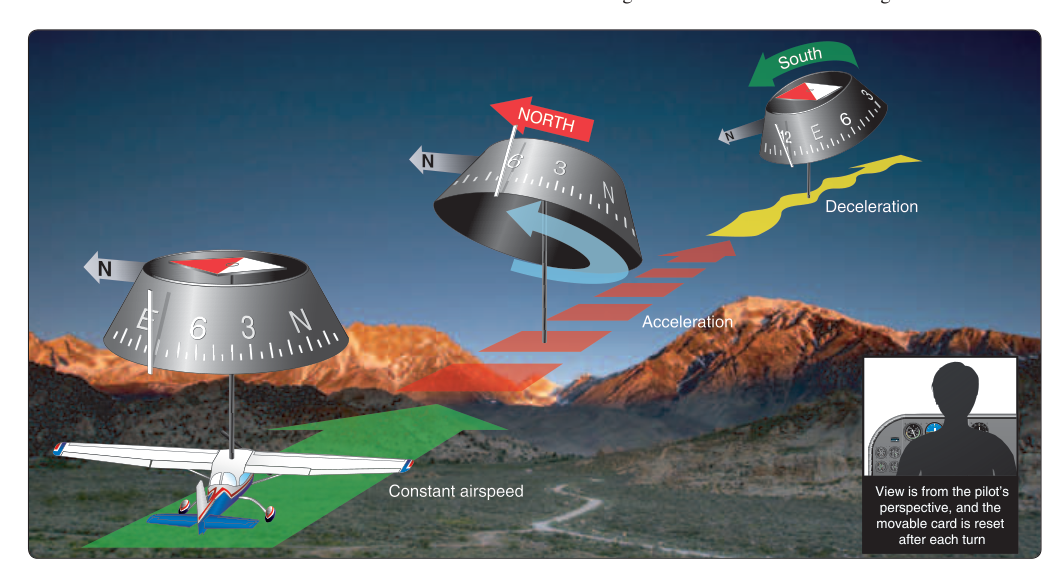
The magnetic compass is one of aviation's oldest and most reliable instruments — it requires no electrical power and never needs to be initialized. Yet despite its simplicity, the compass introduces significant errors whenever an aircraft accelerates, decelerates, or banks into a turn. These errors are not random glitches; they are entirely predictable consequences of Earth's magnetic field geometry, and they are heavily tested on the FAA Instrument Rating knowledge exam. More importantly, understanding them allows a pilot to continue navigating accurately if the heading indicator fails in flight.
This article covers both families of compass error — acceleration/deceleration errors and turning errors (northerly turning error and the lag/lead phenomenon) — with the physics behind each, the specific headings where they are worst, and the practical correction techniques an instrument pilot needs.
How the Magnetic Compass Works
The magnetic compass contains a float assembly with two small bar magnets mounted beneath a compass card. The whole assembly is suspended in a bowl of compass fluid (a clear, dampening liquid) that allows free rotation. Because Earth's magnetic field lines are not parallel to the ground — they dip downward at an angle that increases as you approach the magnetic poles — the compass magnets naturally try to align not just with magnetic north but also with this dip angle. To counteract that dip and keep the card level, the float is engineered to be slightly bottom-heavy, creating a pendulous (pendulum-like) effect.
It is this pendulous mounting — designed to oppose dip — that makes the compass vulnerable to inertial forces. Whenever acceleration or bank tilts the compass float relative to the card's pivot point, the dip-correction geometry is disturbed and the card swings to an incorrect reading.
Acceleration and Deceleration Errors
Acceleration errors occur on east or west headings and are absent (or negligible) on north or south headings. Here is why:
When an aircraft accelerates on an easterly or westerly heading, inertia causes the bottom-heavy pendulous float to swing rearward relative to the direction of flight. Because of the way the dip-correcting weight is positioned, this rearward swing causes the north-seeking end of the magnets to dip toward the nearest magnetic pole. On an east heading, the card rotates and the compass momentarily indicates a turn toward north. On a west heading, it indicates a turn toward north as well — remember, in both cases the compass swings toward the nearer pole, which is north in the Northern Hemisphere.
Deceleration produces the opposite effect: the float swings forward, and the compass falsely indicates a turn toward south on either an east or west heading.
- Acceleration on East or West → apparent turn toward North
- Deceleration on East or West → apparent turn toward South
- On North or South headings: acceleration errors are negligible because the dip-correction weight swings in a plane that has no left-right component relative to the compass card's north reference.
The magnitude of the error is greatest near the magnetic equator (where dip is lowest and the pendulous correction is minimal, actually minimizing this error at the equator) and increases at mid-latitudes across the continental United States. FAA study materials treat this as a practical concern for U.S. operations.
Memory Aid for Acceleration Error
ANDS — Accelerate North, Decelerate South. When flying east or west, accelerating makes the compass swing toward North; decelerating makes it swing toward South. This is the classic FAA mnemonic and it appears directly in the Pilot's Handbook of Aeronautical Knowledge.
Turning Errors (Northerly and Southerly Turning Error)
Turning errors are caused by the same dip phenomenon, but they occur during banked flight rather than straight-and-level acceleration. When an aircraft banks, the compass card — still trying to align with the dipping magnetic field — tilts relative to the pivot point. The result is a false indication of heading change that varies dramatically depending on what heading you are turning through.
Northerly Turning Error
The most significant turning error occurs when the aircraft is near a north heading. If you are heading north and initiate a turn, the banked compass card tilts in the direction of the bank. The dip-correction weights cause the north-seeking end to swing in the same direction as the turn. The practical result is that the compass lags behind (reads less turn than you have actually made) or, at the moment the bank is established from a north heading, the compass may actually appear to swing in the opposite direction to the turn.
This is called northerly turning error: when turning from a north heading, the compass initially indicates a turn in the wrong direction or shows little movement, then catches up. The pilot who relies on the compass alone may over-bank or turn the wrong way. The correction: when rolling out on a northerly heading in the Northern Hemisphere, you must lead your rollout — begin rolling out before the compass reaches the desired heading. The amount of lead is approximately equal to the bank angle used, or by some approximations, the latitude of the aircraft.
Southerly Turning Error
When turning from a south heading, the opposite phenomenon occurs: the compass leads the actual turn — it overshoots, indicating more turn than the aircraft has actually completed. To roll out on a southerly heading, the pilot must delay the rollout until the compass passes the desired heading by a similar amount (bank angle or latitude).
- Turning from North → compass lags → lead the rollout (roll out early)
- Turning from South → compass leads → delay the rollout (roll out late)
- Turning through East or West → errors are minimal; compass is most accurate
Turning errors are worst at the north and south headings and decrease as the aircraft turns toward east or west. At exactly east or west, the compass is momentarily free of turning error, which is why practicing timed turns referencing east or west headings is useful for compass work.
Why It Matters for IFR Flight
Instrument pilots must be prepared for partial-panel operations — scenarios where the heading indicator (HI) has failed or precessed badly. In that case, the magnetic compass becomes the sole heading reference. Without internalizing compass errors, a pilot flying partial panel on a dark night could roll out 20 or 30 degrees off the intended heading while fully believing the compass. In mountainous or oceanic IMC, that error is potentially fatal.
Additionally, the FAA Instrument Rating Airplane Airman Certification Standards (ACS) includes compass turns as a tested maneuver. Examiners will ask you to demonstrate turns to headings using only the magnetic compass, which requires you to anticipate and correct for these errors in real time.
Key Numbers and Rules
- ANDS mnemonic: Accelerate North, Decelerate South — applies on east/west headings only.
- Acceleration errors are zero on north or south headings — the swinging is in line with the north reference and cancels out.
- Turning error is maximum at north and south headings and zero at east and west.
- Lead for northerly rollout ≈ bank angle used (e.g., if flying a standard-rate turn at 15° bank at 45° N latitude, begin rollout ~15° before reaching north).
- Delay for southerly rollout ≈ bank angle used — hold the bank until the compass passes south by the same amount.
- Compass errors increase with latitude because magnetic dip increases toward the poles.
- The compass is most reliable in straight, unaccelerated, wings-level flight — wait several seconds after leveling off before reading it.
Common Test Traps
- Confusing which headings trigger which error. Acceleration errors bite on east/west; turning errors bite on north/south. Students often mix them up. Visualize each separately.
- Applying ANDS to north or south headings. ANDS only applies on easterly or westerly headings. On a north or south heading, there is no significant acceleration error because the inertial swing is in alignment with the compass card's polar reference.
- Forgetting the direction of the rollout correction. North: lead (roll out early). South: delay (roll out late). On an exam, answers that reverse these will be presented as distractors.
- Assuming turning error applies equally at all headings. Test questions sometimes describe turning through east or west and ask whether you need to correct — the answer is that errors are minimal there. Maximum error is at north and south.
- Ignoring the effect of latitude. Some exam questions set scenarios at higher latitudes and ask about error magnitude. The closer to the poles, the greater the dip, and the greater both turning and acceleration errors become.
The magnetic compass is a beautifully simple instrument that has guided aviators for over a century. Its errors are not flaws but predictable physics. An instrument pilot who genuinely understands magnetic dip and the pendulous mounting concept can anticipate every compass error before it appears — turning a potential hazard into just another tool in the partial-panel toolkit.