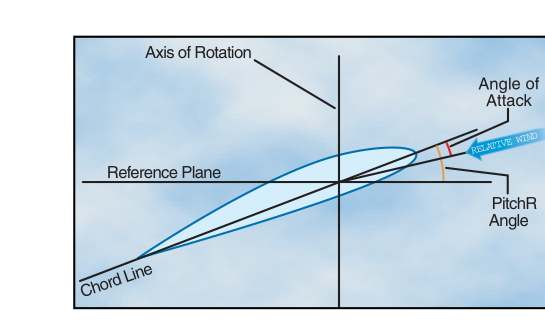
One of the most persistent and dangerous misconceptions in primary flight training is the belief that a high nose equals a high angle of attack, and conversely, that a low nose means the wing is flying safely. Flight and ground instructors who allow this conflation to go uncorrected are, in effect, leaving students with a mental model that will eventually fail them at the worst possible moment. The FAA's Pilot's Handbook of Aeronautical Knowledge (PHAK, FAA-H-8083-25) places the angle of attack concept at the center of stall aerodynamics for precisely this reason. Teaching the distinction between pitch attitude and angle of attack—clearly, repeatedly, and with concrete examples—is one of the highest-value things an instructor can do.
Defining the Two Concepts
Pitch attitude is the angle between the aircraft's longitudinal axis and the natural horizon. It is what the pilot sees on the attitude indicator or through the windshield: nose up, level, or nose down relative to earth. Pitch attitude is a cockpit reference. It says nothing directly about what the wing is experiencing aerodynamically.
Angle of attack (AOA) is the acute angle between the wing's chord line and the relative wind—the direction from which air appears to meet the wing as a result of the aircraft's actual flight path vector. The relative wind is always opposite to and parallel with the flight path, not opposite to the direction the nose is pointing. This distinction is critical. An aircraft in a steep descent with the nose well below the horizon may be pulling aggressively on the elevator, redirecting the flight path upward; in that case the relative wind arrives from a direction steeply below the chord line, and AOA can be very high even though pitch attitude appears low. The PHAK makes explicit that the wing does not "know" where the nose is pointing—it only responds to the angle at which air meets its chord line.
How the Wing Stalls: AOA Is the Only Trigger
The single most important stall fact for any aviator is this: a wing will always stall at the same critical angle of attack, regardless of airspeed, pitch attitude, weight, or load factor. The PHAK states this principle unambiguously. For most general aviation airfoils the critical AOA is in the range of approximately 15 to 20 degrees above the chord line, though the exact value varies by wing design and is established by the manufacturer. What does not vary is the fundamental rule: exceed that critical AOA and the smooth, attached airflow over the upper surface of the wing separates, lift collapses, and the wing stalls.
Stall speed, by contrast, is not fixed. It increases with load factor (which rises in banked turns and during pull-ups), with increased aircraft weight, with forward CG that requires a higher AOA to maintain level flight, and with deployment of certain configurations. A student who memorizes only the published 1-G power-off stall speed from the Pilot's Operating Handbook has learned a number that applies in a narrow set of conditions. An instructor must redirect that student to the underlying concept: what matters is whether the wing's AOA has reached the critical value, and many factors conspire to reach that value at airspeeds well above what the student expects.
Why Pitch Attitude Alone Misleads Pilots
Consider three scenarios that the PHAK and the Airplane Flying Handbook (FAA-H-8083-3) use to illustrate stalls that surprise pilots trained only on the visual cue of a high nose:
- Accelerated stall in a steep turn. In a 60-degree banked level turn the load factor is 2 Gs, which increases stall speed by approximately 41 percent above the 1-G value. The nose may appear to be at or slightly above a normal cruise attitude, yet the pilot pulling to maintain altitude is rapidly increasing AOA. The wing can stall at an airspeed that felt perfectly safe in wings-level flight.
- Base-to-final skidding turn. A pilot who overshoots final approach and applies rudder to skid the nose toward the runway without banking further may actually be pointing the nose at what appears to be a reasonable attitude. However, the uncoordinated flight raises the effective AOA on the inside (lower) wing. The PHAK identifies this scenario as one of the most lethal in general aviation because altitude is low and there is no time to recover.
- Nose-low pull-out from a dive. An aircraft descending steeply that the pilot abruptly pulls out of will have a flight path vector still pointing downward even as the nose comes up. The relative wind is coming from below and ahead; AOA climbs sharply. A stall here can look, from outside the cockpit, like a normal descent—until it does not.
In every one of these cases, pitch attitude provided either no warning or actually a misleading signal. AOA was the variable that determined the outcome.
AOA and Performance: The Bigger Picture
Beyond stall awareness, understanding AOA is the key to unlocking every performance topic in the curriculum. Best glide speed corresponds to the AOA that produces the best lift-to-drag ratio; flying faster or slower than best glide moves the AOA away from that optimum and shortens the glide. Best-angle-of-climb speed (VX) and best-rate-of-climb speed (VY) both correspond to specific AOA values that produce particular relationships between thrust, drag, and lift. When a student grasps that the pilot is essentially managing AOA through every phase of flight, concepts like the back side of the power curve, slow flight, and approach energy management become coherent rather than disconnected facts to memorize.
The PHAK also explains that both lift and drag are functions of AOA (via the lift coefficient and drag coefficient curves), not functions of pitch attitude directly. Teaching this relationship early—ideally in the first ground lesson on aerodynamics—gives students a framework that makes every subsequent aerodynamic discussion easier to understand.
Instructional Strategies for Teaching the Difference
The Aviation Instructor's Handbook (FAA-H-8083-9) emphasizes building correct mental models from the start rather than correcting deeply embedded misconceptions later. For AOA versus pitch attitude, several instructional techniques are especially effective:
- Use the relative wind arrow in diagrams. Draw the flight path vector explicitly; then draw relative wind as its opposite. Show how changing the flight path—not just the nose—changes the angle at which the chord line meets that relative wind.
- In-cockpit demonstration. In slow flight, have the student maintain constant altitude while you call out what the relative wind is doing as airspeed changes. Then demonstrate that pulling further back increases AOA even as the airplane begins to descend—breaking the pitch-equals-AOA assumption in real time.
- The leading question debrief. Ask: "If the nose drops sharply and you immediately pull back hard, does the angle of attack go up or down?" The correct answer—it goes up, because you have curved the flight path so the relative wind is now coming from even further below—is counterintuitive and memorable precisely because it surprises students.
- AOA indicator systems. Where aircraft are equipped with AOA indicators, use them to show how the displayed angle changes independently of the attitude indicator reading. The PHAK notes that AOA indicators provide a more direct measure of stall margin than airspeed, particularly at elevated load factors.
Key Numbers and Rules
- A wing always stalls at the same critical AOA—typically in the 15–20 degree range for general aviation airfoils; the exact value is design-specific.
- Stall speed increases proportionally to the square root of the load factor: at 2 Gs stall speed is about 1.41 times the 1-G value; at 4 Gs it is approximately twice the 1-G value.
- Relative wind is always opposite to and parallel with the actual flight path vector—never opposite to the longitudinal axis.
- AOA is not displayed on the standard six-pack; it must be inferred from airspeed, load factor, and control feedback unless an AOA indicator is installed.
- The critical AOA is independent of weight, density altitude, and configuration—though the speed at which it is reached is not.
Common Test Traps
- "High nose equals stall" framing. Knowledge test questions for the Flight Instructor certificate routinely present stalls occurring in banked turns, on final approach, or in pull-outs from dives—situations where pitch attitude appears normal. Recognize that AOA, not pitch, is the trigger.
- Stall speed versus stall AOA. If a question asks what causes a wing to stall, the answer is always exceeding the critical angle of attack. If it asks what changes stall speed, the answers include weight, load factor, bank angle, and configuration—not changes to the critical AOA itself.
- Relative wind direction. Questions may describe a climbing or descending flight path and ask for the relative wind direction. Always identify the flight path vector first; relative wind is its opposite—not the opposite of where the nose is pointing.
- Load factor and accelerated stalls. A question may ask what happens to stall speed in a 60-degree banked level turn. Recall that load factor is 2 Gs at 60 degrees of bank, so stall speed rises by approximately 41 percent. A student who has only memorized the straight-and-level stall speed will select the wrong answer.
- AOA indicator interpretation. Emerging test questions reference AOA indicator systems. Know that these instruments measure the actual angle between the chord line and the relative wind, and that they provide stall warning that remains valid regardless of aircraft weight or load factor changes—unlike a fixed airspeed threshold.