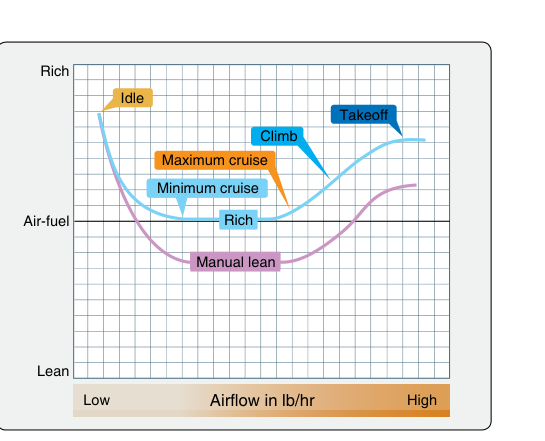
One of the most critical functions in any reciprocating aircraft engine is maintaining the correct fuel-to-air mixture. At sea level on a standard day, a float-type carburetor is calibrated to deliver a specific ratio of fuel to air that allows efficient combustion. As the aircraft climbs, however, air density decreases while the carburetor continues to meter fuel based on volume rather than mass. Without intervention, the mixture becomes progressively richer with altitude, robbing the engine of efficiency and increasing fuel consumption. The mixture control system is the pilot's and mechanic's primary tool for correcting this imbalance across the full operating envelope of the engine.
Understanding how mixture control systems work is essential for Aviation Maintenance Technicians (AMTs) pursuing the Powerplant certificate. These systems appear on the FAA Powerplant Knowledge Test, and — more importantly — their correct maintenance and adjustment directly affects engine longevity, fuel economy, and flight safety.
Why the Mixture Needs Controlling
Combustion requires a precise relationship between fuel and air by mass. The stoichiometric (chemically ideal) ratio commonly cited for aviation gasoline is approximately 15:1 air-to-fuel by weight, though best-power and best-economy mixture ratios used in practice range somewhat richer and leaner than this figure depending on the power setting. In practice, aircraft engines operate at ratios slightly rich of stoichiometric for cooling purposes during high-power operations, and at best-power or best-economy ratios during cruise.
Air density decreases with altitude following the standard atmosphere model. At 8,000 feet density altitude, the air is noticeably thinner than at sea level. A carburetor without mixture control would pull approximately the same volume of fuel regardless, because the fuel-metering jets respond to pressure differential, not air mass. The result is an excessively rich mixture: too much fuel for the available oxygen. Rich mixtures cause incomplete combustion, fouled spark plugs, elevated fuel consumption, and a loss of power, and in extreme cases can lead to rough running or engine stoppage from flooding.
Conversely, leaning too aggressively creates a dangerously lean mixture. A lean mixture burns hotter and more slowly. If lean enough, it can cause detonation — uncontrolled, explosive combustion that can destroy pistons, crack cylinder heads, and ruin an engine in minutes. The mixture control system, when properly understood and operated, keeps the engine in the safe zone between these extremes.
Types of Mixture Control Systems
Float-type carburetors used on most light aircraft engines employ one of two fundamental mixture control designs: the needle-type and the back-suction (economizer) type. Both accomplish the same goal — varying the effective fuel flow at the main discharge nozzle — but do so through different mechanical means.
Needle-Type Mixture Control
In the needle-type system, a tapered needle is positioned within the main fuel passage (or a secondary fuel passage that contributes to the main metering circuit). As the pilot moves the mixture control lever toward the lean position, the needle advances into the jet orifice, physically restricting the area through which fuel can flow. Moving the control to idle cutoff seats the needle fully, shutting off all fuel flow and stopping the engine cleanly — the correct and approved method of engine shutdown because it clears unburned fuel from the induction system and helps prevent engine dieseling or after-firing.
The taper of the needle is carefully machined to provide a progressive, predictable reduction in fuel flow as the control is moved. AMTs inspecting needle-type systems must check for needle wear, corrosion on the seating surface, and proper travel of the control arm. A worn or bent needle can produce an uneven fuel flow curve, making precise leaning difficult and potentially leading to unintentional over-lean conditions.
Back-Suction Mixture Control
The back-suction system takes a different approach. Rather than physically blocking fuel flow, it introduces a controlled amount of low-pressure (venturi-sourced) air into the fuel passage upstream of the main jet. This reduces the effective pressure differential that drives fuel into the airstream, thereby reducing fuel flow without mechanically constricting the jet itself.
In the full-rich position, the back-suction port is closed off and the system operates normally. As the mixture is moved toward lean, the port opens progressively, bleeding in venturi suction and reducing the net pressure that pushes fuel through the discharge nozzle. At idle cutoff, the back-suction port is fully open, dropping fuel pressure so low that fuel delivery essentially stops.
Because back-suction systems have no moving part directly in the fuel stream, they are somewhat less susceptible to fuel deposit buildup around a needle seat. However, the back-suction passages must remain clean and free of blockage; a clogged back-suction line can render the system unable to lean the mixture, effectively locking the engine in a perpetually rich state.
Idle Cutoff vs. Full Rich
Every aircraft mixture control has at least two named positions: Full Rich and Idle Cutoff (ICO). Full Rich provides maximum fuel flow appropriate for sea-level takeoff operations and engine cooling under high power. Idle Cutoff stops fuel flow entirely and is the proper method for shutting down a reciprocating engine. Stopping the engine at idle cutoff ensures no raw fuel remains in the induction system, reducing fire risk and preventing fuel evaporation deposits on internal components.
Many carburetors also have an intermediate detent or marking for Best Power or Best Economy cruise settings, though these positions are more precisely determined by EGT (exhaust gas temperature) indication in flight rather than by lever detent alone. AMTs must verify that the cockpit mixture control cable or linkage travels the full range from idle cutoff to full rich without binding, and that control surface travel matches the carburetor manufacturer's specifications.
Automatic Mixture Controls
Some more sophisticated carburetors — particularly those used on higher-performance engines — incorporate an automatic mixture control (AMC) or altitude-compensating device. These units use an aneroid bellows or similar altitude-sensing element that automatically adjusts fuel metering as air density changes, reducing the pilot's workload. As the aircraft climbs and ambient pressure drops, the aneroid contracts and mechanically repositions the metering element to lean the mixture. On descent, the process reverses.
Automatic mixture controls require careful calibration and periodic inspection. The aneroid must be checked for leaks and proper response across the calibration range. A failed aneroid that remains collapsed (simulating high altitude) will cause a dangerously lean mixture at low altitude; one that remains extended will produce a rich mixture throughout the climb. AMTs must consult the applicable engine manufacturer's maintenance manual for specific AMC inspection intervals and replacement criteria.
Key Numbers and Maintenance Rules
- Stoichiometric ratio: approximately 15:1 air-to-fuel by mass for aviation gasoline; engines typically operate slightly rich of this for cooling at high power settings.
- Idle cutoff: the correct and approved method for shutting down a reciprocating engine equipped with a carburetor; prevents after-fire and fuel residue in the induction system.
- Mixture control cable travel: must achieve full range of motion without binding; verify against the manufacturer's specified travel dimensions during rigging.
- Back-suction passages: must be clean and unobstructed; inspect during 100-hour and annual inspections per 14 CFR Part 43 requirements.
- Automatic mixture control aneroIds: inspect for leaks and proper calibration; a failed aneroid can produce either dangerously lean or excessively rich mixtures at unexpected altitudes.
- Needle-type systems: inspect needle taper for wear, corrosion, or physical damage; a worn needle produces unpredictable fuel flow and imprecise leaning.
Common Test Traps
- Rich vs. lean at altitude: The FAA exam commonly tests whether students know that an uncontrolled carburetor becomes richer (not leaner) as altitude increases, because air density drops while fuel flow remains relatively constant by volume.
- Idle cutoff misconception: Some students believe the engine should be stopped by turning off the magnetos. The correct carburetor shutdown procedure is idle cutoff first; magneto switches are turned off after the propeller stops turning as a safety precaution against an inadvertent start or kickback from a hot or fouled cylinder.
- Back-suction blockage effect: A clogged back-suction passage prevents leaning — the mixture stays rich regardless of control position. Students sometimes assume a blockage would cause a lean condition, but the opposite is true.
- Automatic mixture control failure modes: A collapsed aneroid simulates high altitude and causes an excessively lean mixture at low altitude — potentially causing detonation on takeoff. This is a subtle but important failure mode to recognize.
- Control rigging vs. mixture calibration: Proper mixture control function requires both correct mechanical rigging (full travel, no binding) and correctly calibrated metering hardware. Rigging the cable correctly does not fix a worn needle or clogged jet — both elements must be verified independently during maintenance.