Every time you rotate on takeoff or roll into a bank, your wings are quietly solving an equation. Lift — the aerodynamic force that opposes gravity and keeps the airplane flying — is not magic, and it is not simply "speed." It is the product of several measurable factors working together. Understanding the lift equation, and especially the coefficient of lift (CL), gives you a clear mental model of how a wing works, why angle of attack matters so deeply, and what is really happening when a wing stalls. This understanding also underpins every other aerodynamic topic you will encounter on the FAA knowledge test and, more importantly, in the cockpit.
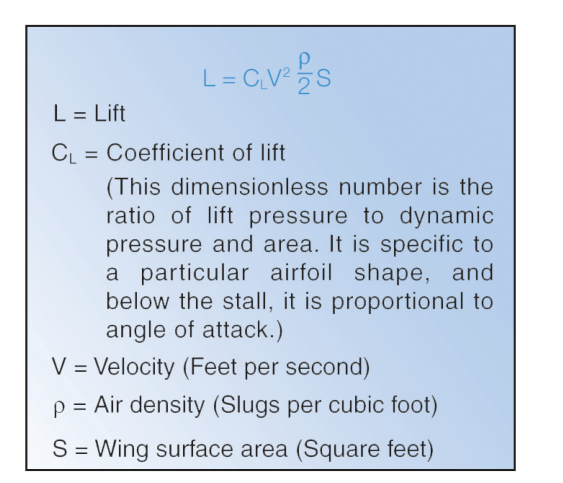
The lift equation is usually written as: L = CL × ½ρV² × S, where L is lift force (in pounds or Newtons), CL is the dimensionless coefficient of lift, ρ (rho) is air density, V is true airspeed, and S is the wing's reference area. Each variable has a distinct physical meaning, and together they form an elegant picture of how wings generate force.
Breaking Down the Lift Equation
Let's walk through each factor so you can see exactly what it contributes and why it appears in the formula.
Dynamic Pressure (½ρV²)
The term ½ρV² is called dynamic pressure and it represents the kinetic energy per unit volume of the moving air. Think of it as the "punch" the airflow delivers to the wing. Density (ρ) reflects how many air molecules are packed into a given space — denser air means more molecules striking the wing per second, generating more force. Velocity (V) is squared, which is critical: doubling your airspeed quadruples dynamic pressure, and therefore has an enormous effect on lift. This squared relationship is why high-speed airplanes do not need to fly at high angles of attack to stay aloft — the airspeed itself delivers tremendous dynamic pressure. Conversely, at low speeds, dynamic pressure drops sharply, and the wing must compensate by other means.
Wing Area (S)
Wing area (S) is simply the planform area of the wing — the footprint you would see looking straight down at it. A larger wing intercepts more air and therefore produces proportionally more lift. This is why heavily loaded cargo aircraft have large wings, and why high-performance gliders with long, broad wings can soar efficiently. For a given airplane, S is fixed by the design — the pilot cannot change it in flight (unless the aircraft has flaps that extend and increase effective area, which we will touch on shortly).
The Coefficient of Lift (CL)
The coefficient of lift is the most nuanced and pilot-relevant term in the equation. CL is a dimensionless number — it has no units — that captures the aerodynamic efficiency of the wing at any given moment. It is a way of expressing how effectively the wing shape and its orientation are turning dynamic pressure into lifting force.
Two things primarily determine CL for a given wing: angle of attack and airfoil shape. For most conventional wings, CL increases in a nearly straight line as angle of attack increases from its zero-lift angle (typically a slightly negative angle) up to the critical angle of attack. Most conventional light-aircraft wings reach their maximum CL (written CLmax) at a critical angle of attack in the neighborhood of 15 to 18 degrees, though the PHAK does not give a single precise universal figure and the exact value depends on the specific airfoil and aircraft design. Once that critical angle is exceeded, airflow separates from the upper wing surface, CL drops suddenly and dramatically, and the wing stalls.
Airfoil shape also affects CL. A highly cambered (curved) airfoil generates more lift at a given angle of attack than a symmetrical airfoil does. This is why different aircraft designed for different missions use different airfoil profiles. Extending flaps changes the effective camber and area of the wing, which is why full flaps increase CLmax — allowing the airplane to fly slower without stalling — at the cost of increased drag.
Angle of Attack Is the Pilot's Lift Control
Here is the insight that ties everything together for a working pilot: in steady, level flight at a constant altitude, lift must equal weight. The lift equation tells you that if airspeed decreases, dynamic pressure (½ρV²) falls. To keep L equal to weight, CL must increase — and the only way to increase CL in flight is to increase the angle of attack. This is exactly what a pilot does instinctively when slowing down: back pressure on the controls raises the nose, increasing angle of attack, keeping lift matched to weight.
This is also why a stall can occur at any airspeed and any attitude. A stall is not about airspeed or nose position — it is about exceeding the critical angle of attack. If you pull back sharply at high speed, you can exceed the critical angle just as surely as you can at low speed. The FAA emphasizes this point strongly because many loss-of-control accidents involve pilots who were surprised by stalls in unexpected flight attitudes.
Why Density Altitude Matters
The density term (ρ) in the lift equation explains why density altitude is so critical to performance. As you climb to higher altitudes, or fly on hot, humid days at low elevations, air density decreases. With lower ρ, dynamic pressure drops for a given true airspeed. To maintain the same lift, the wing must either fly faster (increase V) or fly at a higher angle of attack (increase CL). In practice, your indicated airspeed — which corresponds closely to dynamic pressure — is approximately the same at a given angle of attack regardless of density altitude, though this is a useful approximation rather than an exact rule, since it does not account for compressibility or instrument and position error. Meanwhile, your true airspeed is higher. This is why takeoff roll is longer on hot days: you need more ground roll to reach the true airspeed equivalent of the indicated rotation speed, and even then the engine produces less power in thin air.
Key Numbers and Rules
- Lift is proportional to V²: Doubling airspeed quadruples lift (all else equal), and halving airspeed reduces lift to one-quarter. This squared relationship is one of the most commonly tested aerodynamics concepts.
- CL increases linearly with angle of attack up to the critical angle of attack, at which point the wing stalls and CL drops sharply.
- Stall always occurs at the same critical angle of attack for a given wing configuration, regardless of airspeed, weight, or flight attitude. The FAA tests this concept frequently.
- Flaps increase CLmax by increasing camber and sometimes area, lowering stall speed and allowing slower approach speeds.
- Increased weight requires more lift: A heavier airplane must either fly faster or at a higher angle of attack to maintain level flight — which is why stall speed increases with weight (recall that VS is proportional to the square root of weight).
- Density altitude reduces lift: Lower air density reduces dynamic pressure, degrading climb performance and increasing takeoff distance. High, hot, and humid conditions compound this effect.
Common Test Traps
- "Stall occurs at a specific airspeed." This is false. Stall occurs at a specific angle of attack. The airspeed at which that angle is reached varies with weight, load factor, and configuration. Confusing stall speed with stall angle of attack is one of the most common misconceptions on the FAA test.
- Confusing indicated airspeed and true airspeed in the lift equation. Dynamic pressure (½ρV²) uses true airspeed, but because your airspeed indicator essentially measures dynamic pressure directly, it displays a value that corresponds to the actual aerodynamic environment regardless of altitude. The practical implication is that the airplane "feels" and stalls at approximately the same indicated airspeed even as true airspeed climbs with altitude.
- Assuming nose-high attitude always means high angle of attack. Angle of attack is the angle between the chord line of the wing and the relative wind — not the angle between the fuselage and the horizon. In a steep, nose-high climbing turn that has gone wrong, the relative wind may be coming from a direction that creates a dangerously high angle of attack even before the nose appears excessively high.
- Forgetting that flaps change CLmax, not just drag. Students sometimes think flaps are only drag devices. In reality, flaps increase both lift and drag at essentially all deflections — they are not purely lift devices at small settings and purely drag devices at large ones — and the relative amount of lift versus drag added depends on the specific flap type and deflection angle.
- Ignoring load factor's effect on stall speed. In a coordinated 60-degree bank, load factor is 2g, meaning the wing must produce twice as much lift. This effectively raises stall speed by a factor of the square root of 2, or roughly 41 percent, over the unaccelerated stall speed. The FAA tests load factor and its effect on stall speed in turning flight scenarios regularly.
Pulling It All Together
The lift equation is more than a formula to memorize — it is a diagnostic tool. Whenever you wonder why the airplane behaves a certain way, you can trace the answer back to L = CL × ½ρV² × S. Slow down and you must raise angle of attack to maintain lift. Climb to a mountain airport and you must accelerate faster before rotating. Add weight and you must fly faster in the pattern. Each variable has a tangible, predictable effect, and the pilot who understands those relationships will handle the airplane with greater confidence and safety than one who simply memorizes speeds from the POH without knowing why they exist.
Master the coefficient of lift and the lift equation now, and you will find that the rest of aerodynamics — induced drag, load factor, maneuvering speed, stall characteristics — all flow naturally from this single, elegant foundation.