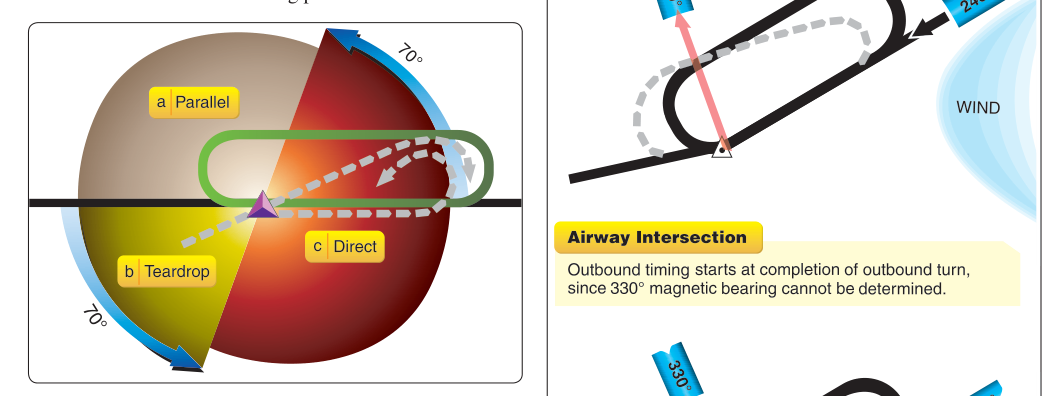
One of the most anxiety-inducing moments for an instrument student is arriving at a holding fix and having only seconds to decide how to enter the pattern correctly. The FAA recognizes three standard holding pattern entries — direct, teardrop, and parallel — and while the AIM provides sector-based guidance for selecting among them, the 70-degree rule is the practical cockpit shortcut that translates that sector guidance into a single, fast mental calculation. Master this rule and you will answer every holding entry question on the instrument knowledge test and, more importantly, fly the pattern correctly in actual IMC.
This article walks through the geometry of holding entries from first principles, explains exactly how the 70-degree rule works, and then drills into the edge cases and test traps that trip up even well-prepared candidates.
The Geometry of a Holding Pattern
A standard holding pattern is a racetrack: the aircraft flies an inbound leg toward the fix, turns right (in a standard pattern) to a 180-degree heading change, flies an outbound leg parallel to the inbound course but in the opposite direction, then turns right again to rejoin the inbound leg. The inbound course is always the defining reference — it is the course published on the chart or assigned by ATC. The outbound leg is simply the reciprocal of the inbound course.
When you arrive at the fix from any direction, you are somewhere on a compass rose relative to the inbound course. That arrival heading determines which of the three entries lets you transition most smoothly into the pattern without overshooting the protected airspace. The FAA divides the compass rose around the fix into three sectors, and each sector corresponds to one entry type. The 70-degree rule is the fastest way to locate yourself in those sectors.
The Three Standard Entries
Direct Entry
When you arrive at the fix already roughly aligned with the pattern — that is, your arrival heading is within the sector on the holding side (the right side for a standard right-hand pattern) — you simply turn to the outbound heading after crossing the fix, fly the outbound leg, and turn inbound. This is the easiest entry because you stay within the protected airspace naturally.
Teardrop Entry
When you arrive from the non-holding side but are not well-aligned for a parallel entry, the teardrop entry guides you back into the pattern efficiently. After crossing the fix, you turn to a heading that is approximately 30 degrees toward the holding side relative to the outbound course, fly outbound for the appropriate time or distance, then execute a turn — usually more than 180 degrees — to intercept the inbound course. The teardrop prevents you from blundering into non-protected airspace on the outbound leg.
Parallel Entry
When you arrive at the fix flying roughly parallel to the outbound leg but on the non-holding side, the parallel entry has you turn to the outbound course after crossing the fix, fly for roughly one minute, then execute a left turn (in a standard right-hand pattern) to cross back over or near the fix and intercept the inbound course. Like the teardrop, it keeps the aircraft within the protected side of the airspace.
How the 70-Degree Rule Works
The 70-degree rule provides a cockpit-ready boundary that separates the three entry sectors without requiring you to draw or mentally visualize the full AIM diagram. Here is the procedure, step by step:
- Identify the inbound course. This is the published or assigned course TO the fix. For example, if the holding is on the 090-degree radial inbound, your inbound course is 090 degrees.
- Determine the outbound course. Add 180 degrees (or subtract if necessary) to find the reciprocal: 270 degrees in this example.
- Apply the 70-degree offset to each side of the outbound course. Subtract 70 degrees from the outbound course (270 − 70 = 200 degrees) and add 70 degrees to the outbound course (270 + 70 = 340 degrees). These two headings form the boundaries of the direct entry sector.
- Identify which sector your arrival heading falls into.
- If your arrival heading falls between 200 and 340 degrees (the direct entry sector, which spans 140 degrees centered on the outbound course of 270), fly a direct entry.
- If your arrival heading falls between 340 and 090 (wrapping through north), you are in the teardrop sector — fly a teardrop entry.
- If your arrival heading falls between 090 and 200 degrees, you are in the parallel sector — fly a parallel entry.
The logic behind the 70-degree split is that the direct entry sector spans 140 degrees total (70 on each side of the outbound course). The remaining 220 degrees of the compass rose is divided between teardrop and parallel, with the inbound course itself (090 in the example) forming the boundary between those two sectors. The teardrop sector sits on the holding side (right side for a standard pattern) of the inbound course, and the parallel sector sits on the non-holding side (left side).
In practical terms, think of it this way: stand at the fix, face the outbound direction (270 degrees). Reach your arms out 70 degrees to each side — your right hand points to about 340 degrees and your left to about 200 degrees. Everything between your hands behind you is the direct entry sector. Behind your right shoulder (between 340 and the inbound course of 090) is teardrop. Behind your left shoulder (between 090 and 200) is parallel.
Why It Matters in the Cockpit
In actual instrument conditions, arriving at a holding fix is a high-workload moment. You are likely managing a descent clearance, communicating with ATC, configuring the aircraft, and monitoring the approach environment — all simultaneously. A rule you can execute in seconds without sketching a diagram is not a nice-to-have; it is a genuine safety tool. The 70-degree rule gives you a repeatable, systematic process that produces the correct answer every time, regardless of whether the holding pattern is right-hand or left-hand (you simply mirror the sectors for a left-hand pattern, where the teardrop sector shifts to the left of the inbound course).
Additionally, ATC may assign a holding pattern with very little notice — sometimes only a single transmission during a busy arrival sequence. Having this framework memorized means you can immediately brief yourself on the entry as you fly toward the fix, rather than scrambling at the last second.
Left-Hand (Non-Standard) Holding Patterns
When ATC or a published procedure specifies left-hand turns, the entire pattern mirrors left. The 70-degree calculation itself is identical — 70 degrees on each side of the outbound course defines the direct entry sector — but the teardrop sector now lies to the left of the inbound course and the parallel sector to the right. Always identify whether turns are standard (right) or non-standard (left) before mentally placing yourself in the sectors.
Key Numbers and Rules
- 70 degrees each side of the outbound course defines the direct entry sector (140-degree total arc).
- The inbound course is the published or assigned course TO the fix — this is your zero reference.
- The outbound course is always the reciprocal (±180 degrees) of the inbound course.
- The teardrop entry involves a turn to approximately 30 degrees toward the holding side from the outbound course after crossing the fix.
- Standard holding airspeeds: at or below 14,000 feet MSL, 200 KIAS maximum in most cases for published procedures; specific leg times or DME distances are charted.
- Standard holding leg time is 1 minute inbound at or below 14,000 feet MSL, 1.5 minutes above 14,000 feet MSL.
- Outbound timing begins when wings are level on the outbound heading (or over the fix/abeam the fix, whichever is later).
Memory Aid
"70 each side — Direct behind, Teardrop on the holding side, Parallel on the non-holding side."
Break it down: 70 reminds you of the degree offset. Direct behind means the direct sector is the 140-degree arc behind you relative to the inbound direction (centered on the outbound heading). Teardrop on the holding side — in a standard right-hand pattern, teardrop arrivals come from the right of the inbound course. Parallel on the non-holding side — parallel arrivals come from the left. Rehearse this phrase on every practice holding clearance until it is automatic.
Common Test Traps
- Confusing inbound and outbound as the reference. The 70-degree offset is applied to the outbound course, not the inbound course. A common error is applying the 70-degree rule to the inbound course and then misidentifying the sectors.
- Forgetting to flip the sectors for left-hand patterns. The FAA knowledge test frequently presents non-standard (left-turn) holding patterns. Mirror the sectors — teardrop becomes left-side, parallel becomes right-side.
- Misidentifying the holding side. The holding side is the side where the turns are made. For a right-hand pattern, all turns are to the right, so the right side of the inbound course (when facing inbound) is the holding side.
- Applying timing incorrectly. Test questions sometimes ask when outbound timing begins. It begins when wings are level outbound — not when the turn starts, and not at the fix crossing itself.
- Treating the 70-degree rule as approximate. Some students think any entry that roughly keeps them inside the protected airspace is acceptable. The FAA expects you to use the correct entry; the sectors are specifically designed to ensure aircraft remain within the obstacle-protected airspace during entry, so the entry type is not arbitrary.
The 70-degree rule is one of those instrument flying tools that rewards the effort of true understanding over rote memorization. Once you grasp why the sectors are shaped the way they are — protecting the aircraft from drifting into unprotected airspace during the transition into the pattern — the rule stops feeling like an arbitrary formula and starts feeling like intuitive geometry. Practice it on every VOR or GPS hold you fly during training, and it will be second nature long before your instrument checkride.