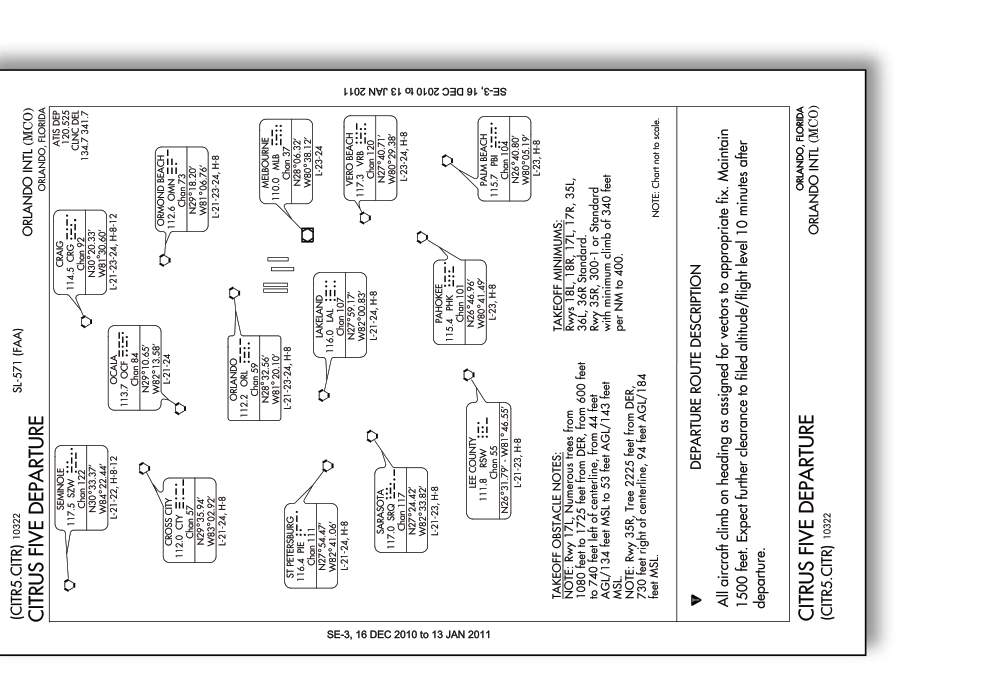
Every IFR departure begins at the most dangerous phase of flight: the transition from the runway to the instrument environment. The ground is close, visibility may be near minimums, and the aircraft is heavy with fuel. To protect pilots from terrain and obstacles during this critical window, the FAA publishes Departure Procedures (DPs) — a family of instrument procedures that provide a safe, obstacle-clear path from the runway environment into the enroute structure. For any pilot seeking an instrument rating, understanding the two main types of DPs, how to read their charts, and the regulatory landscape governing their use is both a knowledge-test staple and a genuine life-safety skill.
DPs come in two distinct flavors: Obstacle Departure Procedures (ODPs) and Standard Instrument Departures (SIDs). Both serve the same fundamental goal — obstacle clearance — but they differ in how they are published, how they are filed, and who can use them. The FAA's Instrument Flying Handbook (FAA-H-8083-15) and the Instrument Procedures Handbook (FAA-H-8083-16) both dedicate significant coverage to DPs because getting them right is non-negotiable in IFR operations.
How Departure Procedures Work
When a runway and surrounding terrain are analyzed by the FAA's Instrument Flight Procedures Industry Team, procedure designers evaluate the obstacle environment in a defined area around the airport. The core standard is a 40:1 obstacle identification surface (OIS) — essentially, a sloped plane rising at a rate of 152 feet per nautical mile that begins at the departure end of the runway. Any obstacle that penetrates this surface must be accounted for in the published procedure. The standard climb gradient required to remain clear of obstacles is 200 feet per nautical mile (ft/NM), measured from the departure end of the runway. If obstacles require a steeper climb, the procedure will specify a higher gradient such as 300 ft/NM or 400 ft/NM.
When a pilot flies an ODP or SID, they are essentially agreeing to fly a specific track (or series of turns and altitudes) that keeps the aircraft in the clear corridor the procedure designers carved through the obstacle environment. Deviating from the published routing — even slightly — removes that guarantee of obstacle clearance.
Obstacle Departure Procedures (ODPs)
An ODP is the simpler of the two DP types. Its sole mission is obstacle clearance; it does not concern itself with traffic flow or ATC efficiency. ODPs may be published in one of two ways: as a textual description in the front section of the Terminal Procedures Publication (TPP, commonly called the approach plate booklet) under the heading "IFR Takeoff Minimums and Departure Procedures," or as a graphic chart when the routing is too complex to describe clearly in words. Graphic ODPs are identified by the notation "(OBSTACLE)" in the procedure title, distinguishing them from SIDs.
A critical regulatory point: 14 CFR Part 91.175(f) does not require pilots operating under Part 91 to fly an ODP unless ATC specifically assigns it. However, the Instrument Procedures Handbook makes clear that flying the ODP is strongly recommended whenever obstacle clearance is a concern — and in low visibility or night conditions at mountainous airports, this is almost always the case. Commercial operators under Parts 121 and 135 face stricter requirements and must comply with published ODPs or equivalent alternate procedures approved by the operator's Operations Specifications.
When no DP of any kind is published for a runway, pilots flying IFR are expected to either cross the departure end of the runway at least 35 feet above ground level (AGL), then climb to 400 feet AGL before making any turns, and maintain the standard 200 ft/NM climb gradient — or they must obtain specific ATC instructions that provide equivalent obstacle clearance. This "diverse departure" or "standard IFR departure" concept is the baseline safety net in the absence of a charted procedure.
Standard Instrument Departures (SIDs)
A SID is an ATC-assigned procedure designed not only for obstacle clearance but also for traffic flow efficiency. SIDs are exclusively graphic procedures — you will always see a chart for a SID. They typically serve busy terminal areas where multiple departures per hour must be organized into an orderly stream. SIDs connect the airport to specific fixes or airways in the enroute structure, and they often include crossing altitude restrictions, speed restrictions, and communication frequency changes.
Unlike ODPs, SIDs require pilot and aircraft equipment compliance. A pilot must possess the appropriate charts and have briefed the procedure before accepting a SID clearance. If a pilot is unable to accept a SID — due to aircraft performance, equipment, or unfamiliarity — they must advise ATC with the phrase "No SID" in the flight plan remarks or request a different departure. SIDs are not optional in the same casual way ODPs might be; once ATC assigns a SID in your clearance, it is part of your IFR clearance and must be flown as assigned unless you receive an amended clearance.
Reading the DP Chart
Both graphic ODPs and SID charts share a common visual language, though SIDs tend to be more complex. Key elements to identify and brief before departure include:
- Runway-specific routing: Many DPs have different initial tracks depending on which runway you depart. Confirm the correct column or transition for your assigned runway.
- Climb gradient: If a non-standard climb gradient is required, it will be printed prominently — often in a note box. This might read "Climb at 300 ft/NM or greater to 3,000 feet" or similar. Calculate whether your aircraft can meet this gradient on the day of flight.
- Minimum climb altitude: The procedure specifies an altitude up to which the special gradient is required. Above that altitude, standard obstacle clearance resumes.
- Lost communications: SID charts include lost-communications instructions. Know these before departure so that if the radio fails immediately after takeoff, you have a rehearsed plan.
- Transition routes: SIDs often have multiple transitions — named routing extensions that connect the SID to different enroute fixes. Your clearance will specify which transition to fly.
- Notes and takeoff minimums: The "T" and inverted triangle symbols on the approach plate index page flag airports with non-standard takeoff minimums or departure procedures. A single inverted triangle (▽) indicates the airport has non-standard takeoff minimums and/or an obstacle departure procedure published in the front of the TPP. The letter T in the triangle indicates non-standard takeoff minimums, IFR departure procedures, or both.
Why Obstacle Departure Procedures Matter
The consequences of ignoring DPs are not theoretical. Controlled flight into terrain (CFIT) on departure has claimed aircraft and lives at airports where surrounding terrain was not obvious from a casual glance at the chart. Mountain airports with valleys running parallel to the runway can have enormous obstacles just off the departure end that are invisible in the dark or in the clouds. An ODP might require an immediate turn after takeoff to remain within the valley corridor — skipping that turn, or climbing too shallowly, can put the aircraft into a ridge.
Even at flat, seemingly benign airports, towers, buildings, and power lines may create a departure corridor that is safe only on the charted route. The 200 ft/NM standard gradient is designed to provide at least 48 feet per nautical mile of obstacle clearance above the 40:1 obstacle identification surface — there is no fat in these numbers. A heavily loaded aircraft on a hot day may struggle to achieve standard gradient, making performance calculations before every IFR departure a genuine safety requirement rather than a bureaucratic checkbox.
Key Numbers and Rules
- Standard obstacle clearance gradient: 200 feet per nautical mile from the departure end of the runway.
- Standard initial departure track: Runway heading until 400 feet AGL before any turns, unless the DP specifies otherwise.
- Crossing height at departure end: 35 feet AGL (the baseline for obstacle clearance surface calculation).
- 40:1 Obstacle Identification Surface: The sloping surface (152 ft/NM) used to identify penetrating obstacles.
- "T" symbol (with triangle): Non-standard takeoff minimums or a specific DP exists — look up the details in the front of the TPP.
- "No SID" notation: Enter in remarks block of your flight plan if you cannot accept a SID assignment.
- Part 91 pilots: Not legally required to fly an ODP unless assigned by ATC, but strongly recommended for obstacle clearance assurance.
- Parts 121/135 operators: Must comply with ODPs or an approved equivalent per their OpSpecs.
Memory Aid
To remember the two types and their priorities, use the phrase "O is for Optional, S is for Someone assigned it" — ODPs are the pilot's obstacle-clearance tool to use at their own initiative, while SIDs are ATC-assigned procedures that become part of a mandatory IFR clearance. This is a simplification, but it captures the key regulatory distinction that the FAA knowledge test probes.
Common Test Traps
- Confusing ODPs with SIDs: Students often assume all DPs are the same. Remember: ODPs exist solely for obstacle clearance and may be textual; SIDs are always graphic, also serve ATC traffic flow, and are assigned in your clearance.
- Thinking ODPs are always mandatory under Part 91: They are not legally required unless ATC assigns them, though operationally you should fly them for safety. The test may offer a scenario where a Part 91 pilot legally departs without an ODP — that choice is legal, just potentially unwise.
- Missing the climb gradient note: Test questions often describe a scenario where an aircraft cannot meet the published climb gradient. If your aircraft cannot achieve the required ft/NM, you either must not depart IFR or must wait for better conditions — you cannot simply ignore the gradient note.
- Forgetting the "T" symbol check: Before filing or departing IFR, pilots must check for the inverted triangle T symbol in the TPP index. Missing a non-standard departure procedure or takeoff minimum is a classic error the test exploits.
- Assuming the standard departure track is always runway heading: It is runway heading only in the absence of a published procedure. A charted DP may require an immediate turn or a specific heading right off the runway — always brief the actual charted routing, not the generic default.