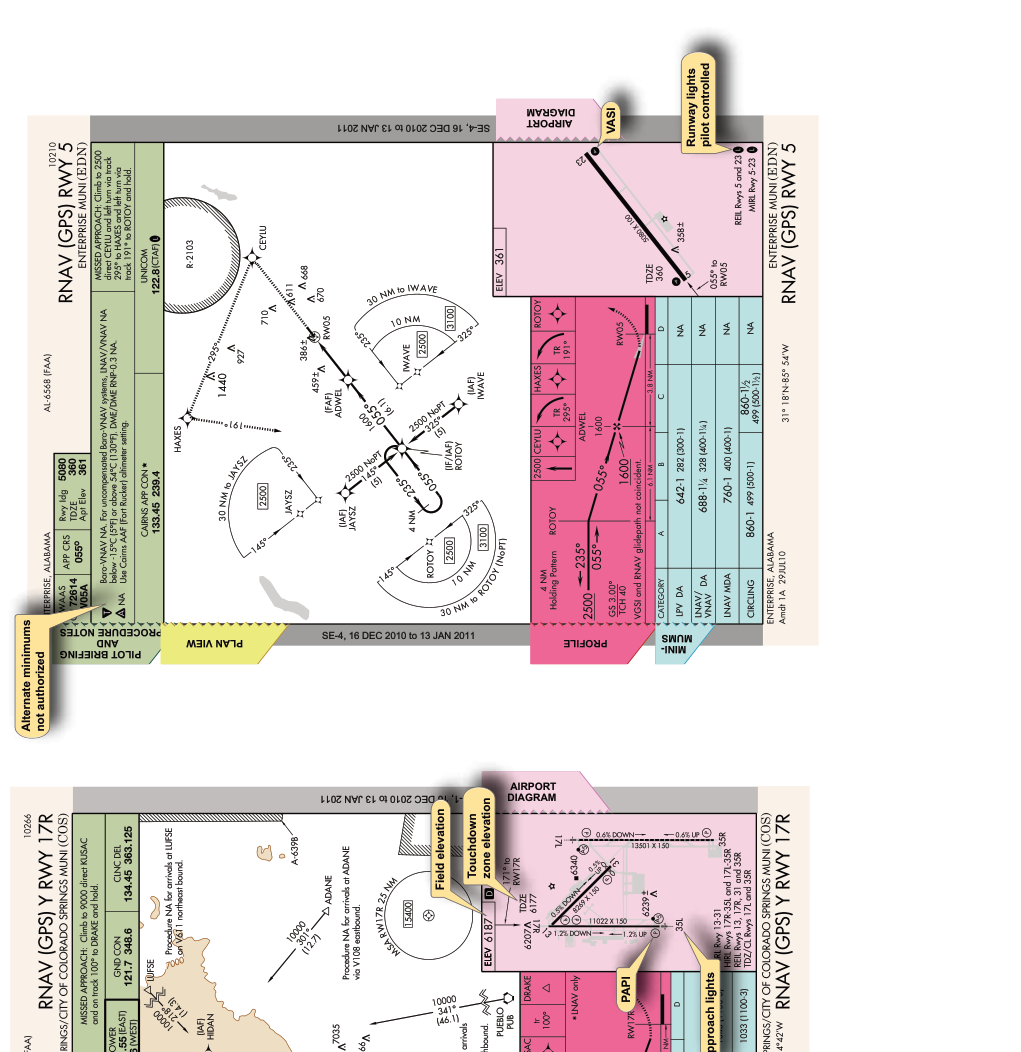
Every instrument approach procedure published by the FAA sets a floor — a minimum altitude below which you may not descend unless the runway environment is in sight and the conditions permit a safe landing. Two distinct terms define these floors: Decision Altitude (DA) and Minimum Descent Altitude (MDA). Knowing which applies, why they differ, and exactly how pilots must use each one is not just an FAA knowledge-test requirement — it is a fundamental safety skill that separates disciplined instrument pilots from those who make dangerous mistakes in the clouds.
These two altitudes reflect fundamentally different approach philosophies. DA belongs to precision (and precision-like) approaches, which provide continuous vertical guidance. MDA belongs to non-precision approaches, which give lateral guidance only. Understanding that distinction unlocks everything else.
Decision Altitude (DA): The Precision Approach Floor
A Decision Altitude is used on approaches that provide a continuous electronic glidepath — specifically ILS (Instrument Landing System), GLS (GBAS Landing System), and approaches charted as LPV (Localizer Performance with Vertical Guidance) or LNAV/VNAV when the chart publishes a DA. The term was changed from "Decision Height (DH)" to "Decision Altitude" to align with international standards; you will still see "DH" on older references and some charts, but the concepts are the same. DA is expressed as a Mean Sea Level (MSL) altitude, while DH is measured above the Touchdown Zone Elevation (TDZE).
The defining characteristic of DA is the decision point in time. As the aircraft descends on the glidepath, the pilot reaches DA at a specific moment — typically with the aircraft still tracking inbound at a constant angle, a few hundred feet above the runway surface. At that exact moment, the pilot must make a binary decision: continue to land or execute an immediate missed approach. There is no loitering at DA. The aircraft is still descending when the decision must be made, so a missed approach initiated at DA means the aircraft may briefly continue below DA momentarily — this is expected and accounted for in the obstacle clearance design. The decision cannot be deferred.
To continue below DA, the pilot must have the runway environment in sight and be in a position from which a normal landing can be made. The FAA defines the "runway environment" to include the approach lighting system, threshold, threshold markings, threshold lights, REIL, VASI/PAPI, touchdown zone, touchdown zone markings, touchdown zone lights, runway, runway markings, and runway lights — any of these may serve as the visual reference required. Under 14 CFR 91.175(c)(3)(i), if the approach lighting system is the only visual reference in sight, descent below 100 feet above the TDZE is not authorized unless the red terminating bars or red side-row bars are also distinctly visible and identifiable; all other elements of the runway environment permit continued descent below that point.
Minimum Descent Altitude (MDA): The Non-Precision Floor
MDA applies to non-precision approaches — those that provide lateral course guidance but no continuous glidepath. Classic examples include VOR, NDB, LOC (Localizer only), LNAV, and VOR/DME approaches. On these procedures, the pilot descends from the Final Approach Fix (FAF) to the MDA and then levels off, flying at the MDA in level flight while looking for the runway environment.
The MDA represents the lowest MSL altitude to which descent is authorized during a non-precision approach segment. Unlike DA, where you descend through the decision point, MDA is a hard floor you may not go below until you have the required visual references and are in a position to make a normal descent to landing using normal maneuvers. Descending below MDA before those criteria are met is a serious violation and a safety hazard — terrain and obstacle clearance below MDA is not guaranteed.
Because the pilot levels off at MDA, there is a segment of flight at that altitude called the visual segment or sometimes the "dive and drive" segment. The pilot has from that level-off point until the Missed Approach Point (MAP) — which may be defined by a specific fix, a DME reading, timing from the FAF, or the end of the runway — to acquire the required visual references. If those references are not obtained by the MAP, a missed approach must be executed immediately.
Why the Distinction Matters for Safety
The operational difference is not merely semantic. On a precision approach, the glidepath itself takes you from the FAF all the way to the flare — descent never stops until you land or go missed. On a non-precision approach, you must manually manage the transition from a descent to level flight at exactly MDA, then from level flight to the landing flare once visual. This level-off segment introduces several risks:
- Controlled flight into terrain (CFIT): If the pilot lets the aircraft settle below MDA — even slightly — obstacle and terrain clearance is lost. MDA often has very little margin above obstacles in the missed approach area.
- Unstabilized approach: After leveling off at MDA and then spotting the runway late, the pilot may be too high and too fast to land normally, leading to rushed, steep descents — a major cause of accidents on non-precision approaches.
- Timing errors at the MAP: When the MAP is defined by timing rather than a fix or DME, errors in groundspeed calculation can cause the pilot to fly past the MAP still at MDA, potentially into rising terrain beyond the runway.
Precision approaches reduce these risks because the glidepath continuously keeps the aircraft on a safe trajectory and the decision point is clear and automatic. This is why ILS approaches with low DA minimums are approved for lower ceilings and visibilities than non-precision approaches — the design geometry and obstacle clearance are fundamentally different.
Key Numbers and Rules
- DA vs. MDA on the chart: When a published minimum is followed by a height in parentheses — e.g., "200 (200-½)" — the MSL value is the DA or MDA; the parenthetical shows height above TDZE and required visibility in statute miles.
- Straight-in vs. circling: Both DA and MDA may have straight-in and circling minimums. Circling MDAs are often higher than straight-in minimums because the circling protected area is typically larger, but this is not guaranteed on every chart — the relationship depends on the specific obstacle environment for that procedure.
- 14 CFR 91.175: This is the controlling regulation. It states that no pilot may operate an aircraft below the authorized DA/MDA unless the aircraft is continuously in a position from which a descent to a landing on the intended runway can be made at a normal rate using normal maneuvers, and the flight visibility is not less than the visibility prescribed for the procedure.
- Flight visibility vs. reported visibility: The pilot must determine that flight visibility meets the approach minimums. Reported ground visibility (ATIS/ASOS) is advisory; the pilot's visual assessment of flight visibility is controlling under 91.175.
- LPV approaches: These WAAS-based approaches publish a DA (not MDA) and can have minimums as low as 200 feet and ¼-mile — comparable to a Category I ILS — but only when WAAS signal integrity is confirmed and the approach is authorized by NOTAM.
- LNAV approaches: Publish an MDA, not a DA, because they provide lateral guidance only (no vertical guidance). Some charts also show LNAV+V, which adds an advisory glidepath but the minimum remains an MDA — the advisory path does not convert it to a precision approach.
- Missed approach timing: On non-precision approaches, the pilot must begin the missed approach no later than the MAP. On precision approaches, a missed approach initiated at or after DA still must be flown as charted.
Memory Aid
"D for Decide, M for Minimum" — At a Decision Altitude, you are actively deciding right now, still on the glidepath, with the aircraft moving. At the Minimum Descent Altitude, you have reached the minimum floor, leveled off, and you wait and look until the MAP. DA = dynamic decision point; MDA = static minimum floor.
Common Test Traps
- Confusing DA with DH: DA is MSL; DH is AGL above the touchdown zone. On the chart, both values are typically shown — the MSL altitude and the height in parentheses. The test may ask which one is MSL and which is AGL.
- Thinking MDA is a floor you can fly along indefinitely: You cannot simply cruise at MDA past the MAP. At the MAP, if visual requirements are not met, a missed approach is mandatory — period.
- LNAV+V traps: An LNAV approach with an advisory vertical path (LNAV+V) still uses an MDA, not a DA. The advisory glidepath is a tool for situational awareness, not a certified vertical guidance signal — many students confuse this with an LPV approach.
- "In sight" is not enough alone: Seeing any part of the runway environment must also be accompanied by being in a position to make a normal landing. The test often presents scenarios where the runway is visible but the aircraft is too close, too high, or in a position requiring an abnormal descent rate.
- Circling minima after flying a straight-in approach: If you break off a straight-in approach to circle to land on another runway, you must immediately climb to the circling MDA (which is typically higher), not continue at the straight-in DA/MDA. Descending toward the new runway before re-acquiring the circling MDA is a dangerous and common conceptual error.