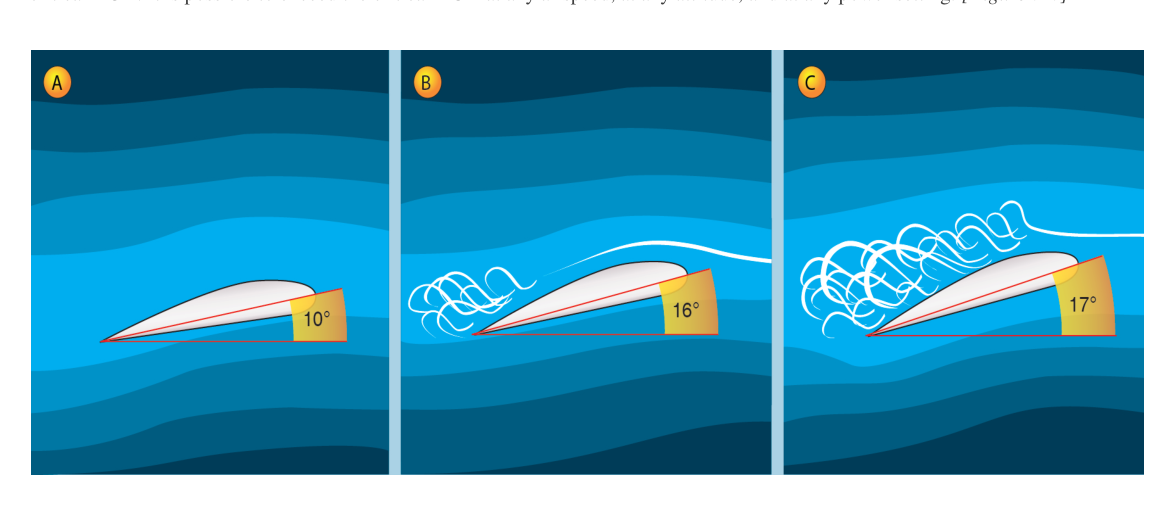
Among all the aerodynamic principles a flight or ground instructor must teach, none is more safety-critical—or more frequently misunderstood—than the relationship between angle of attack (AOA) and the aerodynamic stall. The FAA Pilot's Handbook of Aeronautical Knowledge (PHAK, FAA-H-8083-25) defines the critical angle of attack as the specific angle between the wing's chord line and the relative wind at which airflow over the upper surface separates, causing a sudden and dramatic loss of lift. For most general aviation airfoils, this value falls in the range of roughly 15 to 20 degrees, though the precise figure depends entirely on airfoil geometry. What is universal—and what instructors must drive home relentlessly—is this: exceed the critical AOA and the wing stalls, every single time, at any airspeed, in any attitude, at any power setting. Building a student's mental model around AOA rather than the airspeed indicator is the single most important conceptual task in stall and spin awareness training.
The Physics of Airflow Separation
To teach the critical AOA effectively, an instructor must first understand what is actually happening at the molecular level of the boundary layer. At low angles of attack, air approaching the wing's leading edge splits smoothly, accelerates over the cambered upper surface, and reattaches cleanly at the trailing edge. This acceleration reduces static pressure above the wing relative to below it—the pressure differential that constitutes lift. The thin layer of air molecules in direct contact with the wing surface, called the boundary layer, remains attached and flows in an orderly, laminar-to-turbulent transition toward the trailing edge.
As the pilot increases AOA by applying aft control pressure, the stagnation point—where the oncoming airflow divides—migrates progressively toward the lower surface of the leading edge. The air flowing over the top must negotiate an increasingly sharp curve. At some critical point, the adverse pressure gradient along the upper surface becomes too steep for the boundary layer to overcome; the flow can no longer follow the contour of the wing. The boundary layer separates abruptly from the surface, and the smooth pressure differential collapses. Lift drops sharply, drag increases dramatically, and the separated wake produces the turbulent buffet that is often one of the first physical sensations a pilot notices before full stall.
The PHAK explains that this separation typically begins near the trailing edge at moderate angles of attack and progresses forward toward the leading edge as AOA increases. When separation reaches the leading edge region, the stall is complete. Some airfoils—particularly those with sharp leading edges—experience an abrupt leading-edge separation that provides little aerodynamic warning, a design characteristic that underscores why different aircraft have markedly different stall characteristics even if their published stall speeds appear similar.
Why the Stall Is Independent of Airspeed
The most persistent student misconception is equating stall with a specific indicated airspeed. The PHAK is unambiguous: a stall is a function of AOA alone, not airspeed. The published stall speed (VS or VS1) listed in the Pilot's Operating Handbook represents the minimum airspeed at which the aircraft can maintain level, unaccelerated flight at maximum gross weight in a specified configuration—it is the speed at which the wing happens to reach critical AOA under those narrow, defined conditions. Change any variable—add weight, increase bank angle, pull additional g-load, add contamination to the wing—and the airspeed at which the critical AOA is reached changes accordingly.
The FAA Airplane Flying Handbook (FAA-H-8083-3) reinforces this with the concept of the accelerated stall: a stall that occurs at airspeeds well above VS because increased load factor demands a higher lift coefficient, which in turn requires a higher AOA to produce. In a 60-degree banked level turn, load factor reaches 2.0 g, and stall speed increases by a factor of approximately 1.41 (the square root of the load factor). An aircraft with a wings-level stall speed of 50 knots would stall near 70 knots in that turn. A pilot fixated on the airspeed indicator and seeing 70 knots as "safe" could stall the aircraft without any warning from the ASI needle.
Similarly, a pilot recovering aggressively from an unusual attitude at 150 knots can exceed the critical AOA and stall the wing despite flying at three times the published stall speed. The wing's aerodynamic sensors—if we can use that metaphor—do not read the airspeed indicator. They respond only to the angle at which they meet the relative wind.
Instructor Strategies for Teaching AOA
The Airplane Flying Handbook notes that modern aircraft equipped with AOA indicators give pilots the most direct possible feedback about proximity to the critical AOA, and the FAA has encouraged broader adoption of these devices in general aviation. Where an AOA indicator is installed, instructors should make it the primary teaching reference during slow-flight and stall training, deliberately having students ignore the airspeed indicator during demonstrations to break the habitual airspeed-equals-stall mindset.
Even without an AOA indicator, instructors can leverage aerodynamic cues: the onset of control mushiness as elevator effectiveness decreases near critical AOA, the buffet from separated trailing-edge flow striking the horizontal stabilizer, and the progressive loss of roll authority as ailerons lose effectiveness. The PHAK and Airplane Flying Handbook both stress that training stall recognition on feel and aerodynamic cues—rather than on the VSI, altimeter, or ASI—produces more robust pilot responses in the real environment where stalls most often occur unexpectedly.
The base-to-final cross-controlled stall is perhaps the most instructionally important scenario. Overshooting the final approach turn and applying opposite aileron while holding rudder into the bank can cause the outside (raised) wing to reach critical AOA first, precipitating an incipient spin with little altitude available for recovery. The PHAK and Risk Management Handbook (FAA-H-8083-2) both identify this scenario as a leading factor in fatal approach-phase accidents. Instructors must connect the critical AOA concept directly to the traffic pattern environment, not just to deliberately practiced power-off stalls in cruise configuration.
Key Numbers and Regulatory Context
- Critical AOA range: Approximately 15–20 degrees for most general aviation airfoils; exact value is airfoil-specific and established by the manufacturer.
- Load factor effect on stall speed: Stall speed increases as the square root of the load factor. At 2 g (60° bank), multiply VS by approximately 1.41; at 4 g, multiply by approximately 2.0.
- 14 CFR 23.207 (and the corresponding Part 25, §25.207) certification: Aircraft are required to have adequate stall warning (buffet or a device such as a stall warning horn) beginning at a speed exceeding the stalling speed by not less than 5 knots or 5 percent of the stalling speed, whichever is greater, providing the aerodynamic cue mandate behind the built-in warning systems pilots rely on.
- Spin entry: A spin requires both a stall and a yaw condition (asymmetric lift). The critical AOA must be exceeded for a spin to develop—making stall prevention synonymous with spin prevention.
Common Test Traps
- "Stalls occur at a fixed airspeed." False. VS is published for specific conditions. Weight, load factor, configuration, and ice contamination all change the airspeed at which critical AOA is reached.
- "More power prevents a stall." False. Power can reduce the rate of descent and the AOA needed to sustain level flight at a given speed, but it cannot prevent the pilot from exceeding the critical AOA through aft control pressure.
- "A stall always looks like a nose-high attitude." False. Accelerated stalls, cross-controlled stalls, and stalls entered from unusual attitudes can occur at level or nose-low attitudes with no visual warning from outside the cockpit.
- "Pulling back always increases lift." Only up to the critical AOA. Beyond that point, increasing AOA further deepens the stall and reduces lift; the only recovery is to reduce AOA by relaxing or pushing forward on the control.
- "Wing contamination only reduces performance slightly." False. Even a thin layer of frost or ice can alter the airfoil's pressure distribution enough to significantly reduce the critical AOA and stall speed margin, as addressed in the PHAK and AIM cold-weather operations guidance.
Memory Aid
The phrase "Any Attitude, Any Airspeed" is widely used in CFI training to reinforce that exceeding the critical AOA is the sole cause of a stall, regardless of what the instruments show. Pair it with a direct student exercise: demonstrate identical control inputs at two very different airspeeds to show that aft pressure in both cases moves toward the same aerodynamic outcome—a powerful, memorable illustration of why AOA is the governing variable.