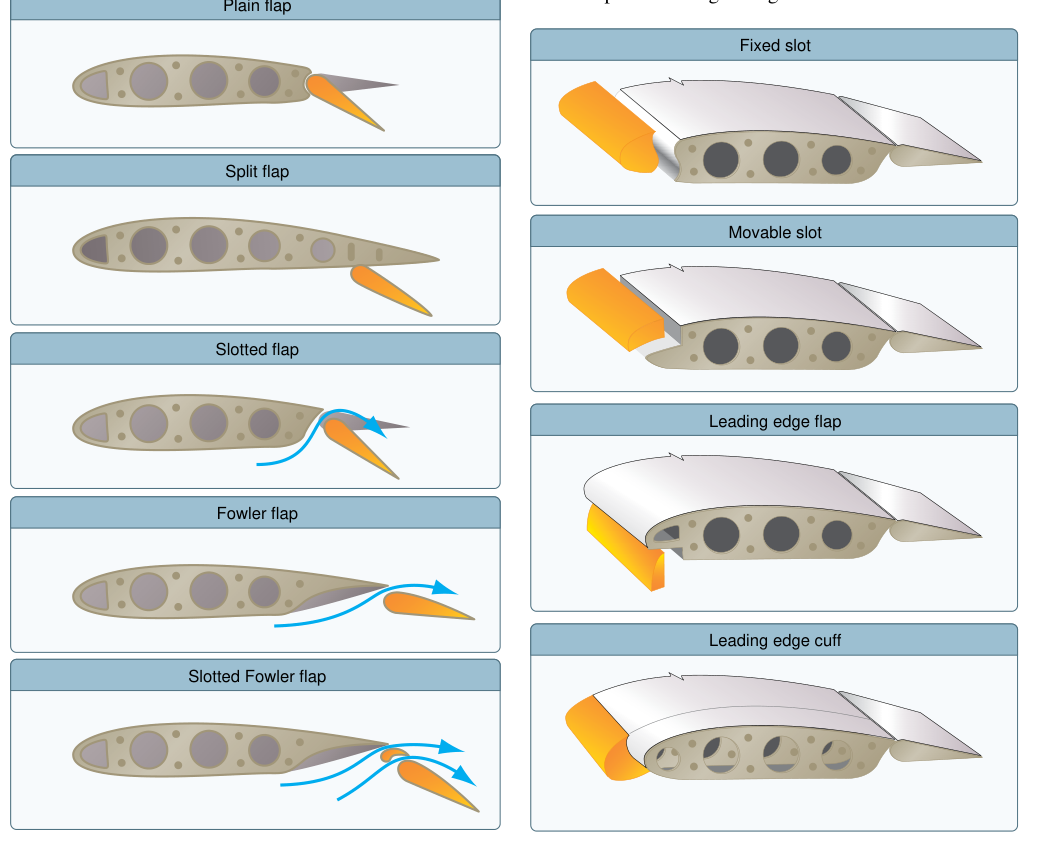
When a pilot lowers the flaps on final approach or extends leading-edge slats before a slow-speed maneuver, something fundamental changes about the wing's aerodynamic personality. These high-lift devices reshape the effective camber, chord length, or both, allowing the wing to generate substantially more lift at speeds that would otherwise produce a stall. For flight and ground instructors, a deep command of this topic is essential — not only because it appears frequently on FAA knowledge tests, but because misunderstanding high-lift devices has direct, serious safety consequences in the cockpit.
To appreciate what high-lift devices do, you first need a firm grip on the lift equation. Lift equals the product of dynamic pressure (one-half times air density times velocity squared), wing area, and the coefficient of lift (CL). CL is itself a function of angle of attack and wing camber — the curvature of the mean camber line running between the upper and lower surfaces. When a wing's camber increases, the pressure differential between upper and lower surfaces intensifies at any given angle of attack, pushing CL higher. High-lift devices exploit this relationship deliberately, letting the pilot trade airspeed for camber and area so that the required lift can be generated at a much lower velocity. The Pilot's Handbook of Aeronautical Knowledge (PHAK, FAA-H-8083-25) treats this in detail in its aerodynamics chapters, and the Airplane Flying Handbook (FAA-H-8083-3) ties the aerodynamic principles directly to piloting technique.
Trailing-Edge Flaps: Four Designs, Four Trade-Offs
The PHAK identifies four principal trailing-edge flap configurations. Understanding each design — and why engineers chose it — is more useful than memorizing a list.
Plain Flaps
The plain flap is the simplest: a hinged panel that rotates downward from the trailing edge, increasing the wing's effective camber. The lift gain at small deflection angles (roughly 10–15°) is significant and the drag increase is modest. Beyond about 15–20° of deflection, however, the upper surface flow begins to separate around the hinge line, causing drag to grow much faster than lift. Plain flaps are mechanically reliable but aerodynamically inefficient at large deflections.
Split Flaps
A split flap deflects only the lower surface of the trailing edge while the upper surface remains fixed. The turbulent wake behind the deployed lower panel creates substantial drag — comparable to a plain flap — but the disruption to upper-surface flow is somewhat reduced, yielding a slightly different (though not dramatically better) lift-to-drag profile. Split flaps also tend to produce a greater nose-down pitching moment than plain flaps at equivalent deflections, because the fixed upper surface combined with the deflected lower surface increases the download aft of the CG and alters the wake and downwash more strongly.
Slotted Flaps
Opening a carefully shaped gap, or slot, between the flap and the main wing element is the key innovation of the slotted flap. High-energy air from the high-pressure region beneath the wing accelerates through the slot, re-energizing the boundary layer on top of the flap. This delays flow separation to higher angles of attack, allowing significantly more lift for a given amount of drag compared with plain or split designs. Slotted flaps are extremely common on general aviation aircraft precisely because they offer a better lift-to-drag ratio across the approach deflection range, giving the pilot meaningful speed reduction without a prohibitive drag penalty in the early stages of the approach.
Fowler Flaps
Fowler flaps first translate rearward along tracks before rotating downward. This rearward travel exposes additional wing area and increases chord length before any significant camber change occurs. The result is a two-stage benefit: increased wing area adds directly to the lift equation through the area term, and the subsequent downward rotation increases camber further. Fowler flaps produce the greatest increase in maximum CL of any trailing-edge device and are the standard choice on regional airliners and many high-performance light aircraft. Their mechanical complexity is the principal trade-off.
Leading-Edge Devices: Slats, Slots, and Droop Noses
Trailing-edge flaps work primarily by increasing camber aft of the wing's maximum-thickness point. Leading-edge devices, by contrast, reshape the forward portion of the wing and attack a different aerodynamic problem: flow separation at the leading edge under high-angle-of-attack conditions.
Fixed Slots
A fixed slot is a permanent gap in the leading edge that allows a thin, high-velocity stream of air to flow from the lower surface to the upper surface, energizing the boundary layer and delaying stall to a higher angle of attack. Because the slot is always open, it produces a small drag penalty at cruise speeds, limiting its use to slow, simple aircraft.
Movable Slats
Slats are movable leading-edge panels that extend forward and downward, simultaneously opening a slot and increasing the wing's effective chord and camber at the leading edge. Extended slats allow the wing to reach a significantly higher maximum angle of attack before the flow separates — the critical AOA rises rather than simply the CL at a fixed AOA. This is the fundamental distinction between leading-edge slats and trailing-edge flaps: slats raise the maximum AOA ceiling, while flaps primarily raise CL at angles of attack well below that ceiling. Aircraft equipped with both extended slats and large Fowler flaps — common on commercial jets — achieve remarkably low approach speeds because they combine both benefits simultaneously.
Stall Speed, Stall Character, and the Critical Angle of Attack
A perennial exam trap is the assumption that flaps change the critical angle of attack. They do not — for trailing-edge flaps, the wing still stalls at essentially the same critical AOA (typically around 15–18° for most general aviation airfoils), but because CL is higher at every AOA below that critical value, the airspeed needed to produce sufficient lift is lower. Stall speed varies inversely with the square root of CL-max, so a higher CL-max directly lowers stall speed. Full flaps on a typical light trainer might reduce stall speed by 10–15 knots from the clean configuration — a significant safety margin close to the ground.
Slats, as noted, genuinely do increase the critical AOA by reshaping the leading-edge pressure distribution, allowing the wing to operate at higher angles of attack without separating. This is a mechanistically different benefit and should not be conflated with what trailing-edge flaps accomplish.
Beyond stall speed, flap deployment alters stall character. Large flap deflections shift the spanwise lift distribution and change the location of initial flow separation. Slotted and Fowler flaps can make the stall break more abrupt in some configurations. Full flaps also introduce a nose-down pitching moment that must be trimmed out; failure to retrim after a large flap change is a common source of pitch upsets.
Operational Considerations: Go-Arounds, Short Fields, and Climb
The Airplane Flying Handbook is explicit that retracting flaps suddenly at low altitude and low airspeed is dangerous. When flap deflection drops, CL falls abruptly, and the aircraft may descend faster than engine power alone can arrest. The correct go-around technique calls for incremental flap retraction — typically reducing to an intermediate setting first, allowing airspeed to build, then continuing to retract as performance permits. This staged approach keeps the wing operating below its critical AOA throughout the transition.
For short-field operations, full flaps serve a different purpose: the steep, draggier approach path allows clearing obstacles at minimum speed while still achieving a short ground roll. For obstacle-clearance climb after takeoff, however, excess drag from large flap deflections reduces the climb gradient, which is why most aircraft POHs specify a partial (often 10° or equivalent) flap setting for best short-field takeoff performance rather than full deflection.
Key Numbers and Rules
- Lift increase versus drag increase: At small deflections (≤15° for most designs), flaps add lift efficiently. Beyond roughly 30–40°, incremental drag grows faster than incremental lift; additional deflection is used for approach path control, not lift maximization.
- Area effect: Only Fowler flaps meaningfully increase wing area. Plain, split, and basic slotted flaps change camber but leave planform area essentially unchanged.
- Stall speed relationship: Stall speed (VS) varies with the square root of the ratio of CL values: VS-flaps = VS-clean × √(CL-clean / CL-flaps). A higher CL-max directly lowers VS.
- Leading-edge slats vs. trailing-edge flaps: Slats raise maximum AOA; flaps raise CL at sub-critical AOA. Combining both maximizes low-speed capability.
- Pitching moments: Most trailing-edge flap types produce a nose-down pitching moment; slats produce a smaller nose-down or even slight nose-up tendency depending on design. Always retrim after deployment.
Common Test Traps
- Flaps do not eliminate the stall — they lower the airspeed at which the critical AOA is reached, but the stall still occurs at the same AOA.
- Full flaps are not used for maximum climb — the drag penalty reduces climb gradient; partial flaps or clean configuration is used for best climb performance.
- Fowler flaps are unique in providing an area increase; confusing area-based CL gain with camber-based CL gain leads to incorrect answers about why Fowler flaps outperform other designs.
- Sudden flap retraction at low altitude is a classic accident scenario — incremental retraction is not just a technique preference; it is a safety-critical procedure described in FAA-H-8083-3.
- Slats raise the critical AOA ceiling — stating that all high-lift devices work solely by increasing camber is incorrect; slats fundamentally extend the AOA range of the wing.
Memory Aid
For the four trailing-edge flap types in order of increasing lift-generating effectiveness, use: "Plain Splits Slots Fowler" — picture a progression from the simplest hinge to the most mechanically sophisticated track-and-rotate system, with CL-max capability increasing at every step.