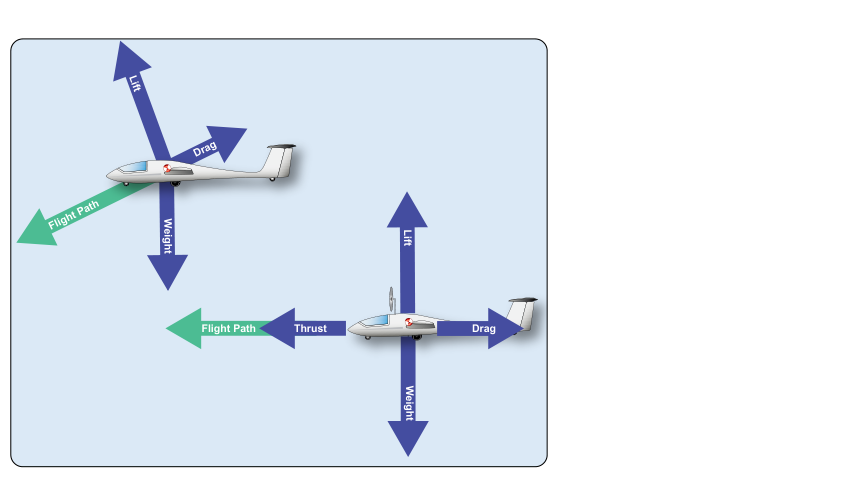
Pick up an aircraft model and you immediately sense its weight pulling it earthward. Coax it into flight and three additional forces enter the contest: lift pressing upward against that weight, thrust driving it forward, and drag resisting every foot of forward progress. These four forces of flight—lift, weight, thrust, and drag—act on every airplane simultaneously, and their balance (or imbalance) dictates whether the aircraft accelerates, decelerates, climbs, descends, or holds straight-and-level flight. For flight and ground instructors, the four forces are not merely a lesson-one concept; they are the conceptual scaffolding on which every subsequent aerodynamics topic—stalls, performance, turns, energy management—is built. Getting students to truly internalize these relationships, rather than memorize a diagram, is one of the most consequential things an aviation educator can do.
Lift: The Upward Aerodynamic Force
The Pilot's Handbook of Aeronautical Knowledge (PHAK, FAA-H-8083-25) defines lift as the net aerodynamic force acting perpendicular to the relative wind. Two complementary physical principles explain its origin. First, Bernoulli's principle: because the upper camber of a typical airfoil is more curved than the lower surface, airflow must accelerate over the top, reducing local static pressure. The higher pressure below the wing produces a net upward pressure difference. Second, Newton's third law: the wing deflects a large mass of air downward (downwash), and the equal-and-opposite reaction pushes the wing upward. Neither explanation alone is complete; together they describe the full picture.
Lift is quantified by the lift equation: L = CL × ½ρV² × S, where CL is the coefficient of lift, ρ is air density, V is true airspeed, and S is wing area. For pilots, the most controllable variable is CL, which is almost entirely governed by angle of attack (AOA)—the angle between the chord line and the relative wind. As AOA increases, CL rises in a nearly linear relationship until the critical AOA (typically around 15–20 degrees for most general aviation airfoils) is reached. Beyond that point, airflow separates from the upper surface, CL drops abruptly, and a stall occurs. This is a fixed aerodynamic threshold; it has nothing to do with a particular airspeed or pitch attitude.
Weight: Gravity's Relentless Pull
Weight is the force of gravity acting on the total mass of the aircraft—airframe, fuel, occupants, and cargo—and it acts vertically downward through the aircraft's center of gravity (CG). Unlike lift, weight does not change with airspeed or attitude; it is constant for a given loading condition (though it decreases gradually as fuel burns). In straight-and-level, unaccelerated flight, lift equals weight. The moment lift exceeds weight, the aircraft climbs; the moment weight exceeds lift, it descends.
CG location matters enormously. A CG forward of the allowable envelope increases the nose-down pitching moment and demands more elevator authority to rotate, which also raises the stall speed. A CG aft of limits reduces longitudinal stability and can make recovery from a stall difficult or impossible. These implications explain why weight-and-balance computation is a safety-critical preflight task, not an administrative formality.
Thrust: The Propulsive Force
Thrust is the forward force produced by the powerplant—whether a piston engine turning a propeller, a turbofan, or a turboprop. For a propeller-driven aircraft, thrust is the reaction force of the propeller accelerating a mass of air rearward (Newton's third law again). Thrust acts generally along the aircraft's thrust line, which on most single-engine aircraft is close to—but not exactly—the longitudinal axis. This slight offset, combined with propeller effects such as torque, P-factor, spiraling slipstream, and gyroscopic precession, creates asymmetric flight tendencies that pilots must anticipate and counter with rudder input.
In straight-and-level, unaccelerated flight, thrust equals drag. Add power and thrust exceeds drag; the aircraft accelerates or climbs. Reduce power and drag exceeds thrust; the aircraft decelerates or descends. Importantly, the relationship between thrust and the other forces changes with flight path angle. During a steady climb, thrust must overcome both aerodynamic drag and the rearward component of weight acting along the inclined flight path. This is why climb performance is so sensitive to density altitude: as air density falls, engine power output decreases and propeller efficiency drops, reducing available thrust at the same time the aircraft needs more of it.
Drag: The Aerodynamic Resistance
Drag is the aerodynamic force acting parallel to and opposite the relative wind. It has two primary components that behave in opposite ways with airspeed.
- Parasite drag includes form drag (pressure differences caused by the shape of the aircraft), skin-friction drag, and interference drag where airflow around different aircraft components interacts. Parasite drag increases with the square of airspeed—double the speed, roughly quadruple the parasite drag.
- Induced drag is the unavoidable by-product of lift production. It arises from the wingtip vortices and downwash generated whenever the wing produces lift. Induced drag is inversely related to airspeed squared: it is highest at slow speeds (high AOA) and decreases as speed increases.
The sum of these two components produces a characteristic U-shaped total drag curve. The airspeed at the bottom of that curve—where total drag is minimized—corresponds to the best lift-to-drag (L/D) ratio, and for most light aircraft it occurs near the best-glide speed. Flying at best glide speed maximizes range in a glide and is a critical number to know after an engine failure. Flying faster or slower than that airspeed increases total drag and degrades glide performance.
How the Four Forces Interact in Real Flight
Straight-and-Level Unaccelerated Flight
This is the reference condition: lift = weight and thrust = drag. Any deviation from this equilibrium is what makes the aircraft maneuver. Understanding equilibrium first makes deviations intuitive.
Climbs and Descents
In a steady climb, thrust exceeds drag by an amount sufficient to also overcome the rearward weight component along the flight path. Lift in a climb does not equal weight—it equals the component of weight perpendicular to the flight path, which is slightly less than total weight. Conversely, in a steady power-off descent (glide), the forward component of weight along the flight path effectively replaces thrust as the driving force. This is why an engineless aircraft can maintain a stable descent: weight itself propels it forward while drag decelerates it to an equilibrium glide speed.
Level Turns
In a banked turn, the lift vector tilts with the wing. The vertical component of lift must still equal weight to maintain altitude, but because total lift is now divided between a vertical component (opposing weight) and a horizontal component (providing centripetal force), total lift must increase. The pilot achieves this by increasing AOA—adding back pressure. This raises induced drag, so additional power is often needed to maintain airspeed. Steeper bank angles amplify this effect dramatically: a 60-degree banked turn requires the wing to produce twice as much lift as in wings-level flight, doubling the load factor and sharply increasing stall speed.
Key Numbers and Rules
- Critical AOA for most general aviation airfoils is approximately 15–20 degrees; the stall occurs at this AOA regardless of airspeed or aircraft attitude.
- At a 60-degree bank angle, load factor is 2 Gs, and stall speed increases by approximately 41 percent over the wings-level stall speed (the square root of the load factor).
- Best-glide speed corresponds to the minimum total drag (best L/D) condition; flying faster or slower reduces glide ratio.
- Parasite drag varies with V²; induced drag varies inversely with V²—understanding this explains why low-speed flight is dominated by induced drag and high-speed flight by parasite drag.
- CG must remain within the approved envelope; aft CG reduces longitudinal stability and stall recovery capability.
Common Test and Instructional Traps
- Lift is perpendicular to the relative wind, not to the ground. In a bank, lift tilts inward with the aircraft—this is the source of centripetal force in a turn and a frequent source of confusion on written-test questions.
- In a climb, lift does not equal weight. It equals the weight component perpendicular to the flight path. Many students assume the straight-and-level relationship carries over unchanged into a climb.
- Stall is an AOA event, not a speed event. An aircraft can stall at any airspeed if the critical AOA is exceeded—including in a steep level turn at cruise speed with an abrupt back-pressure input.
- Thrust line offset creates secondary effects. On most propeller aircraft, thrust acts slightly below the CG, producing a nose-up pitching moment at high power settings—one reason a go-around demands prompt pitch management.
- Weight decreases in flight as fuel burns, affecting CG and, indirectly, the AOA required to maintain lift equal to weight—a subtlety that matters on long cross-country flights.
Memory Aid
The classic memory aid remains reliable: "Lift opposes Weight; Thrust opposes Drag." Visualize a simple cross with a vertical axis (Lift up, Weight down) and a horizontal axis (Thrust forward, Drag aft). In balanced, unaccelerated flight each pair is equal. Any imbalance along either axis causes acceleration in that direction—climb or descent on the vertical axis, speed change on the horizontal axis. This mental picture converts abstract physics into an instant cockpit decision-making tool.