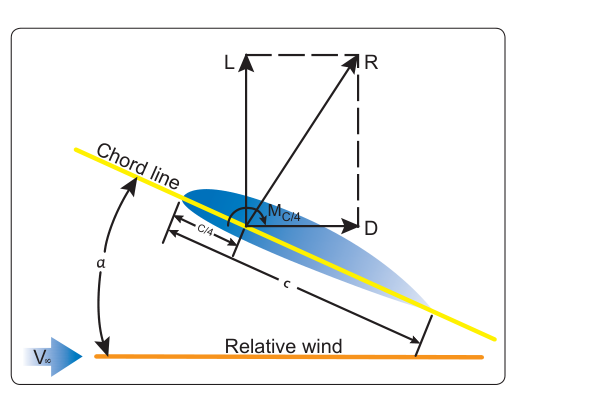
Of all the concepts in aerodynamics, angle of attack (AOA) is perhaps the single most important one for a pilot to truly internalize — not just for the written exam, but for every flight. Angle of attack is not the same as pitch attitude. It is not the same as climb angle. It is something more fundamental: the relationship between the wing and the air flowing over it. When you understand AOA at a deep level, concepts like stalls, slow flight, load factor, and maneuvering speed all click into place as natural consequences of one core principle.
This article will walk you through exactly what angle of attack is, how it generates lift, what happens as it increases, and why exceeding a critical value is always dangerous — regardless of how fast you are flying.
What Is Angle of Attack?
The angle of attack is defined as the angle between the chord line of the wing and the relative wind. Let's unpack both of those terms. The chord line is an imaginary straight line drawn from the leading edge of the wing to its trailing edge. The relative wind is the direction of the airflow as experienced by the wing — it is always parallel to and opposite the aircraft's flight path, regardless of the direction the nose is pointing. Note that AOA is not necessarily an acute angle — in situations such as a deep stall or spin, the angle between the chord line and the relative wind can exceed 90 degrees.
This distinction matters enormously. The relative wind is defined by where the airplane is going, not where it is pointing. If an aircraft is in a steep nose-high pitch attitude but descending, the relative wind is coming from below and ahead. The nose may be pointing up at 20 degrees, but if the aircraft is sinking, the angle between the chord line and that relative wind could be much higher than a pilot looking only at the attitude indicator might expect.
How Angle of Attack Produces Lift
A wing generates lift through two related mechanisms: the shape of the airfoil and the angle at which it meets the air. A cambered (curved) airfoil produces lift even at zero degrees angle of attack because its shape causes air to travel faster over the curved upper surface, reducing pressure there compared to the lower surface. This pressure differential — lower pressure above, higher below — is the lift force.
When AOA increases, several things happen simultaneously. The stagnation point (where airflow splits to go over or under the wing) moves downward and toward the leading edge. Air accelerating over the upper surface must travel even farther around the longer path, increasing its velocity and further reducing pressure above the wing. Air striking the lower surface at a steeper angle also increases the positive pressure below. Both effects add to lift.
The relationship between AOA and lift is expressed through the coefficient of lift (CL). At low angles of attack, CL increases nearly linearly as AOA increases. This is highly predictable and controllable. A pilot climbing at the same airspeed as cruise is simply flying at a higher AOA, generating more lift per unit of wing area to support the aircraft's weight.
The Critical Angle of Attack — And the Stall
The linear relationship between AOA and lift does not last forever. As the angle of attack continues to increase, the airflow over the upper surface must make an increasingly sharp turn around the leading edge. At some point — typically around 15 to 20 degrees for most light aircraft, though the exact value depends on the specific airfoil design — the airflow can no longer follow the upper surface smoothly. It separates from the wing, becoming turbulent and chaotic rather than smooth and attached. When this happens, the coefficient of lift drops dramatically and suddenly. This is a stall.
Here is the most critical fact about stalls, and the one most frequently misunderstood by new students: a stall is always caused by exceeding the critical angle of attack. It has nothing to do with being slow, per se. An aircraft can stall at any airspeed — even well above normal cruise speed — if the AOA is forced beyond its critical value. This is exactly what happens in an accelerated stall: the pilot pulls back hard in a turn or a sudden maneuver, increasing AOA rapidly, and the wing stalls even though the airspeed may be much higher than the published stall speed.
The published stall speed (VS) in the Pilot's Operating Handbook is valid only at a specific set of conditions: wings level, 1g flight, at maximum gross weight, with a specific flap configuration. Any deviation from those conditions — bank angle, increased weight, abrupt back-pressure — changes the airspeed at which the critical AOA is reached. This is why understanding AOA, not just airspeed, is the correct mental model for stall awareness.
Factors That Change the Stall Speed (But Not the Critical AOA)
It is worth emphasizing a subtle but important point: the critical angle of attack for a given wing does not change. What changes is the airspeed at which the pilot reaches that angle. Several factors cause a pilot to reach the critical AOA at a higher airspeed than expected:
- Bank angle: In a turn, the wing must produce more lift to support the aircraft's weight while also providing centripetal force. The wing does this by flying at a higher AOA. At 60 degrees of bank, the load factor is 2g, and stall speed increases by approximately 41% compared to straight-and-level flight.
- Increased weight: A heavier aircraft requires more lift from the same wing, meaning the wing must fly at a higher AOA at any given airspeed. Stall speed increases with weight.
- Turbulence and abrupt control inputs: Sudden gusts or sharp back-pressure can momentarily increase AOA well beyond what the airspeed would normally suggest, producing a snap stall.
- Flaps and leading-edge devices: Lowering flaps increases the wing's camber and its maximum CL, allowing the wing to reach the same critical AOA at a lower airspeed, which is why flaps allow slower flight before stalling.
AOA and Energy Management in Real Flying
In the cockpit, thinking in terms of AOA rather than just airspeed improves situational awareness in several ways. During a go-around from a slow, high-drag configuration, a pilot who understands AOA knows that simultaneously adding full power, raising flaps incrementally, and maintaining a positive pitch attitude requires careful coordination — pitching too aggressively while still slow and heavy with drag can spike the AOA to the critical value before the aircraft accelerates to a safe margin.
On final approach, the classic stall-spin accident scenario involves a low, slow turn from base to final where the pilot adds back-pressure and rudder to tighten the turn. The bank increases load factor, the back-pressure directly raises AOA, and the uncoordinated rudder creates additional adverse yaw — a perfect combination for reaching the critical AOA in the most dangerous phase of flight. Recognition of AOA as the direct cause of the stall, rather than low airspeed as an indirect symptom, helps pilots catch these situations earlier.
Modern aircraft increasingly feature AOA indicators in the cockpit, which display the wing's actual angle relative to the relative wind. These instruments give a direct, continuous readout of the stall margin regardless of airspeed, bank angle, or weight, making them a valuable safety tool. The FAA has taken steps, including policy changes to ease certification requirements, to encourage the installation of AOA indicators in general aviation aircraft.
Key Numbers and Rules
- The critical angle of attack for most light aircraft airfoils is approximately 15–20 degrees; always check the specific aircraft's POH for exact values.
- Stall speed increases with the square root of the load factor. At 60° bank (2g), stall speed is about 1.41 times the 1g stall speed.
- The critical angle of attack is fixed for a given airfoil — it does not change with airspeed, altitude, or weight.
- A stall can occur at any airspeed and at any attitude if the critical AOA is exceeded.
- The coefficient of lift reaches its maximum (CL max) exactly at the critical angle of attack, then drops sharply beyond it.
- Power does not prevent a stall; only reducing AOA (pushing forward on the controls) recovers from a stall.
Common Test Traps
- Confusing pitch attitude with AOA: The FAA knowledge test may describe an aircraft in a steep nose-high attitude and ask about AOA. Remember — AOA is measured from the relative wind, not the horizon. A descending aircraft can have a very high AOA even with the nose near level.
- Assuming stalls only happen at low airspeed: The exam frequently presents scenarios involving accelerated stalls or stalls in steep turns. A stall is always an AOA event, never purely a speed event.
- Forgetting load factor increases stall speed: Questions about stall speed in a 60° banked turn are common. Know that the 2g load factor raises stall speed by approximately 41% above the 1g figure.
- Thinking flaps lower the critical AOA: Flaps primarily increase the wing's camber and CL max, which is why flaps allow slower flight — the wing still stalls at essentially the same critical AOA for that configuration, just at a lower airspeed.
- Assuming power recovery eliminates stall: Adding power during a stall recovery helps restore airspeed and minimizes altitude loss, but it does not itself reduce AOA. Proper recovery always begins with reducing back-pressure to fly below the critical angle of attack.