Every airplane must strike a careful balance between two competing demands: it must be stable enough to fly predictably without constant pilot input, yet maneuverable enough to respond promptly when the pilot does act. These two qualities pull in opposite directions — a highly stable airplane resists being displaced from its trimmed attitude, while a highly maneuverable airplane responds quickly and precisely to control inputs. Understanding how stability works in each of the three axes of flight is fundamental to safe airmanship and one of the most-tested topics on the FAA Private Pilot Knowledge Test.
Stability is described in three dimensions corresponding to the three axes around which an airplane rotates: the longitudinal axis (nose to tail, controlling roll), the lateral axis (wingtip to wingtip, controlling pitch), and the vertical axis (top to bottom, controlling yaw). An airplane can exhibit positive, neutral, or negative static stability in each axis independently, and the combination of all three determines the overall flying character of the aircraft.
Static vs. Dynamic Stability
Before diving into the three axes, it is important to understand two overlapping concepts: static stability and dynamic stability. Static stability describes the airplane's initial tendency after being displaced from equilibrium. If it tends to return toward the original attitude, it has positive static stability. If it stays where it ended up, it has neutral static stability. If it continues to move further away from the original attitude, it has negative static stability — a dangerous condition.
Dynamic stability describes what happens over time after the initial reaction. Even if an airplane has positive static stability (it initially starts moving back toward equilibrium), it might oscillate around that equilibrium with increasing amplitude — meaning the oscillations grow larger over time — which is called dynamically unstable. Oscillations that gradually die out represent positive dynamic stability, and constant, non-growing oscillations represent neutral dynamic stability. Most well-designed light training aircraft have both positive static and positive dynamic stability in all three axes, though some modes are more strongly damped than others.
Longitudinal Stability: The Pitch Axis
Longitudinal stability refers to the airplane's tendency to return to its original pitch attitude after being disturbed — for example, after a gust pushes the nose up or down. Pitching motion occurs about the lateral axis (wingtip to wingtip), and this stability is controlled primarily by the horizontal stabilizer and elevator, making it arguably the most critical form of stability for normal flight operations.
The key to longitudinal stability is the relationship between the center of gravity (CG) and the center of lift (center of pressure). For positive longitudinal stability, the CG must be located ahead of the center of lift. When a gust raises the nose, angle of attack increases, generating more lift at the wing and causing the nose to pitch further up momentarily. However, the horizontal stabilizer simultaneously experiences an increase in downward aerodynamic force that pushes the tail down and the nose back toward level — a restoring moment. The further forward the CG, the stronger this restoring force, and the more longitudinally stable the airplane.
A forward CG produces strong longitudinal stability but requires more back pressure to rotate and may make landing flare more demanding. An aft CG reduces longitudinal stability progressively, and if the CG moves behind the aft limit, the airplane can become longitudinally unstable — a potentially unrecoverable condition. This is why CG limits printed in the Pilot's Operating Handbook (POH) are not suggestions; they are hard limits with direct safety implications.
The phenomenon known as a phugoid oscillation demonstrates dynamic longitudinal stability. If a pilot releases the controls after a pitch disturbance, the airplane may gently cycle through a series of shallow climbs and descents with slow, long-period oscillations. In most light trainers, this phugoid is positively damped — the oscillations shrink over time — meaning the airplane will eventually return to trimmed flight on its own.
Lateral Stability: The Roll Axis
Lateral stability is the airplane's tendency to return to wings-level after being rolled by a disturbance, such as a turbulent gust banking one wing down. Rolling motion occurs about the longitudinal axis (nose to tail), and several design features contribute to lateral stability, working together in a complementary way.
Dihedral is the most important contributor. When the wings are angled upward from root to tip (dihedral), a roll to the right causes the left wing to present a slightly higher angle of attack than the right wing, because the left wing moves more directly into the relative wind. This generates more lift on the left wing, rolling the airplane back toward level. Dihedral effect is why many high-wing trainers are inherently quite laterally stable — they exhibit strong self-leveling tendencies.
Wing sweep also contributes to lateral stability: when a swept-wing aircraft rolls, the leading wing presents more of its span perpendicular to the relative wind, increasing its effective lift and providing a restoring force. High wing placement contributes through pendulum effect — the center of gravity hangs below the center of lift, creating a natural self-righting tendency, similar to a pendulum returning to its lowest point. Keel effect from the fuselage and vertical fin also adds a small amount of lateral stability.
Too much directional stability relative to lateral stability can actually work against coordinated maneuvering, contributing to a tendency called spiral instability (a dynamic instability discussed below under Dutch roll and spiral divergence).
Directional Stability: The Yaw Axis
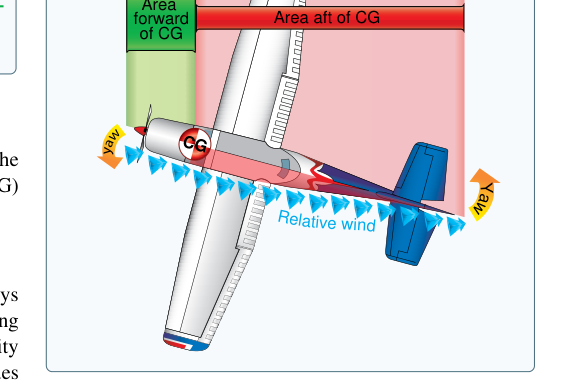
Directional stability is the airplane's tendency to weathervane — to align its nose back into the relative wind after being yawed by a disturbance. It is provided almost entirely by the vertical stabilizer (fin) and the rudder surface. When a yaw displaces the nose to the left, the relative wind strikes the left side of the vertical fin, creating an aerodynamic force that pushes the tail left and yaws the nose back to the right, restoring alignment. The larger and taller the vertical fin, the stronger the directional stability.
Directional stability and lateral stability are closely linked through a phenomenon called Dutch roll. Dutch roll is a coupled oscillation in which the airplane simultaneously rolls and yaws — the nose swings left as one wing rises, then swings right as the other wing rises, in a rocking, corkscrew-like motion. It results from an imbalance between strong lateral stability (dihedral effect) and relatively weak directional damping. Dutch roll is usually a nuisance rather than a danger in light aircraft, since it tends to be positively damped, but it is much more pronounced in swept-wing jets — which is why many jets use yaw dampers to automatically suppress it.
A related dynamic tendency is spiral instability: when an airplane with strong directional stability but weak lateral stability enters a bank, the directional stability yaws the nose into the low wing, tightening the bank and increasing the descent rate in an ever-tightening spiral. Most light airplanes are mildly spiral-unstable but recover easily with slight aileron input. A pilot who ignores a gradual bank can find the airplane in a graveyard spiral — a key reason for maintaining situational awareness.
Why It Matters
Understanding stability has direct practical value. An airplane loaded with an aft CG will feel light on the controls and may be difficult to recover from an unusual attitude. An airplane with too little directional stability will be difficult to maintain coordinated flight in crosswinds. Knowing why an airplane tends to return to level flight (or why it does not) helps a pilot predict behavior, manage emergencies, and load the airplane within limits every single flight.
Maneuverability must also be considered. Aerobatic and military aircraft are deliberately designed with reduced stability — sometimes to the point of neutral or even slight negative stability — to achieve rapid, precise attitude changes. Training aircraft sacrifice some agility in exchange for the forgiving handling that makes them easier and safer to learn in.
Key Numbers and Rules
- CG forward of center of lift — required for positive longitudinal stability; aft CG limits are hard safety limits.
- Dihedral angle — primary design feature providing positive lateral stability in most light aircraft.
- Vertical fin size — primary design factor governing directional stability and Dutch roll damping.
- Phugoid period — long, slow pitch oscillation; positively damped in most trainers (oscillations die out).
- Dutch roll — coupled roll-yaw oscillation; stronger when dihedral effect exceeds directional damping.
- Spiral instability — mild tendency in most light aircraft; requires slight aileron correction to prevent tightening spiral.
- Positive static stability — airplane returns toward original attitude after disturbance (initial tendency).
- Positive dynamic stability — oscillations following a disturbance decrease in amplitude over time.
Common Test Traps
- Confusing static and dynamic stability: An airplane can have positive static stability (initially returns toward equilibrium) but negative dynamic stability (oscillations grow larger over time). These are separate concepts tested independently.
- Lateral vs. directional axis: Many students mix up which axis is which. Remember — lateral stability is about the roll axis (longitudinal, nose to tail), and directional stability is about the yaw axis (vertical). The word