Every aircraft that rolls off a production line represents a carefully engineered compromise. A designer who maximizes stability produces an airplane that stubbornly resists attitude changes—predictable and forgiving, but potentially sluggish in an emergency recovery. A designer who maximizes maneuverability produces an aircraft that responds instantly to every control input—but one that may demand the pilot's constant vigilance to keep coordinated and on course. The Pilot's Handbook of Aeronautical Knowledge (PHAK, FAA-H-8083-25) defines stability as an aircraft's inherent tendency to return to its original condition of flight after a disturbance, without pilot input. Maneuverability, in contrast, is the quality that permits a pilot to change attitude and direction readily and to withstand the stresses that accompany those changes. Understanding how this tension plays out across all three axes—longitudinal, lateral, and directional—is essential knowledge for both the Flight Instructor Airplane and Ground Instructor written tests, and it gives your students a mental framework that makes aircraft behavior feel logical rather than arbitrary.
Stability: Static and Dynamic Dimensions
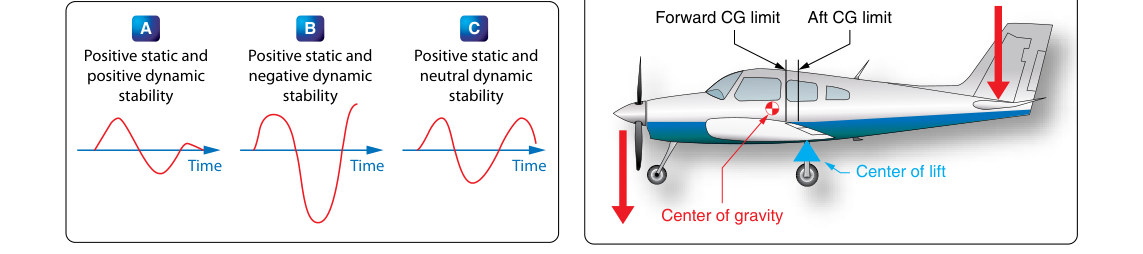
Before diving into each axis, it is worth distinguishing two layers of stability that appear on FAA tests. Static stability describes the initial tendency of the aircraft after a disturbance: does the nose start moving back toward its trimmed position (positive), remain where it is (neutral), or continue moving away (negative)? Dynamic stability describes the long-term behavior of those corrections over time: do the oscillations diminish (positive dynamic stability), remain constant (neutral), or grow (negative dynamic stability)? An aircraft can be statically stable yet dynamically unstable—its nose starts to return but then overshoots and oscillates with ever-increasing amplitude. The PHAK explains this clearly, and the distinction is a frequent source of test questions. Most certificated light aircraft are designed with positive static stability and positive dynamic stability in all three axes, though the degree of each varies by design intent.
Longitudinal Stability: The Pitch Axis
How It Works
Longitudinal stability governs pitch—nose-up and nose-down motion around the lateral axis. The central design tool is the relationship between the center of gravity (CG) and the center of pressure (CP), or more precisely, the aerodynamic center (AC) of the wing. When the CG sits ahead of the wing's aerodynamic center, the aircraft has a natural nose-down pitching tendency. The horizontal tail—producing a downward aerodynamic load at the aft end of the moment arm—counteracts this tendency and provides a restoring pitching moment. If a gust pitches the nose upward, the angle of attack increases, lift and drag on the tail change, and the restoring moment pushes the nose back toward the trimmed attitude. This is positive longitudinal stability.
The CG–Stability Link
Moving the CG aft weakens the nose-down tendency and shortens the moment arm between CG and the tail. The restoring force diminishes. At some rearward CG position—the aft CG limit—the aircraft reaches neutral longitudinal stability. Beyond that limit, stability becomes negative: a pitch disturbance causes the nose to continue pitching away from trim, and the pilot must actively correct every deviation. This is why an aft CG condition is operationally dangerous, not merely a regulatory violation. It also explains why a stall recovery may be impossible if the pilot cannot push the nose forward against a destabilizing pitching moment. The forward CG limit, conversely, is set to ensure the pilot has enough elevator authority to raise the nose for landing—excessive forward CG makes the aircraft stable to the point of being difficult to flare.
Trade-off With Maneuverability
A trainer like the Cessna 172 is designed with notably positive longitudinal stability so that students can release the controls momentarily without the aircraft diverging. An aerobatic aircraft is designed closer to neutral stability so that pitch attitude changes require minimal force and the aircraft stays where it is pointed. The pilot of an aerobatic airplane must actively fly every moment; the pilot of a trainer enjoys built-in self-correction.
Lateral Stability: The Roll Axis
Design Features That Provide Lateral Stability
Lateral stability is the tendency to return to wings-level after an uncommanded roll. Several design elements contribute, and instructors should be able to explain each:
- Dihedral: Wings angled upward from root to tip. When a disturbance rolls one wing down, the aircraft sideslips toward the low wing. That low wing meets the relative wind at a higher angle of attack and generates more lift, creating a restoring rolling moment. Dihedral is the most powerful and most common lateral stability device in light trainers.
- Sweepback: On swept-wing aircraft, a sideslip changes the effective sweep angle each wing presents to the relative wind. The advancing (into-the-wind) wing effectively becomes less swept and generates more lift, while the receding wing becomes more swept and generates less lift, creating a restoring rolling moment.
- High-wing placement: Placing the wings above the fuselage's center of gravity produces a pendulum effect—the heavy fuselage hanging below the wings tends to swing back to wings-level after a roll disturbance.
- Keel effect: The combined side area of the fuselage, vertical tail, and (on high-wing designs) the wing root fairing resists sideslip and indirectly supports lateral stability.
Too Much of a Good Thing
Excessive lateral stability produces an aircraft that is sluggish in roll. Large aileron deflections are required for modest bank changes, and the aircraft resists snap maneuvers. This is the direct trade-off with roll maneuverability. Low-wing aircraft typically use more dihedral than high-wing aircraft for this reason—the high-wing pendulum effect provides some lateral stability that a low-wing design must instead build in through additional dihedral.
Directional Stability: The Yaw Axis
How It Works
Directional stability is the tendency to weathervane into the relative wind after a yaw disturbance. The primary contributor is the vertical tail—the fixed fin and movable rudder assembly. When the nose yaws left, the relative wind strikes the left side of the vertical fin, producing a rightward force that pushes the tail back into alignment and returns the nose toward the original heading. A larger vertical fin increases the lever arm and the correcting force, improving directional stability. The fuselage itself contributes some destabilizing yawing tendency (the forward fuselage area forward of the CG acts like a weather vane in reverse), which the vertical tail must overcome.
Trade-off With Yaw Maneuverability
Aerobatic aircraft intentionally use smaller vertical tail surfaces to allow faster, crisper yaw response for snap rolls and spins. Transport-category aircraft favor large vertical tails primarily to provide adequate control in the event of an engine failure and to meet crosswind and handling requirements; yaw dampers and, on many modern jets, fly-by-wire flight control systems are used to damp Dutch roll and refine handling qualities rather than to compensate for a deficiency created by tail sizing. Every size choice is a deliberate design decision.
The Interaction: Dutch Roll
Lateral and directional stability do not operate in isolation—they interact, and an imbalance between them produces a coupled oscillation called Dutch roll. When an aircraft with strong lateral stability but relatively weak directional stability is disturbed, the roll restoring tendency (dihedral effect) overpowers the yaw restoring tendency. The aircraft rolls and yaws simultaneously in a corkscrew-like oscillation that can be uncomfortable and, if dynamic stability is marginal, divergent. Swept-wing and jet aircraft are particularly susceptible because wing sweep contributes substantial dihedral effect, though the degree of susceptibility also depends on each aircraft's specific balance between directional and lateral stability, not on wing sweep alone. Most transport-category aircraft suppress Dutch roll automatically with a yaw damper, which senses yaw rate and inputs small rudder corrections faster than a pilot can. The PHAK discusses Dutch roll in the context of dynamic stability, and it appears frequently on instrument and commercial-level tests as well as flight instructor tests.
Why This Matters in the Cockpit and the Classroom
These concepts are not purely academic. When students ask why a Cessna 172 feels so forgiving compared with a Piper Cherokee, the answer lies partly in dihedral angle and wing placement. When a student loads an aircraft with baggage stuffed into the aft baggage compartment and the airplane suddenly feels light on the controls, the answer is a shifting CG reducing longitudinal stability. When a student practicing slow flight notices the aircraft requires constant rudder inputs to stay coordinated, directional stability margins are reduced at high angles of attack because the vertical tail operates in disrupted airflow from the stalled or near-stalled wing. Connecting stability concepts to these real, felt sensations is what separates a great instructor from one who merely recites definitions.
- Positive static stability: initial tendency to return to trim — most certificated aircraft.
- Positive dynamic stability: oscillations damp out over time — required for most certificated aircraft in normal category.
- Aft CG: reduces longitudinal stability, increases pitch sensitivity, may prevent stall recovery.
- Forward CG: improves longitudinal stability but reduces elevator authority for flare.
- Dihedral: primary lateral stability device in most light trainers.
- Vertical tail: primary directional stability device in virtually all fixed-wing aircraft.
- Dutch roll: coupled roll-yaw oscillation from mismatched lateral and directional stability.
Common Test Traps
- Aft CG improves performance but degrades stability. Students confuse better climb gradient with safety. An aft CG within limits may improve climb and cruise, but it reduces the longitudinal stability margin and must never be confused with being aerodynamically benign.
- Dihedral is a lateral stability device, not a directional stability device. The vertical tail handles directional stability. Dihedral is irrelevant to weathervaning.
- Static stability and dynamic stability are separate qualities. An aircraft that initially pitches back toward trim (positive static) can still develop growing oscillations (negative dynamic). Both must be positive for a well-behaved aircraft.
- Dutch roll is a coupled phenomenon. It is not purely a roll problem or purely a yaw problem—it requires an imbalance between the two stability axes. Calling it only a yaw instability is incomplete and incorrect.
- High stability does not guarantee safety in all conditions. An aircraft with very high longitudinal stability may resist the nose-up pitch needed to arrest a sink rate at landing, and it may be harder to recover from an unusual attitude if the restoring forces oppose the pilot's inputs.