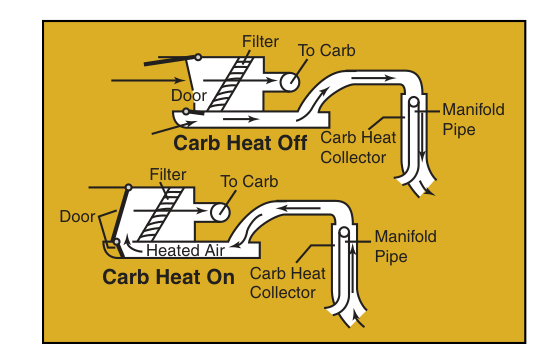
Of all the subtle threats a piston-engine pilot faces, carburetor icing stands out because it can develop silently in seemingly benign conditions — clear skies, moderate temperatures — and reduce engine power dramatically before the pilot even suspects a problem. The carburetor heat system is the primary defense against this hazard, and understanding how it works, when to use it, and what to expect when you apply it is essential knowledge for every private pilot candidate.
This article covers the full picture: the physics of carburetor ice, how the heat system combats it, the specific conditions that demand its use, and the practical cockpit techniques that keep pilots safe.
Why Carburetor Ice Forms
A float-type carburetor mixes fuel and air by drawing air through a venturi and adding atomized fuel. Two simultaneous physical processes make the carburetor throat dramatically colder than the surrounding air. First, as air accelerates through the venturi, its pressure drops sharply, and that pressure drop causes a corresponding temperature drop — this is the venturi cooling effect, which can reduce local air temperature by up to approximately 70°F (around 21°C) below ambient. Second, when liquid fuel vaporizes, it absorbs heat from the surrounding air, producing an additional cooling effect — evaporative cooling — that can contribute another 10–14°F of temperature reduction.
Combined, these two effects can lower the temperature inside the carburetor throat by up to roughly 70°F or more below the outside air temperature. This means ice can form inside the carburetor even when the outside air temperature is as high as 70°F (21°C), as long as there is sufficient moisture in the air. The FAA identifies carburetor icing as a hazard at outside air temperatures between approximately 20°F and 70°F (-7°C to 21°C) with visible moisture or high relative humidity — and the risk is greatest at temperatures between 30°F and 50°F (about -1°C to 10°C) when humidity is high.
Ice accumulates on the throttle plate (butterfly valve) and the walls of the carburetor throat, progressively restricting airflow. The result is a drop in engine RPM on a fixed-pitch propeller aircraft, or a loss of manifold pressure on a constant-speed propeller aircraft, often without any rough running initially. Left uncorrected, carburetor ice can cause complete engine failure.
How the Carburetor Heat System Works
The carburetor heat system provides a simple but effective solution: it routes air that has been pre-heated by the engine past the carburetor, raising the temperature inside the carburetor throat above the freezing point so that ice cannot form — or melts any ice that has already formed.
On most light piston aircraft, the heat source is a shroud or muff surrounding the engine exhaust pipe. Ambient air is ducted through or around this heat exchanger, picking up significant warmth before being directed into the carburetor. The system is controlled by a cockpit control labeled Carb Heat — usually a push-pull knob or a lever — that operates a simple butterfly valve or door in the induction system. In the cold (normal) position, the valve routes unheated ram air directly to the carburetor. In the hot position, it diverts airflow through the heat exchanger before it enters the carburetor.
Because the heated air is less dense than ambient air, applying carburetor heat always causes a slight reduction in engine power. This is normal and expected — the richer, less-dense mixture produces a small, noticeable drop in RPM (typically 50–100 RPM on a fixed-pitch aircraft). If the drop is larger than expected, or if the engine runs rough immediately after carb heat is applied, ice has likely been present and is now melting.
What Happens When You Apply Carb Heat to an Iced Carburetor
Understanding the sequence of events when you apply carb heat to an already-iced carburetor is critical, both for passing the knowledge test and for not panicking in the airplane. Here is what typically happens:
- Initial roughness: As the heated air begins melting the ice, water — liquid water — passes through the engine momentarily, causing rough running. This is expected and normal. Do not pull the carb heat off thinking something is wrong.
- RPM drop: The engine may temporarily run even rougher or the RPM may drop a bit further as the ice melts and the water is ingested.
- Smoothing out and RPM rise: As all the ice melts and the carburetor clears, the engine will smooth out and RPM will rise back toward — and ideally exceed — the pre-application reading (since the restriction is now gone). If RPM only partially recovers and stays below the original value, that is the normal density-related penalty for having the carb heat on; turn it off if icing is no longer a concern.
If you apply carb heat and notice no change whatsoever — no roughness, no RPM variation — either there was no ice present or the heat is insufficient. Always check the aircraft's Pilot's Operating Handbook (POH) for the manufacturer's specific guidance.
When to Use Carburetor Heat
The decision of when to apply carburetor heat is one of the most practically important judgment calls in piston-engine flying. The FAA's guidance, reflected in the Pilot's Handbook of Aeronautical Knowledge and the Airplane Flying Handbook, provides the following framework:
- Any time icing conditions are suspected or encountered. The classic signs are unexplained RPM drop, rough running, or loss of power under conditions favorable to icing.
- Anytime you operate at reduced power settings in conditions conducive to icing. During descent with the throttle partially or fully closed, the venturi cooling effect is still active but engine heat output is reduced, making icing more likely.
- Before landing when operating in conditions favorable to icing. Many pilots apply carburetor heat as a precautionary measure when beginning the descent and during the landing approach, then return it to cold just before the final power reduction for landing, in accordance with the POH.
- During run-up. The pre-flight run-up includes a brief carburetor heat check: apply heat, observe a small RPM drop (confirming the system is working), then return to cold. A small RPM rise after returning to cold is normal. Note that applying carb heat during run-up at high power introduces unfiltered air into the engine; this check should be brief.
Importantly, carb heat is generally not used during takeoff and initial climb at full power, because at full throttle the engine is producing maximum heat and the rapid airflow tends to prevent ice accumulation. Additionally, during full-power operations, applying carb heat significantly reduces power output and introduces unfiltered air — a double penalty right when you need maximum performance. Always defer to the POH for your specific aircraft.
Key Numbers and Rules
- Carburetor ice can form at outside air temperatures as high as 70°F (21°C) with sufficient humidity.
- The highest risk window is outside air temperatures of 30°F to 50°F (-1°C to 10°C) with high relative humidity or visible moisture.
- Venturi effect alone can reduce carburetor throat temperature by approximately 70°F below ambient.
- Applying carb heat at cruise will typically cause a 50–100 RPM drop due to reduced air density — this is normal.
- After carb heat clears ice, engine should smooth out and RPM should return to or near original pre-ice value.
- Carburetor heat is typically checked during the pre-takeoff run-up per the POH checklist.
- Carb heat is generally NOT used for takeoff unless specifically required by the POH.
- Always consult the aircraft's POH/AFM — carburetor heat procedures vary between aircraft makes and models.
Common Test Traps
- Expecting clear skies to mean no icing risk. Carburetor ice is not the same as structural ice. It can form in clear air whenever temperature and humidity combine unfavorably. The FAA knowledge test frequently presents scenarios with warm, seemingly benign conditions that are actually high-risk for carburetor icing.
- Misidentifying the rough-running response. Students often think engine roughness after applying carb heat means they've made things worse. In fact, roughness and a temporary RPM drop immediately after carb heat application indicate ice was present and is melting — a good sign that the system is working. Do not turn carb heat off during this phase.
- Thinking a power loss alone confirms icing. An unexplained RPM drop should always trigger a carb heat check, but power loss has other causes. The test may present scenarios requiring you to distinguish between likely icing conditions and other causes of power loss.
- Forgetting the density penalty. Some students expect RPM to fully return to its original value after applying carb heat. Remember: carb heat introduces warmer, less-dense air, so RPM with carb heat ON will be slightly lower than normal cruise RPM even with zero ice present. The net RPM after ice clears will typically be higher than the iced value but lower than the original pre-heat, pre-ice value.
- Assuming carb heat works on all aircraft. Fuel-injected engines do not use float-type carburetors and do not have carburetor ice as a hazard. They may experience throttle body or induction icing under very specific conditions, but the carburetor heat system described here applies specifically to carburetor-equipped (non-fuel-injected) piston engines.