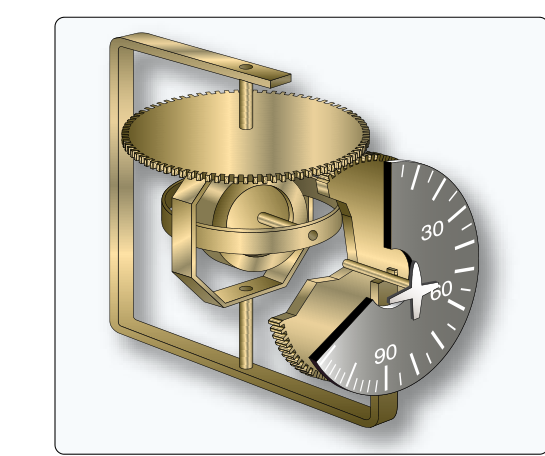
Every pilot quickly learns that the magnetic compass, while indispensable, is a frustrating instrument to read in flight. It swings, lags, leads, and oscillates every time the aircraft accelerates, turns, or hits turbulence. Enter the directional gyro (DG) — also called the heading indicator or gyroscopic heading indicator — a rock-steady instrument that uses the principle of gyroscopic rigidity to maintain a consistent directional reference throughout the flight. Understanding how it works, what its limitations are, and how to manage it correctly is essential for both the FAA knowledge test and real-world cockpit discipline.
The directional gyro does not sense magnetic north on its own. Instead, it must be periodically set to agree with the magnetic compass. Once set, it holds that heading reference with remarkable stability — far superior to the compass during maneuvering flight. But it is not perfect. Gyroscopic drift and mechanical friction mean that the DG will wander from its initial setting over time, making regular cross-checks mandatory.
How the Directional Gyro Works
The DG is a gyroscopic instrument, meaning it relies on a spinning rotor to maintain spatial orientation. In most light aircraft, the rotor is spun either by the engine-driven vacuum (suction) system or, in some aircraft, by an electrically driven motor. The vacuum system draws air across vanes on the rotor, spinning it at approximately 18,000 RPM or more, depending on the design. The rotor is mounted in a gimbal assembly that allows the instrument face (compass card) to rotate freely around the stabilized rotor.
The operating principle is gyroscopic rigidity in space: a spinning mass tends to remain fixed in its plane of rotation relative to inertial space, regardless of how the frame around it is tilted or rotated. When the aircraft turns, the aircraft and instrument case rotate around the gyro, while the rotor — and the heading card attached to it — stays pointed in its original direction. The heading displayed is therefore the angle between the aircraft's nose and that fixed reference.
In a typical installation, the pilot sets the DG by rotating the knob on the face of the instrument until the compass card shows the same heading currently indicated on the magnetic compass. This must be done while in straight, unaccelerated, wings-level flight so the magnetic compass itself is reading accurately.
Gyroscopic Precession and Drift
The most important limitation of the directional gyro is precession — the tendency of a gyroscope to drift away from its original orientation over time. Precession in the DG is caused by two sources:
- Mechanical precession (real drift): Friction in the gimbal bearings applies a small torque to the rotor. By gyroscopic law, any force applied to a spinning gyro results in movement 90 degrees ahead in the direction of rotation. This slowly rotates the gyro away from its set heading. The amount of drift varies by instrument quality, but FAA handbooks describe approximately 3 degrees per 15 minutes as a general guideline for acceptable precession — a handbook rule-of-thumb rather than a formal regulatory pass/fail standard.
- Apparent precession (earth rate drift): Because the Earth rotates beneath the gyroscope, and because the gyro remains fixed in inertial space, the heading it shows will appear to drift relative to the Earth's surface. This effect is more pronounced at higher latitudes. It is called apparent precession because the gyro is not actually moving — the Earth is rotating under it.
The combined result of real and apparent drift means that a directional gyro left unchecked can accumulate significant heading error over the course of a flight. This is why the FAA and every operating handbook recommend the pilot re-align the DG with the magnetic compass approximately every 15 minutes during flight.
The Vacuum (Suction) System and Gyro Health
Because most light-aircraft DGs are vacuum-powered, the health of the vacuum system directly determines the reliability of the heading indicator. The vacuum system consists of an engine-driven vacuum pump, suction relief valve, vacuum gauge, and associated plumbing and filters. Typical system suction is commonly cited in the range of 4.5 to 5.5 inches of mercury, but the exact specification is aircraft-specific — always check the POH rather than treating this as a fixed FAA-mandated figure.
If the vacuum pump fails or suction falls below the required level, the rotor will spin down. As rotor RPM decreases, gyroscopic rigidity weakens, and the DG will begin to tumble or wander erratically. A DG that is winding down may appear to work for several minutes before showing obvious errors, making it a subtle and dangerous failure mode. This is why cross-checking the heading indicator against the turn coordinator (which has its own gyro) and the magnetic compass is a critical skill, particularly when entering IMC or during night flight.
Setting and Checking the Directional Gyro
Proper DG management follows a specific sequence:
- Before taxi: Ensure the vacuum gauge reads within the normal range and the gyro has had adequate time to spin up (typically 2–5 minutes after engine start).
- Run-up / before takeoff: Align the DG with the magnetic compass while the aircraft is stationary and wings-level. Verify that the indication is stable.
- In flight: Cross-check the DG against the magnetic compass approximately every 15 minutes. Choose a period of straight, unaccelerated flight to take the compass reading. Make small corrections using the set knob as needed.
- Approach and landing: A final check before entering the pattern helps ensure the heading is current and correct.
A DG that drifts noticeably more than the general 3-degrees-per-15-minutes guideline, or that tumbles during normal maneuvering, should be treated with suspicion and discussed with a mechanic — while FAA handbooks describe this drift figure as guidance rather than a codified dispatch standard, persistent excessive drift or tumbling can indicate a malfunctioning instrument that is unsuitable for IFR flight.
Why It Matters — Safety and Situational Awareness
The directional gyro is the primary heading reference for navigation in both VFR and IFR flight. A pilot who does not cross-check and reset the DG regularly can accumulate a heading error that leads to significant off-course deviations — especially during cruise flight over long distances or in low-visibility conditions. In instrument meteorological conditions (IMC), an undetected DG error can quickly put an aircraft in a critically dangerous position.
The DG also plays a central role in instrument scan technique. Because it is free from compass errors caused by acceleration and turning, pilots can rely on it for immediate heading reference during level turns and when rolling out on a target heading. The magnetic compass is used only to verify and reset, not as the primary turning reference.
Key Numbers and Rules
- Rotor spin-up: typically 2–5 minutes after engine start before the DG is reliable.
- Typical vacuum system suction: commonly 4.5 to 5.5 inches of mercury (verify in the POH — this is aircraft-specific, not a fixed FAA figure).
- General guideline for acceptable precession drift: approximately 3 degrees per 15 minutes (a handbook rule-of-thumb, not a regulatory standard).
- Re-alignment interval: set the DG to the magnetic compass approximately every 15 minutes during flight.
- The DG must be set during straight, level, unaccelerated flight when the magnetic compass is accurate.
- The DG has no north-seeking ability — it must always be manually aligned to magnetic north via the compass.
Memory Aid
To remember when your magnetic compass is accurate enough to use for resetting the DG, remember that it is reliable only during straight-and-level, unaccelerated flight. This is not tied to a specific FAA-published acronym, but the underlying rule is essential: if the aircraft is banking, accelerating, or decelerating, the compass swings away from the true magnetic heading, making it useless as a reference for resetting the DG.
Common Test Traps
- Confusing the DG's limitations with the compass's limitations: The DG does NOT have northerly turning error or acceleration/deceleration error. Those errors belong to the magnetic compass. The DG's own error is precession drift.
- Forgetting it must be manually set: The DG has no internal magnetic sensing. If you do not set it before flight or after starting a new leg, it will reflect whatever heading it was last set to — which may be completely wrong.
- Assuming a reading is correct because the gyro is spinning: A low-vacuum condition can allow the gyro to spin but with reduced rigidity, causing slow, hard-to-detect drift. Always cross-check the vacuum gauge.
- Setting the DG during a turn or acceleration: If you reset the DG while the compass is mid-swing, you will lock in a false heading. Always wait for settled, straight, level flight.
- Treating DG drift as a fixed, predictable error: Drift rate varies with temperature, instrument condition, and latitude. Never assume a consistent offset — always cross-check and re-align.