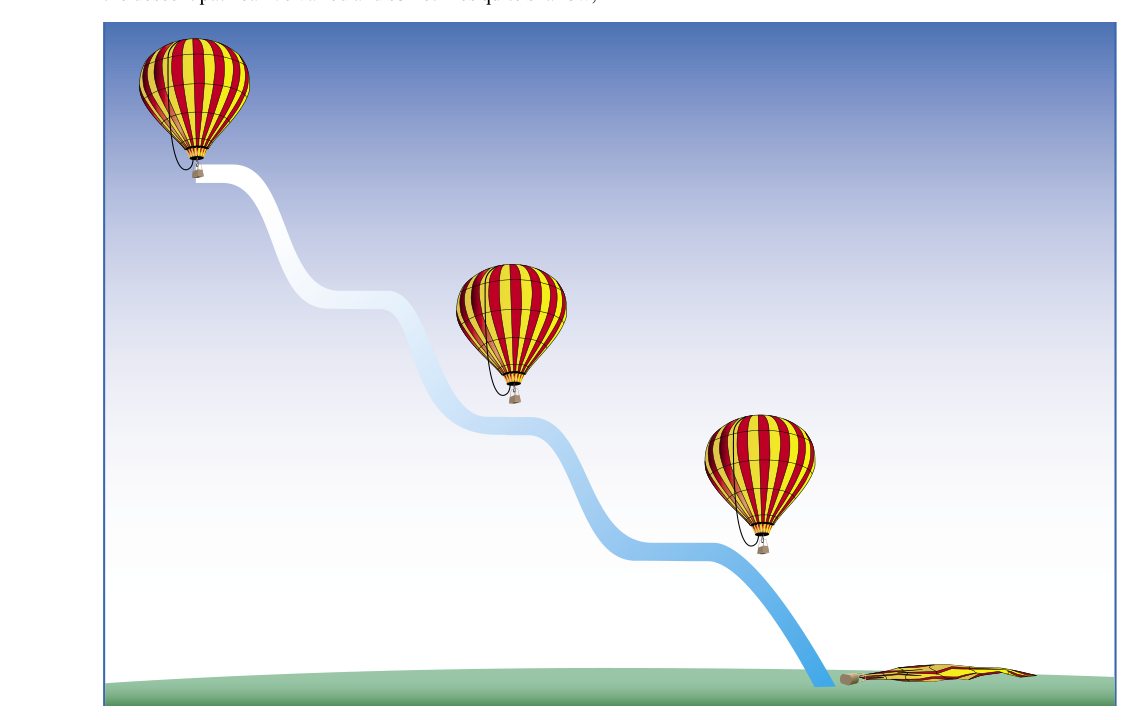
When you fly a non-precision approach (NPA) — a localizer, VOR, NDB, RNAV (GPS) without vertical guidance, or similar procedure — you descend to a Minimum Descent Altitude (MDA) and then fly level until you either see the runway environment or reach the missed approach point (MAP). Unlike a precision approach, there is no electronic glide path pulling you smoothly down to the runway threshold. Instead, the approach plate hands you a series of altitudes you must respect, segment by segment, until you reach the MDA. Those intermediate altitude floors are called step-down fixes, and understanding them is absolutely central to flying non-precision approaches safely and to passing your instrument rating knowledge test.
This article breaks down exactly what step-down fixes are, why they exist, how they affect the MDA, and the practical cockpit discipline required to use them correctly.
What Is the MDA?
The Minimum Descent Altitude is the lowest altitude, expressed in feet MSL, to which a pilot may descend on a non-precision approach or a circling approach unless the required visual references for the runway are in sight. The MDA is set by the FAA to guarantee obstacle clearance across the entire protected area for that approach. Once you reach the MDA you must fly level — you may not descend further until you have established the visual references required by 14 CFR 91.175, and you are in a position to make a normal landing.
The MDA is not a suggestion and it is not a target altitude to duck below while hunting for the runway. Flying below the MDA before acquiring the required visual references is a serious regulatory violation and, more importantly, a genuine collision-with-terrain risk.
What Are Step-Down Fixes?
A step-down fix is an intermediate altitude restriction published on a non-precision approach procedure between the Final Approach Fix (FAF) and the Missed Approach Point (MAP). Think of the final approach segment as a staircase descending toward the runway: each step is a fix, and at each fix you are allowed to descend to a lower altitude than the previous segment, provided that obstacle clearance in the new segment can be guaranteed.
Step-down fixes appear on approach plates as a fix identifier (usually a named waypoint, a DME distance, or a crossing radial) accompanied by a minimum crossing altitude displayed inside a small box or with an underline, depending on the chart format. When you cross that fix, you are authorized to descend to the next lower altitude. If you cannot identify the fix — because your receiver is not tuned, your DME is inoperative, or the fix relies on equipment you don't have — you cannot use it, and you must hold the higher altitude all the way to the MAP, which typically means flying a higher MDA.
Why Step-Down Fixes Exist
Obstacle clearance on a non-precision approach is calculated differently from a precision approach. Without a glide slope, the FAA must guarantee that a pilot who descends immediately to the MDA at the FAF and flies level for the rest of the segment will clear every obstacle in the protected airspace. If a tall obstacle exists partway down the final segment, maintaining the MDA needed to clear that obstacle all the way from the FAF would result in a very high MDA — possibly high enough to prevent the pilot from ever seeing the runway in low visibility.
Step-down fixes solve this problem elegantly. The procedure designer places a step-down fix after the tall obstacle. From the FAF to the step-down fix, the MDA is set high enough to clear the obstacle. Once the pilot passes the fix — confirming they are now beyond the obstacle — they are authorized to descend to a lower altitude for the remainder of the final segment. The result is a lower final MDA than would otherwise be achievable, giving pilots a better chance of breaking out of the clouds with enough time to land.
In short: step-down fixes allow the procedure to take advantage of the fact that not every obstacle exists for the entire length of the final approach segment. They make NPAs more usable without compromising safety.
Identifying Step-Down Fixes in Flight
Step-down fixes may be defined by any of several navigation references, depending on the type of approach:
- DME distance: Common on VOR and NDB non-precision approaches. You cross the fix when your DME reads the published distance from the navaid. ILS approaches more typically use marker beacons, DME, or a compass locator to identify step-down points.
- Crossing radial or bearing: An intersecting VOR radial or NDB bearing defines the fix. Requires a second receiver tuned to the intersecting facility.
- GPS waypoint: On RNAV approaches, step-down fixes are coded as named waypoints in the approach database, making identification straightforward when flying with an approved GPS navigator.
- Marker beacon: Older procedures may use a middle or inner marker. Rare on modern charts but still possible.
The key point for the knowledge test and for practical flying: if you cannot positively identify the step-down fix, you must treat the higher altitude as your floor until the MAP. You do not get to estimate your position and descend early.
The Relationship Between Step-Downs and the Published MDA
Many approach plates publish a single MDA on the minimums section, but that MDA is only achievable if the crew can identify all step-down fixes on the approach. If the step-down fix cannot be identified — for example, because the approach requires DME but the aircraft is not DME-equipped — a higher, alternate MDA may be published. You will see this on some plates as two separate rows of minimums, sometimes labeled with equipment requirements.
On GPS/RNAV approaches flown with an approved navigator, the avionics automatically sequence through the step-down waypoints, and the lower MDA is available because the equipment provides positive fix identification. This is one of the major advantages of GPS over traditional ground-based NPAs: the navigator handles step-down fix identification automatically, consistently, and without requiring additional tuning.
Descent Discipline on the Final Segment
A critical practical skill — and a common source of both accidents and checkride failures — is proper altitude management on the final approach segment with step-down fixes. The correct technique is:
- Cross the FAF at or above the FAF crossing altitude. Begin descent toward the first step-down altitude (or the MDA if there are no step-downs).
- Level off at the step-down altitude before reaching the step-down fix. Do not descend through the step-down altitude before you have identified the fix.
- Cross the step-down fix at or above the step-down altitude. Once positive fix identification is confirmed, descend to the MDA.
- Level off at the MDA and maintain it until the MAP. Do not descend below the MDA regardless of what you see (or think you see) outside.
- At or before the MAP, either initiate the missed approach or — if visual references are established — continue to land.
A common trap is to continue descending through a step-down altitude while still short of the fix, rationalizing that the obstacle is probably already behind you. This reasoning has led to controlled flight into terrain. The fix exists precisely because the procedure designer could not make that assumption — and neither can you.
Key Numbers and Rules
- The MDA is expressed in feet MSL, not AGL.
- You may not descend below the MDA unless the required visual references in 14 CFR 91.175(c) are clearly visible and you are in a position to make a normal landing.
- Step-down fix altitudes are also MSL and are mandatory minimums, not advisory.
- If a step-down fix cannot be identified, the pilot must use the higher applicable MDA for the entire final segment.
- The Missed Approach Point on an NPA is the point by which the pilot must either see the required visual references or execute the missed approach — continuing past the MAP below MDA in IMC is not permitted.
- Obstacle clearance on a straight-in NPA final segment generally provides a minimum of 300 feet of clearance above the highest obstacle in the primary area, with reduced clearance tapering in the secondary area, per FAA TERPS criteria (FAA Order 8260.3).
Common Test Traps
- Descending before the fix: The FAA knowledge test may present a scenario where a pilot begins the descent to the lower step-down altitude before crossing the step-down fix. This is incorrect — you must cross the fix first, then descend.
- Confusing MDA with DA: A Decision Altitude (DA) used on precision approaches is reached while still descending; the missed approach begins immediately if visual references aren't established. The MDA on an NPA is a floor — you level off and fly to the MAP before deciding. These are fundamentally different concepts.
- Assuming the published MDA is always available: The lowest MDA on the plate may require equipment (DME, GPS, second VOR) to identify step-down fixes. Without that equipment, a higher MDA applies.
- Flying past the MAP at MDA: Once you reach the MAP without the required visual references, you must execute the missed approach immediately. Continuing beyond the MAP below MDA in IMC is prohibited regardless of whether you are still at MDA.
- Ignoring step-downs on GPS approaches: Some students assume that because GPS approaches are modern, step-down fixes are irrelevant. LNAV approaches (non-precision GPS minimums) can have step-down waypoints, and the avionics sequences them automatically — but the pilot must understand the concept and verify the avionics are operating correctly.
Mastering step-down fixes is not just an academic exercise. It directly determines how low you can legally and safely fly on some of the most commonly used approaches in the national airspace system. A precise understanding of when you can descend — and when you absolutely cannot — is the difference between a successful approach and a tragedy.