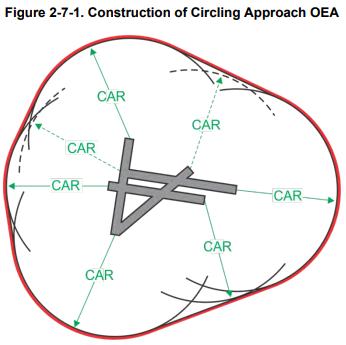
A circling approach is one of the most demanding maneuvers in instrument flying. Unlike a straight-in approach, where the final approach course aligns closely with the runway centerline, a circling approach requires you to descend to a published minimum altitude, acquire the airport environment visually, and then maneuver the aircraft at low altitude to land on a runway that is not aligned with the approach course. Because this maneuvering takes place in limited visibility, often at night or in marginal weather, the FAA has established a carefully defined protected airspace — the circling approach area — along with strict altitude and visibility requirements. Every instrument-rated pilot must understand these limits cold, both for the knowledge test and for real-world safety.
Circling approaches appear on approach plates whenever the approach procedure title lacks a specific runway designation (e.g., "VOR-A" or "RNAV(GPS)-B"), or when the procedure is titled to a specific runway but the runway's offset angle or descent gradient makes a straight-in landing impractical. In either case, the circling minima apply, and the pilot must respect the protected circling area at all times during the maneuver.
How the Circling Approach Area Is Defined
Historically, the FAA defined the circling area using fixed radii centered on each runway threshold — 1.3 nautical miles for Category A aircraft, expanding up to 4.5 nautical miles for Category E. The overlapping circles around all runways at the airport formed an irregular protected boundary. In 2012, the FAA adopted an expanded radius methodology for newly charted procedures, and TERPS criteria were updated to use larger protected areas that account for actual circling ground tracks more accurately. New procedures may carry the notation "Expanded Circling Approach Area" on the plate, and the radii are significantly larger:
- Category A: 1.3 NM (legacy) / 1.3 NM (expanded — same minimum, but boundary shape is refined)
- Category B: 1.5 NM (legacy) / 1.5 NM (expanded)
- Category C: 1.7 NM (legacy) / 2.7 NM (expanded)
- Category D: 2.3 NM (legacy) / 3.6 NM (expanded)
- Category E: 4.5 NM (legacy) / 4.5 NM (expanded)
These radii are drawn as arcs from each runway threshold (not the airport reference point). The union of all arcs around all runway ends defines the total protected circling area for that airport. Obstacles within this area are evaluated, and the Circling Minimum Descent Altitude (MDA) published on the approach chart guarantees at least 300 feet of obstacle clearance — but only if the pilot stays within the appropriate radius for their aircraft category.
Aircraft Categories and Speed
Aircraft approach category is determined by 1.3 times the aircraft's stall speed in the landing configuration (VSO), expressed as indicated airspeed. The categories are:
- Category A: Less than 91 knots
- Category B: 91 to 120 knots
- Category C: 121 to 140 knots
- Category D: 141 to 165 knots
- Category E: 166 knots or more
This matters enormously for circling because a faster aircraft sweeps a larger ground track during the visual maneuver. If you fly a circling approach at a speed higher than your aircraft's category limit, you may exit the protected area and fly over uncharted obstacles below your MDA. You may fly a higher aircraft category's minimums (for example, using Category C minima in a Category B aircraft), but you must never fly slower than the speed appropriate for the higher category you selected if doing so could cause you to leave that category's protected area. In practice, most light general aviation aircraft fall into Category A or B.
The Circling MDA and Visibility Requirements
The circling MDA is always published separately from any straight-in minimums and is typically higher. This is because the circling protected area is based on obstacle surveys conducted for a maneuvering aircraft, not a stabilized final approach path. The 300-foot obstacle clearance margin within the circling area is the regulatory floor; some areas with tall obstacles may require an even higher MDA.
Circling visibility minimums are also usually higher than straight-in visibility because the pilot must maintain visual contact with the airport throughout the entire maneuver. The Aeronautical Information Manual states that if visual reference is lost during the circling maneuver, the pilot must execute the missed approach immediately. Because different sides of the airport may be used depending on the active runway, the pilot must keep the airport environment continuously in sight — not just glance at it and dive toward the runway.
Restrictions on Circling
Not every direction around an airport is approved for circling. Approach plates frequently carry notes restricting the circling area:
- "Circling NA" (Not Authorized): Circling is entirely prohibited. This appears when obstacle clearance cannot be guaranteed in the circling area under any conditions.
- "Circling NA east of Runway 15/33" (directional restriction): Circling is prohibited in a specified sector. Terrain, towers, or other obstacles on that side of the airport exceed safe limits. You must maneuver only on the approved side.
- Night circling restrictions: Plates may prohibit circling at night, or restrict it to specific runways, because obstacle lighting or visual cues are insufficient.
- Specific runway restrictions: Notes such as "Circling to Runway 27 NA" mean landing on that runway via a circling maneuver from this approach is not authorized, typically because of excessive descent gradient requirements or terrain.
These restrictions are not suggestions — they are the boundaries of the obstacle survey. Violating them means you may be maneuvering with no guaranteed obstacle clearance.
Executing the Circling Maneuver
When you reach the circling MDA, you must have the airport environment in sight before you can leave the final approach course to maneuver. Pilots should plan the circling path to remain within the protected radius. A recommended technique is to fly a modified traffic pattern that keeps the runway continuously visible — typically on the downwind leg with the runway clearly off your wing. Bank angles during circling should be kept to a standard traffic-pattern bank (about 30 degrees or less) to avoid excessive altitude loss or spatial disorientation at low altitudes.
The transition from circling to landing must be accomplished promptly once aligned with the landing runway. If at any point you lose sight of the runway environment, or if you cannot complete the landing from your current position safely, you must execute the published missed approach. The AIM advises that when a missed approach is required from the circling maneuver, the pilot should initially turn toward the landing runway and climb to the circling MDA while maneuvering to join the missed approach course. This keeps the aircraft within the protected area during the climb-out.
Key Numbers and Rules
- Circling MDA provides at least 300 feet of obstacle clearance within the protected radius.
- Aircraft category is based on 1.3 × VSO.
- Legacy circling radii range from 1.3 NM (Cat A) to 4.5 NM (Cat E); expanded criteria may increase these significantly for Categories C and D.
- If visual reference is lost during circling, execute the missed approach immediately.
- You may use a higher category's minima but must fly within that category's speed range to stay within its protected area.
- "Circling NA" notes are hard restrictions, not advisories.
- Circling minimums are always equal to or higher than straight-in minimums for the same approach.
Common Test Traps
- Confusing the circling radius with the airport reference point. The radii are centered on each runway threshold, not the center of the airport. The protected area forms an overlapping lobe shape, not a single circle around the field.
- Assuming you can always circle if weather is above MDA. Directional or runway-specific "NA" restrictions may still prohibit circling in certain sectors even if ceiling and visibility exceed minima.
- Forgetting that a missed approach from circling is different from a straight-in missed approach. You must first turn toward the landing runway and climb to MDA before intercepting the published missed approach course — do not fly directly to the missed approach fix if it takes you away from the protected area at low altitude.
- Mixing up aircraft categories. The question may describe a stall speed and ask which category applies. Remember: 1.3 × VSO determines the category, and category determines both the applicable minima and the size of the protected circling area.
- Thinking circling MDA and straight-in DA/MDA are interchangeable. They are separate lines on the approach chart; circling minima apply whenever you leave the final approach course to maneuver, regardless of what the straight-in line says.