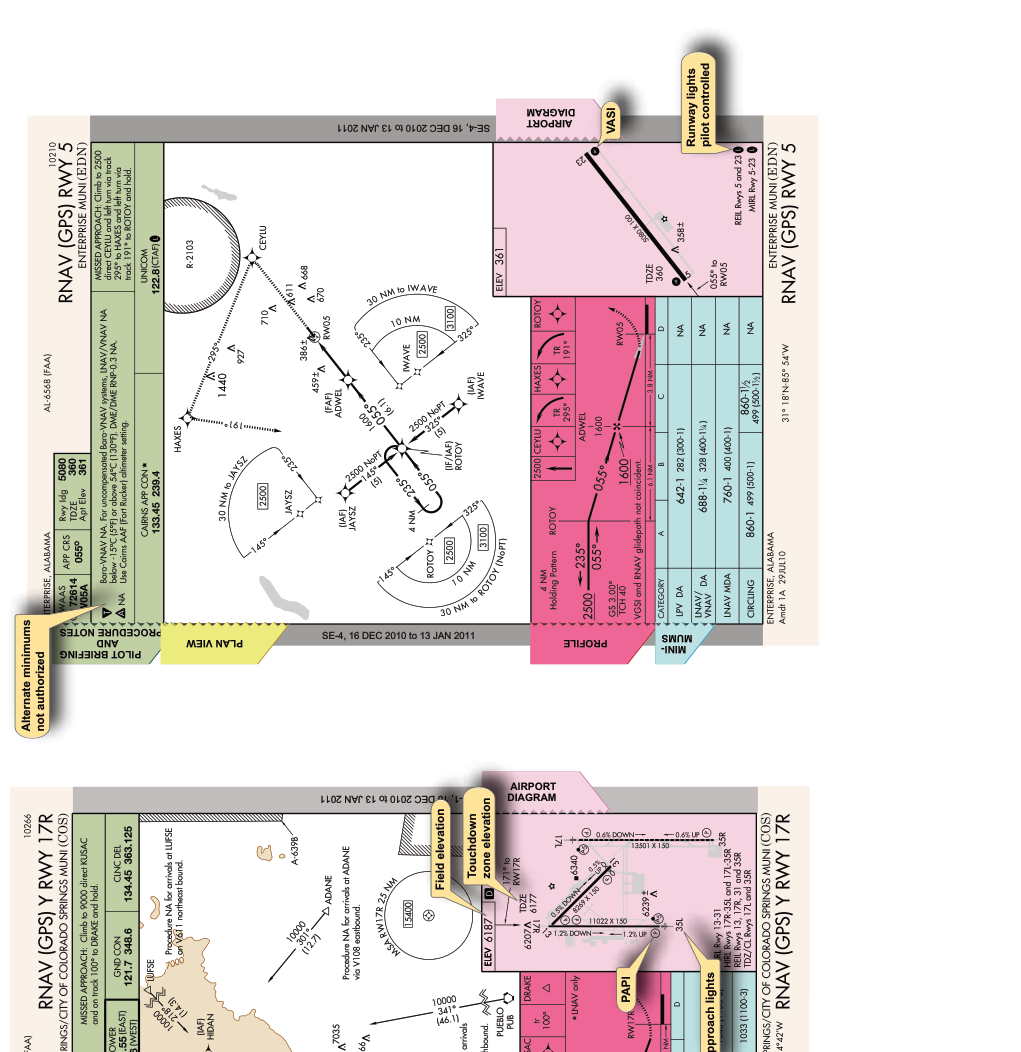
Every instrument approach procedure (IAP) published by the FAA comes with a set of legally binding minimums that define the lowest the pilot may descend and the least amount of visibility required to continue toward a landing. These numbers are not suggestions — they are regulatory floors established through flight inspection, obstacle surveys, and years of procedural refinement. Whether you are flying a precision ILS approach down to 200 feet above the runway or a non-precision GPS approach to 400 feet, you must understand exactly what the minimums mean, where to find them on the plate, and what actions the regulations require at each critical point.
This article walks through the structure of approach minimums as presented on FAA instrument approach procedure charts, the regulatory framework from 14 CFR Part 91 and Part 97, and the practical cockpit decisions that hinge on those numbers. Mastering this material is central to both the instrument rating knowledge test and, more importantly, to flying IFR safely for the rest of your career.
The Two Core Minimums: DA and MDA
All instrument approach minimums fall into one of two categories based on the type of approach being flown.
Decision Altitude (DA) — formerly called Decision Height (DH) — applies to precision approaches and approaches with vertical guidance (APV). A precision approach, such as an ILS (Instrument Landing System) or a PAR (Precision Approach Radar), provides both lateral (localizer) and vertical (glideslope) guidance. Approaches with vertical guidance, such as an LPV (Localizer Performance with Vertical Guidance) approach using WAAS GPS, also use a DA. The DA is expressed as an altitude above mean sea level (MSL) and represents the point at which the pilot must either have the required visual references in sight and be in a position to make a normal landing, or must execute an immediate missed approach. Critically, the missed approach is initiated at the DA — not after passing it.
Minimum Descent Altitude (MDA) applies to non-precision approaches, which provide lateral guidance only — think VOR, NDB, LOC (localizer only), or LNAV GPS approaches. The MDA is the lowest altitude you may descend to and then fly level (the so-called "dive and drive" technique) while searching for the runway environment. You may not descend below the MDA until you have the required visual references and can make a normal descent to landing. Unlike the DA, you may fly at the MDA for some time; the key constraint is that descent below it is prohibited until the visual references are acquired.
Where Minimums Appear on the Plate
FAA instrument approach charts (published by the National Aeronautical Charting Office) organize minimums in the minimums section at the bottom of the plate. This section is divided into columns based on aircraft approach category (A, B, C, D, and sometimes E), and into rows based on the type of approach being flown — for example, S-ILS, S-LOC, CIRCLING, LNAV, LNAV/VNAV, or LPV.
Each cell in the minimums section contains two pieces of information presented together: the DA or MDA, followed by the required visibility. Visibility is expressed either in statute miles (e.g., ½ SM) or in runway visual range (RVR) expressed in hundreds of feet (e.g., RVR 1800, meaning 1,800 feet of forward visibility along the runway). RVR is measured by a transmissometer system installed at the airport and reported as a value in feet. When RVR equipment is out of service or not available, the FAA publishes a conversion table in the AIM that allows pilots to substitute a reported ground visibility in statute miles.
The minimums section also displays the HAT (Height Above Touchdown) or HAA (Height Above Airport) in parentheses next to the DA or MDA. The HAT is used for straight-in minimums and tells you how far above the touchdown zone elevation you will be at the DA or MDA. The HAA is used for circling minimums and references the airport elevation. For example, a minimums line might read: DA 1,240 (200-½) — meaning the DA is 1,240 feet MSL, you will be 200 feet above touchdown elevation at that point, and the required visibility is one-half statute mile.
Aircraft Approach Categories
The category of your aircraft determines which column of minimums you use. Category is based on 1.3 times the aircraft's stall speed in the landing configuration at maximum certificated gross weight (1.3 VSO or 1.3 VS1). The categories are:
- Category A: speed less than 91 knots
- Category B: 91 knots or more but less than 121 knots
- Category C: 121 knots or more but less than 141 knots
- Category D: 141 knots or more but less than 166 knots
- Category E: 166 knots or more
Most light training aircraft fall into Category A or B. A pilot may fly a higher category's minimums (using that category's higher visibility and altitude requirements), but may not use a lower category's minimums than the aircraft's actual speed requires, unless specifically authorized.
Required Visual References
14 CFR §91.175 is the governing regulation for operations below DA or MDA. A pilot may not operate below the DA or MDA unless at least one of the following visual references for the intended runway is distinctly visible and identifiable:
- The approach light system (ALS)
- The threshold, threshold markings, or threshold lights
- The runway end identifier lights (REIL)
- The visual approach slope indicator (VASI or PAPI)
- The touchdown zone, touchdown zone markings, or touchdown zone lights
- The runway, runway markings, or runway lights
An important nuance tested on the knowledge exam: if the only visual reference the pilot can identify is the approach light system (without the red terminating bars or red side row bars), the pilot may descend to 100 feet above the touchdown zone elevation but may not continue below that altitude unless additional runway environment references come into view. This is a commonly tested rule.
Circling Minimums
When the final approach course is not aligned within 30 degrees of the runway, or when the pilot wishes to land on a different runway than the one the approach serves, circling minimums apply. Circling minimums are always higher than straight-in minimums because the pilot must maneuver visually at low altitude around the airport. The circling MDA is referenced to airport elevation (HAA). The pilot must maintain visual contact with the runway environment throughout the circling maneuver. If visual contact is lost, an immediate missed approach must be executed.
Circling areas are defined by protected radii around each runway end, with the radius depending on approach category. Category A aircraft have the smallest protected radius (1.3 NM); Category D has the largest (2.7 NM under the legacy standard, though newer expanded circling areas may apply on more recently designed procedures).
Why These Minimums Matter
The minimums published on an approach plate are derived from a rigorous FAA obstacle clearance evaluation. The MDA or DA guarantees a specific obstacle clearance margin — typically 250 feet above the highest obstacle in the final approach segment for non-precision approaches. Descending below the MDA without the required visual references removes that safety margin entirely and puts the aircraft in a region where terrain, towers, or other obstructions may exist below the aircraft. Controlled flight into terrain (CFIT) is historically one of the leading causes of fatal aviation accidents, and the majority of CFIT events on approaches occur when crews either descend below published minimums or lose situational awareness in low-visibility conditions.
Key Numbers and Rules
- DA: used on precision and APV approaches; missed approach initiated at the DA.
- MDA: used on non-precision approaches; pilot may not descend below MDA without required visual references.
- §91.175: the primary regulation governing operations at and below minimums.
- ALS-only rule: may descend to 100 feet above TDZE with ALS in sight, but no lower unless other runway references appear.
- RVR 1800: equivalent to ½ statute mile visibility (RVR values are not interpolated below the next-higher published increment); a common visibility value for CAT I ILS approaches.
- Visibility required, not ceiling: the published minimums specify visibility; there is no regulatory ceiling requirement for instrument approaches (though ceiling affects whether you can depart IFR from certain airports).
- Alternate minimums: when filing an alternate airport, standard alternate minimums are 600-2 for precision approaches and 800-2 for non-precision approaches, unless the approach plate states "NA" (not authorized as alternate) or specifies non-standard alternate minimums.
Common Test Traps
- DA vs. MDA confusion: Many students mix up which term applies to which approach type. Remember: DA = Decision, used on precision/APV; MDA = Minimum Descent, used on non-precision. At a DA you decide instantly; at an MDA you may loiter at that altitude.
- HAT vs. HAA: HAT (Height Above Touchdown) is for straight-in minimums; HAA (Height Above Airport) is for circling minimums. The test may ask which applies in a scenario involving circling.
- The ALS-only descent rule: The exam frequently asks what the pilot may do when only the approach lights — without red terminating bars — are in sight. The answer is descend to 100 feet above TDZE, not all the way to the runway.
- Alternate minimums: "NA" on a plate means the approach (or airport) is not authorized for alternate filing under standard conditions — the test may present this as simply meaning the approach can't be flown, which is incorrect.
- Visibility vs. ceiling: Published instrument approach minimums specify a visibility requirement, not a ceiling. Students sometimes believe there must also be a specific ceiling requirement to shoot an approach, but §91.175 governs based on visibility and visual references, not reported ceiling.